

We plan for medical emergencies so the response is immediate and coordinated.
Most rehabs do not tell you what happens when something goes seriously wrong during detox. Jintara does. Our medical detox program has clear, practised escalation protocols and established relationships with Chiang Mai's two leading hospitals, so that if a transfer is needed, it happens without delay and without panic.
- Established partnerships with Bangkok Hospital Chiang Mai and Chiang Mai RAM
- 24-hour awake nursing staff trained in emergency escalation protocols
- CIWA-Ar and COWS scoring used to detect deterioration before crisis develops
- Client treatment plan maintained and continued after any hospital stay

Fully Licensed and Hospital Accredited
Hospital Transfer During Detox Is a Planned Medical Response, Not a Failure.
A hospital transfer moves a client from residential detox into an acute medical setting. It is not a sign that detox went wrong. It is evidence that the monitoring worked. At Jintara, the decision to transfer follows a documented escalation protocol that begins on the day of admission, not the moment something goes wrong, and that same escalation pathway is much of why home detox is so much riskier than it appears in the early hours. That threshold sits lower again for pregnancy and medical detox, where two patients are being watched rather than one. Nurses assess risk on arrival, score it continuously, and have a clear threshold for when the situation requires hospital-level intervention.
What makes this different from most residential settings is preparation. The hospital relationships, the escalation criteria, and the transfer logistics are agreed in advance. When a nurse sees rising distress, abnormal vital signs, or symptoms that do not follow the expected path during supervised alcohol detox, the response is immediate because the protocol is already in place. There is no time lost to decisions that should have been made earlier.
Darren Lockie's position on this is direct: "If we didn't have these safeguards in place, I don't think I'd sleep very well." That is not a marketing line. It is a description of how seriously the team takes the responsibility of medical supervision.
For clients and families who want to understand what withdrawal involves before arrival, our guide to what withdrawal involves by substance explains severity, timing, and medical risk by substance type.

Severe Alcohol Withdrawal Is the Most Common Reason for a Hospital Transfer.
Alcohol withdrawal syndrome is one of the few withdrawal states that can be directly life-threatening without medical intervention, and it is the primary clinical driver of hospital transfers at Jintara. NIAAA's resource on alcohol use disorder lists seizures and delirium tremens among the symptoms of alcohol withdrawal. These are not theoretical risks. They are the well-documented consequences visible in the alcohol withdrawal timeline for any detox that moves too slowly or responds too late.
- CIWA-Ar above 14: Reassessment every one to two hours. On the Sullivan et al. CIWA-Ar scale.
- Moderate range: Checks every four to six hours.
- Stabilised clients: Monitored less frequently, but not abandoned.
The risk window is specific. Seizures typically occur between 8 and 48 hours after the last drink. Delirium tremens risk follows, typically between days two and four. Jintara's nursing team monitors through this window against the range of medical complications that can arise during detox, with structured vital signs checks and CIWA-Ar scoring at intervals matched to the client's current risk level. If scores trend upward despite medication, or if symptoms such as severe agitation, hallucinations, or fever appear, the team does not wait. Transfer begins.
Seizure Risk in Alcohol and Benzodiazepine Withdrawal Changes the Escalation Threshold.
Seizures are the clearest clinical trigger for immediate hospital transfer. In alcohol withdrawal, seizures typically occur between 8 and 48 hours and can appear suddenly in clients who looked stable minutes before. In benzodiazepine withdrawal, the risk window extends further, often peaking between days two and five depending on whether the substance was short-acting or long-acting. A client withdrawing from both alcohol and benzodiazepines simultaneously carries compounded seizure risk, and GHB withdrawal escalation can follow the same abrupt seizure course, so the monitoring threshold shifts accordingly. The StatPearls review of alcohol withdrawal syndrome sets out the clinical evidence on seizure timing.
At Jintara, seizures have occurred three times in the facility's history. On each occasion, the response was transfer to hospital. Lertkhwan Sukpia, Jintara's senior nursing lead, describes the reasoning clearly: the moment a client enters criteria for a medical emergency, the team acts. There is no deliberation. Nurses are trained in emergency protocol and can arrange transport immediately, at any hour.
The clinical approach to seizure prevention is medication-based and CIWA-Ar-guided, consistent with SAMHSA TIP 45 detox protocols. For clients at significant seizure risk, the psychiatrist prescribes benzodiazepines specifically to reduce that risk during alcohol and benzodiazepine withdrawal. The aim is to prevent the transfer trigger, not simply to respond to it.

Clients Who Arrive in Poor Physical Condition May Go to Hospital Before Detox Begins.
Not every hospital transfer happens during detox. Some happen on or near arrival. If a client presents in a state where it is clinically safer for them to receive hospital stabilisation before remaining in the facility, Jintara sends them immediately. This is not a failure of admissions screening. It reflects a pre-existing physical condition, undisclosed substance use, or a combination of substances that creates a level of medical risk the residential setting cannot safely absorb in the first 24 to 48 hours. SAMHSA's Treatment Improvement Protocol 45 identifies this as a standard clinical pathway in residential detox settings.
Darren is transparent about what this means financially: if a client requires hospital stabilisation on arrival rather than remaining at Jintara, those hospital costs are borne by the client. This is disclosed at admission, not discovered in crisis. Families researching treatment deserve to know the financial picture before they arrive, not after. That clarity is part of the admission conversation.
Once stabilised, the client returns to Jintara and begins their detox program. The 30-day stay is counted from the point of clinical engagement, not the point of arrival. Clients who needed a hospital stay at the start can still complete a full 30-day program. Understanding what happens in the first week helps families plan around this possibility from the outset.

Nurses Are Trained to Read the Signs Before Symptoms Become Emergencies.
The reason hospital transfers are rare at Jintara is not luck. It is the quality of observation that happens before a crisis develops. Nursing staff are awake around the clock. During active detox, early-stage clients receive checks every one to two hours. Nurses are observing:
- Vital signs, CIWA-Ar and COWS scores.
- Sleep quality, mental state and agitation patterns.
- Answers that do not track.
- Agitation that arrives in waves.
- Headaches that build rather than ease.
- Pain that does not match the expected withdrawal path.
This level of monitoring meets the national hospital-grade accreditation standard that Thailand applies to its hospitals, delivered in a residential setting. The withdrawal monitoring protocol covers how scoring, observation, and shift handovers work together to prevent deterioration. The difference between catching a problem early and responding to a collapsed client is often a matter of how carefully someone read the first two hours of a shift. At Jintara, nurses are not on call. They are present. The philosophy underpinning this is stated simply on Jintara's clinical governance page: the aim is to catch risk while the client is still stable enough for a calm, coordinated response. By the time a situation looks dramatic, good monitoring has already been tracking it for hours.
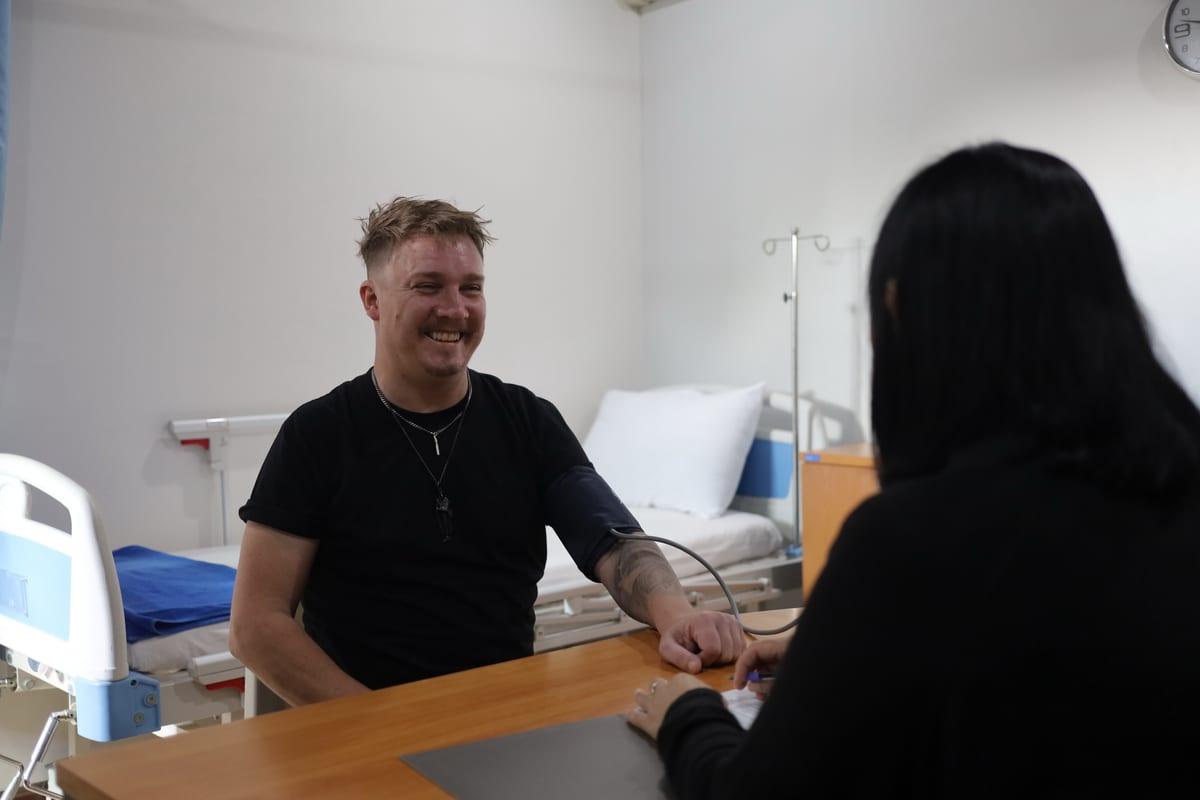
“We have a no-risk, no-compromise strategy. If we feel the client could be in danger, we prefer a hospital check now rather than regret later.
A Transfer at 2am Works the Same as One at 2pm.
The escalation protocol at Jintara runs around the clock, regardless of the time of day. Darren describes a 2am call as routine, not exceptional: "The client wakes up with severe abdominal pains, extreme headaches, and we will go to hospital at two o'clock in the morning." The nursing team is awake. The hospital relationships are established. The decision does not wait for a more convenient time.
- Identify the trigger.
- Document it.
- Arrange transport. The client receives a plain explanation: something needs assessment, and the team is taking them to get checked now. Nurses are trained not to heighten anxiety in that moment. They move with calm authority and a simple next step.
Lertkhwan Sukpia, Jintara's nursing lead, describes the standard clearly: if a client meets emergency protocol criteria, transport is immediate. If the situation is urgent but not acute, the team makes same-day or next-day arrangements depending on assessment. In either case, the decision is made by clinical assessment, not by what hour it is or whether it is a weekend.

Bangkok Hospital Chiang Mai and Chiang Mai RAM Are Jintara's Two Hospital Partners.
Jintara works exclusively with two hospitals: Bangkok Hospital Chiang Mai and Chiang Mai RAM Hospital. Both facilities are among the highest-rated hospitals in northern Thailand, and both have addiction-specialist psychiatrists on staff. The relationship is established, not improvised. When Jintara's team contacts either hospital, they are speaking to professionals who know the facility, understand the clinical context, and can act without lengthy explanation.
Bangkok Hospital Chiang Mai is approximately 8 minutes from Jintara; Chiang Mai RAM is approximately 20 minutes. In an emergency, either distance is covered without delay. For non-emergency psychiatric appointments, the team books at whichever hospital can provide the fastest appointment. On weekends or when the primary pathway is fully booked, Jintara arranges access through associated clinics so that psychiatrist review does not pause. The goal, in Darren's words, is speed and continuity: stabilise safely, adjust the medication plan as required, and keep the detox moving forward.
- Full blood spectrum.
- Liver function.
- Kidney function.
- EKG.
- Chest X-ray.
Every detox client attends a full medical assessment at Bangkok Hospital Chiang Mai on day two of their stay. This is included in the program fee and serves as the clinical baseline that informs the entire detox plan. These findings also inform which of the conditions listed on the what we treat page require extended monitoring beyond the standard acute detox window.

After a Hospital Stay, Your Treatment Plan Continues Where It Left Off.
A hospital transfer does not end a person's treatment at Jintara. Once medically stable, the client returns to the facility and resumes their program. The 30-day structure remains in place. Therapy sessions resume. The clinical team is already familiar with the client's history and does not need a restart. For most clients who experience a transfer, the hospital stay lasts two to three days. They return calmer, better medicated, and physically more stable than they were at the point of transfer.
This matters because the fear behind a hospital transfer, for clients and families alike, is often what does this mean for recovery. The answer is: it means the monitoring worked and the risk was managed in time. A transfer is not a setback to the program. It is part of the program's medical safety infrastructure doing its job. The protocols governing that infrastructure were independently assessed by the Healthcare Accreditation Institute, the same national body that accredits Thailand's hospitals. Held to that bar, and still a facility that is small enough to have someone watching through every hour of the night. Clients who return from a hospital stay are typically better placed to engage with dual diagnosis treatment and therapy than those who tried to push through a dangerous withdrawal without escalation. NIDA's overview of treatment and recovery notes that detoxification alone without subsequent treatment generally leads to a return to use.
For families coordinating from overseas, Jintara communicates any transfer, its reason, and the expected return timeline as soon as the decision is made. Families are not left guessing. This page covers the escalation triggers specifically. If you want to understand what medical detox at Jintara looks like in practice, including the day-two workup, the nursing model, and the licensing, that is covered in a separate guide.

Talk with Our Admissions Team
Your enquiry is confidential and goes only to our admissions team.
Common Questions About Hospital Transfers During Detox at Jintara
Severe alcohol withdrawal is the most common trigger. Specifically, escalating CIWA-Ar scores, seizure risk, delirium tremens onset, and symptoms that do not respond to medication adjustment. Occasionally, severe opioid withdrawal requires transfer when on-site medication cannot stabilise the client safely. A small number of clients also transfer on or near arrival because their physical condition on intake is too poor for residential management.
Transfers are rare because of the quality of early detection and medication planning. Seizure-related transfers have occurred three times in Jintara's history. The nursing team's goal is to prevent the conditions that lead to transfer, not simply to respond when they appear. The medication plan is designed with a 7 to 10 day buffer, and CIWA-Ar and COWS scoring allow adjustment before symptoms escalate.
Jintara works exclusively with Bangkok Hospital Chiang Mai and Chiang Mai RAM Hospital. Both are among the highest-quality hospitals in northern Thailand and both have addiction-specialist psychiatrists on staff. Bangkok Hospital Chiang Mai is approximately 8 minutes from Jintara; Chiang Mai RAM is approximately 20 minutes.
Yes. The nursing team is awake around the clock and the escalation protocol does not have business hours. If a client meets emergency criteria at 2am, they are transferred immediately. For non-emergency psychiatric reviews over a weekend, Jintara uses associated clinics when the hospitals are fully booked, so assessment is never delayed by the day of the week.
Your treatment plan continues after you return. A typical hospital stay following transfer is two to three days, after which the client returns to Jintara and resumes their 30-day program. Therapy sessions, clinical reviews, and the program structure all remain in place. The transfer does not restart the clock.
The day-two diagnostic workup at Bangkok Hospital is included in the program fee. If a client requires hospital stabilisation on arrival because their physical condition is too poor to remain at Jintara in the first 24 to 48 hours, those hospital costs are borne by the client. This is disclosed at admission. Emergency transfers during the program that result from clinical deterioration are handled as part of Jintara's medical responsibility, and the team will advise on any cost implications transparently.
Chiang Mai has internationally accredited hospital facilities. Jintara's transfer partners, Bangkok Hospital Chiang Mai and Chiang Mai RAM, provide the same level of acute medical care available in major Australian or UK cities. The 20-minute proximity and the pre-existing hospital relationship mean that in a genuine emergency, the response is equivalent to what a client would receive in a well-equipped Western residential setting.
Ask which hospitals they use and whether those relationships are established or improvised. Ask whether nursing staff are awake overnight or on call. Ask what scoring tool they use to monitor alcohol withdrawal. Ask what happens to the treatment plan after a transfer and whether the client returns. Jintara answers all of these directly during the pre-admission conversation.
Yes. Jintara holds accreditation certificate no. 25/2569, issued jointly by the Healthcare Accreditation Institute, the Princess Mother National Institute on Drug Abuse Treatment, and the Department of Medical Services, Ministry of Public Health. The accreditation certifies that Jintara's processes and care standards meet Thailand's national quality standard for drug treatment and rehabilitation facilities, valid 20 May 2026 to 19 May 2029. Jintara is one of only six private rehabs in Thailand to hold this certification.
The joint accreditation by the Healthcare Accreditation Institute, PMNIDAT, and the Department of Medical Services assesses care processes, clinical governance, nursing standards, documentation, medication management, and patient safety systems. That includes the escalation protocols that govern when a hospital transfer is triggered and how it is managed. The assessment is conducted against Thailand's national quality standard for drug treatment facilities, which is the same framework used across the healthcare system.
Jintara is a small adult residential rehab in Chiang Mai with awake overnight nurses and a 3.2:1 staff-to-client ratio. Medical detox is included in every stay.
Jintara Rehab is licensed by the Thai Ministry of Public Health as a rehabilitation centre. The clinical information on this page describes Jintara's general approach to supporting clients during the early recovery period. Medical decisions, including medication protocols, are determined by addiction-specialist psychiatrists through our partner hospital pathway. Individual treatment varies based on clinical assessment. This content is for informational purposes and does not constitute medical advice.