

Hourly vital signs, clinical scoring tools, and nurses who stay awake.
Medical detox at Jintara is built around continuous monitoring, not periodic check-ins. From arrival through the most acute phase of withdrawal, our nursing team uses validated clinical tools, vital sign documentation, and adaptive medication protocols to keep each person safe. Learn more about our medical detox program.
- Vital signs checked hourly during the first 48 to 72 hours of acute withdrawal
- CIWA-Ar scoring for alcohol and COWS scoring for opioids guide every medication decision
- Nurses remain awake through every overnight shift, not waiting on-call in a separate room
- Hospital transfer protocols activate immediately when vital signs trend outside safe parameters

Fully Licensed and Hospital Accredited
Withdrawal monitoring is a clinical process, not a precaution.
Withdrawal monitoring is the continuous clinical assessment of a person's physiological and psychological state during substance cessation.
That definition matters because many rehab facilities describe their nursing care as monitoring without specifying what it involves. For some, monitoring means two visits a day. For others, it means hourly vital sign checks, validated scoring scales, shift handover documentation, and an active escalation pathway to a partner hospital, available at any hour.
- Breathalyser test.
- Urine drug screen: Covering five to six substance panels.
- Structured nursing assessment.
- Medication history review.
Withdrawal scoring begins that night. The CIWA-Ar scale is used for alcohol; COWS for opioids. Both continue through the acute withdrawal period. Read more about what to expect in your first week at Jintara.

“Having nurses that are awake and continually checking on clients, preparing medication, dealing with client issues proactively is very, very important. A nurse who is asleep and waiting on a phone call I think is almost negligent.
Vital signs during the first 48 to 72 hours show how the body is coping.
Jintara checks vital signs hourly for the first 48 to 72 hours of acute withdrawal because this is the window when withdrawal severity peaks and dangerous complications are most likely to emerge.
- Heart rate.
- Blood pressure.
- Temperature.
- Blood oxygen saturation.
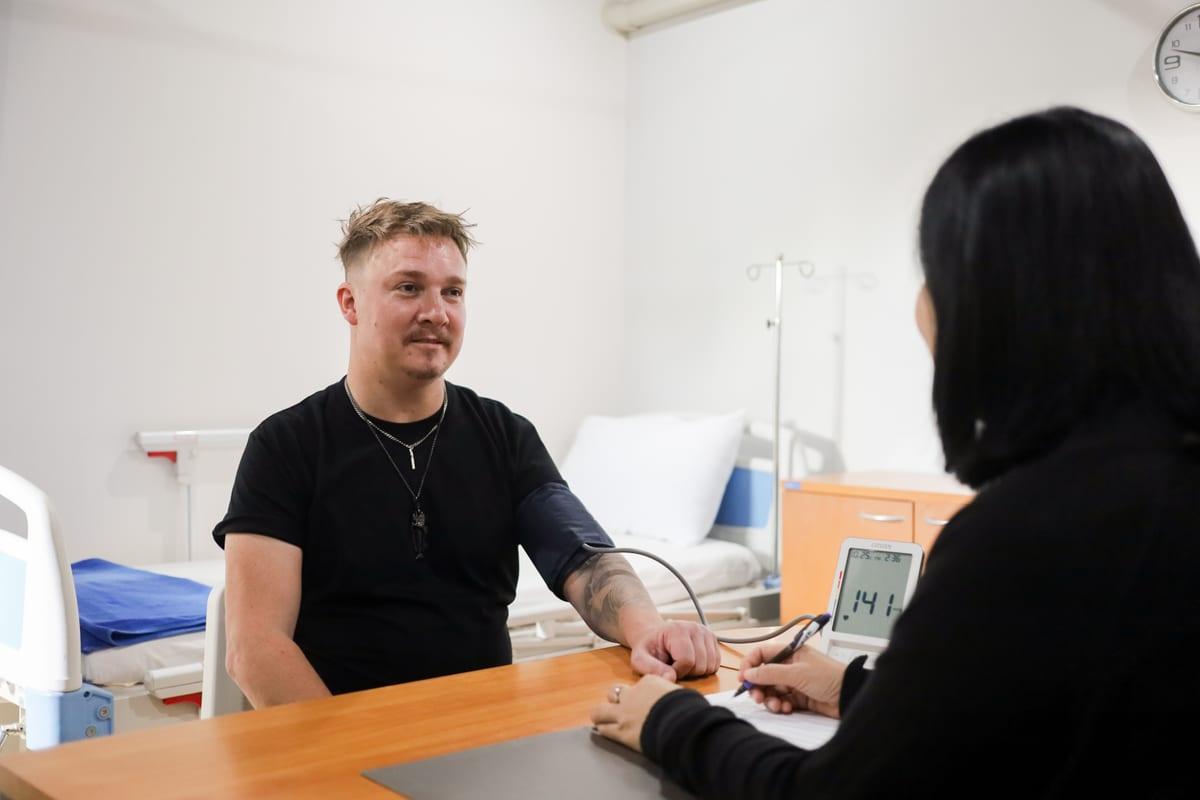
Those early shifts are the first sign of the medical complications the monitoring team watches for, and they are clinically meaningful before they become visible as obvious distress. MedlinePlus notes that alcohol withdrawal symptoms typically peak between 24 and 72 hours after the last drink, which is the same window when seizures and severe alcohol withdrawal syndrome most commonly occur. Hourly observation creates a data record that allows the nursing team to catch a worsening trend before it becomes a crisis. As withdrawal stabilises, check frequency adjusts. A client with a high CIWA-Ar score, or with cardiac, liver, or neurological conditions identified at admission, may be checked every two hours overnight. Once scores reach moderate range, the schedule moves to twice daily, and extended withdrawal monitoring continues past the acute phase. Once stable, once daily. The clinical score drives the decision, not a fixed timetable. All vital signs are recorded in each client's individual clinical file, reviewed at every shift handover. Each incoming nurse arrives knowing the trajectory of the previous six to eight hours. For alcohol specifically, see the alcohol detox page for detail on how the acute phase progresses.
CIWA-Ar is the validated scale for alcohol withdrawal severity.
The Clinical Institute Withdrawal Assessment for Alcohol, Revised (CIWA-Ar) is a ten-item validated scale measuring alcohol withdrawal across neurological, autonomic, and perceptual domains. Developed by Sullivan et al. in 1989, it is the recognised clinical standard for guiding alcohol detox medication decisions.
- Nausea.
- Tremor.
- Sweating.
- Anxiety.
- Agitation.
- Sensory disturbances.
- Headache.
- Orientation.
The total score determines the medication response and monitoring frequency. At Jintara, CIWA-Ar scoring is not administered on a fixed schedule. If a client's score rises overnight, the nurse acts within the parameters established by the psychiatrist at intake without waiting for the morning shift. This adaptive approach is what separates clinical withdrawal symptom management from a fixed dosing schedule, which can leave a client under-medicated as withdrawal intensifies or over-sedated as it resolves. Lertkhwan Sukpia, Jintara's Head Nurse, notes that benzodiazepine withdrawal is often harder to manage than alcohol withdrawal because the drug persists longer in the central nervous system. For clients using both, CIWA-Ar monitoring continues for both withdrawal syndromes simultaneously. The alcohol addiction treatment page covers what clinical management looks like across the full 30-day stay.
COWS guides opioid withdrawal and the medication taper.
The Clinical Opiate Withdrawal Scale (COWS) is the parallel tool for opioid withdrawal assessment, measuring eleven observable signs including resting pulse rate, sweating, restlessness, joint pain, and gastrointestinal symptoms. SAMHSA's Treatment Improvement Protocol 45 chapter on physical detoxification sets out medically assisted opioid withdrawal, including methadone taper in a supervised setting.
COWS scoring begins at intake for any client reporting opioid use. The score informs both the initial medication and the taper plan. Clients are prepared for the arc of opioid detox: the first 24 to 48 hours are often more manageable on the initial protocol, while days three to five typically bring the most acute symptoms as the taper begins. Informed clients who know what is coming are far less likely to self-discharge at the hardest point. For a full breakdown of how COWS scores drive the opioid detox protocol at Jintara, see the dedicated page.
Jintara's approach to the taper plan involves the client directly. As Lertkhwan Sukpia describes: "We would like to have the client participate and have the opinion on the plan, and they know what is going to happen to them. We work as a team." COWS is also used for kratom opioid-class withdrawal, which shares the same receptor mechanism and the same withdrawal management approach. For tranq dope and xylazine-fentanyl presentations, COWS scoring addresses the fentanyl dependence; the xylazine component requires additional clinical attention to wound status and cardiovascular baseline that sits alongside, not within, the standard COWS protocol.
Behavioural observation catches what scores sometimes miss.
Clinical scoring tools quantify withdrawal severity in a structured format. What they cannot fully capture is the subtle shift in a person's presentation that signals something is changing before the numbers change.
- Agitation in conversation.
- Withdrawal from interaction.
- Unusual irritability.
- A change in eye contact.
These can be early signs of an escalating withdrawal episode, an adverse medication response, or emerging anxiety that will worsen overnight if not addressed. Lertkhwan Sukpia describes the pattern: "We see from far. We see when they are talking, easy to get angry. We can see. And if they come to the nurse, we usually check the blood pressure to see if it is affecting." The subjective signal triggers an objective check. If the check confirms concern, the response escalates to medication review. In a maximum ten-client facility, the nursing team knows each person individually and notices deviation from their baseline. This is clinically harder to replicate in a larger setting. Where withdrawal is complicated by a co-occurring mental health condition, Jintara's dual diagnosis treatment approach runs alongside the detox from the start.

Medication is adjusted to score, not dispensed on a fixed schedule.
Adaptive medication dosing is what separates medically supervised detox from a withdrawal attempt managed at home. When someone attempts to stop without clinical oversight, there is no feedback loop, part of why detoxing at home without medical support carries risks that are easy to underestimate. In Jintara's protocol, the prescribing psychiatrist establishes a framework at intake that sets parameters rather than fixed doses. The nursing team can adjust within those parameters as CIWA-Ar or COWS scores change, without waiting for a new prescription each time.
NIAAA's Core Resource on Alcohol identifies benzodiazepines as the clinical standard for managing alcohol withdrawal syndrome, with dosing adjusted to symptom severity. This is the principle Jintara's protocol is built on.
Jintara's psychiatrists are addiction specialists working with Bangkok Hospital and Chiang Mai RAM, the two leading hospital facilities in Chiang Mai. The day-one psychiatric assessment is included in the detox fees. Darren Lockie notes the distinction: "Most rehabs, psychiatric services are an extra charge and not included, which means clients don't always want to use them." The treatment program page details how the psychiatric component fits into the full 30-day structure.
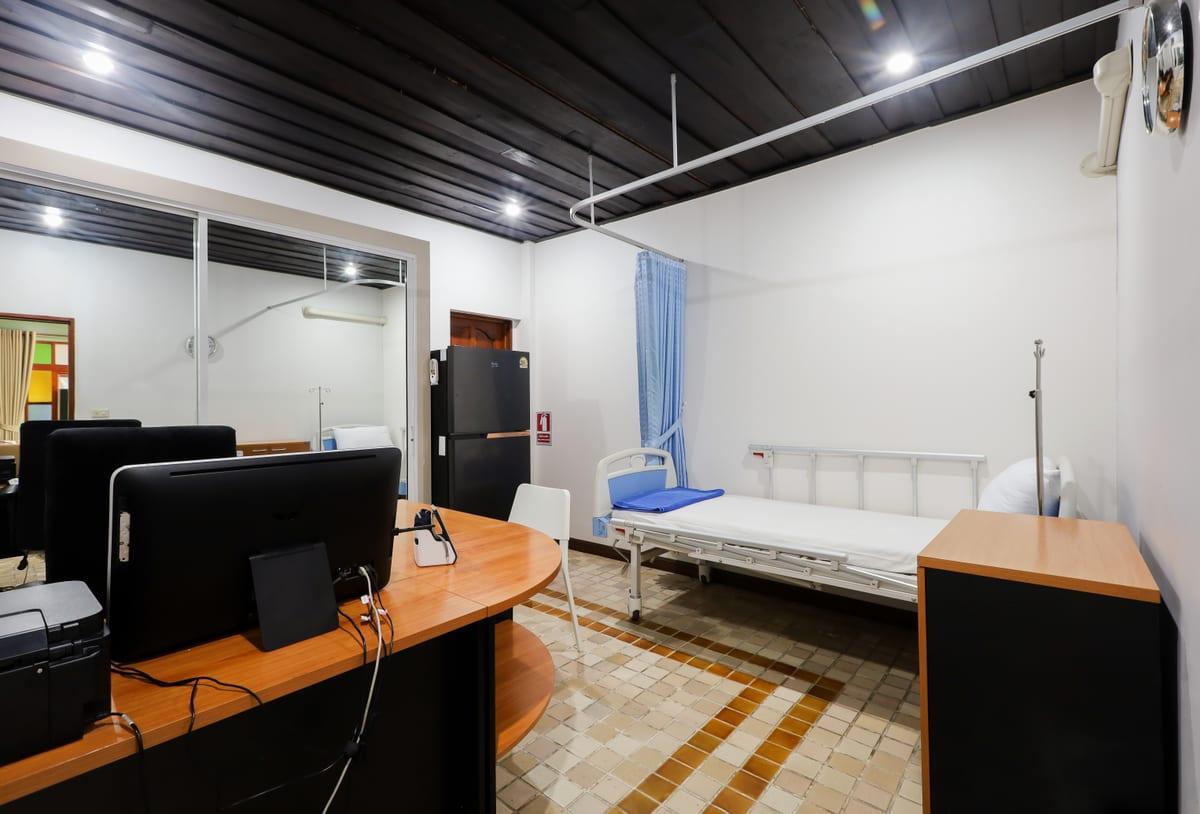
Escalation protocols determine when hospital transfer happens.
Monitoring produces a decision, not just a record. Jintara's hospital transfer protocol operates on a no-risk, no-compromise basis: if vital signs trend outside safe parameters, if a client reports severe or unusual symptoms, or if the nursing team observes deterioration that medication adjustment does not resolve, the client goes to hospital.
Darren Lockie: "We prefer to err on the safe side and take clients to hospital if we feel, or the client feels, that there's something not right. Sometimes it could be at two o'clock in the morning."
Hospital transfers are designed to be immediate. Jintara has an active clinical relationship with Bangkok Hospital and Chiang Mai RAM, meaning admission procedures are not being established in the moment. Other clients in the facility are informed matter-of-factly when a hospital visit occurs. Because scheduled Day 2 diagnostics at Jintara's partner hospital are a routine part of every stay, hospital visits are not alarming to the other people in the program. The Jintara residential facilities page describes the on-site nursing infrastructure that makes this response possible.

“We have the emergency protocol. If the client is in the criteria for emergency, we can take them straight away. There is no timeframe. We can take them to hospital immediately.
The overnight nurse remains awake through every night shift.
The most dangerous hours of alcohol and benzodiazepine detox commonly fall overnight in the first days after the last drink. A nurse who is asleep in a separate room and responding only to requests cannot intercept a deteriorating situation the way an awake nurse conducting scheduled checks can.
At Jintara, the overnight nurse remains awake through every night shift. Before clients sleep, the nurse conducts a CIWA-Ar or COWS check and assesses the client's readiness for the night. A client with a high score gets a check every two hours, and the thresholds set for detox for older adults are tighter again because sedatives clear more slowly with age. A client who has stabilised is checked before sleep and again in the morning, with the nurse available immediately in between.
Lertkhwan Sukpia puts the clinical case plainly: "With the nurse, they can take action straight away. If you have someone who is not a professional nurse, you may lose five, ten minutes or more to call for help. Some clients cannot lose this time."
This is the gap between on-call nursing and awake nursing. Families researching detox options should ask every facility directly: are your night nurses awake, or on-call? The Jintara team page for Lertkhwan Sukpia describes her nursing background and clinical role in detail.
The question families carry into research is often this: what if something goes wrong at two in the morning, and I am not there? At Jintara, that question has a factual answer. The overnight nursing protocols, the medication handling, and the clinical escalation procedures described on this page were independently assessed against Thailand's hospital-grade national standard and met it. The assessment was conducted by the Healthcare Accreditation Institute, the Princess Mother National Institute on Drug Abuse Treatment, and Thailand's Department of Medical Services. Certificate 25/2569, valid through May 2029.


Talk with Our Admissions Team
Your enquiry is confidential and goes only to our admissions team.
Common Questions About Withdrawal Monitoring at Jintara
Hourly during the first 48 to 72 hours of acute withdrawal. Frequency then adjusts based on CIWA-Ar score: high scores are checked every one to two hours; moderate scores every four to six hours; stabilised clients once daily. The score drives the decision, not a fixed schedule.
CIWA-Ar is the Clinical Institute Withdrawal Assessment for Alcohol, Revised. It is a ten-item validated scale measuring tremor, anxiety, nausea, sweating, sensory disturbances, and orientation. Jintara nurses score clients at each check-in. The total determines medication adjustments and monitoring frequency throughout the alcohol withdrawal period.
COWS is the Clinical Opiate Withdrawal Scale. It measures eleven observable signs of opioid withdrawal. Jintara uses it for any client reporting opioid use. The score guides the methadone taper plan and helps the team identify whether the current medication protocol is sufficient.
Yes. Jintara's nurses remain awake through every overnight shift. This is not an on-call arrangement. The overnight nurse conducts scheduled checks, assesses CIWA-Ar or COWS scores before clients sleep, and is actively available if anything changes during the night.
The prescribing psychiatrist establishes a medication framework at intake that includes parameters within which the nursing team can adjust doses based on CIWA-Ar or COWS scores. This is what makes adaptive dosing possible during overnight hours. Significant changes or new prescriptions require a direct psychiatrist review.
Jintara operates a no-delay hospital transfer protocol. Criteria include vital signs outside safe parameters that do not respond to medication adjustment, severe or unusual symptoms reported by the client, or nursing team observation of deterioration. The transfer is immediate. Jintara has established relationships with Bangkok Hospital and Chiang Mai RAM.
Yes. Therapy begins in the first week alongside medical detox. Detox alone, without addressing the underlying reasons for substance use, has a high relapse rate. Both are integrated from the start of the 30-day stay.
Jintara is a small adult residential rehab in Chiang Mai with awake overnight nurses and a 3.2:1 staff-to-client ratio. Medical detox is included in every stay.
Jintara Rehab is licensed by the Thai Ministry of Public Health as a rehabilitation centre. The clinical information on this page describes Jintara's general approach to supporting clients during the early recovery period. Medical decisions, including medication protocols, are determined by addiction-specialist psychiatrists through our partner hospital pathway. Individual treatment varies based on clinical assessment. This content is for informational purposes and does not constitute medical advice.