

Group therapy at Jintara runs daily in a setting of up to ten people.
Most people arrive certain they are the only one this bad, carrying a quiet conviction that the safest thing is to stay hidden. Group is where that belief meets other people who recognise it from the inside. Each morning, clients gather for a facilitator-led session that covers recovery skills, psychoeducation and honest peer discussion. Group therapy is one of the core components of the 30-day treatment program at Jintara, designed to work alongside individual therapy rather than replace it.
- Facilitated by therapists with post-graduate qualifications in counselling or psychology
- Four-week rotation covering relapse prevention, CBT skills and SMART Recovery
- Maximum ten clients per session for a close, confidential setting
- Sessions run daily, Monday to Friday, from 09:30 to 12:15

Fully Licensed and Hospital Accredited
Group Therapy Is a Structured Peer Session Where Clients Learn Core Recovery Skills
Group therapy is a structured peer session where clients learn and practice core recovery skills. SAMHSA's Treatment Improvement Protocol on Group Therapy (TIP 41) identifies group therapy as one of the most widely used and effective modalities in addiction treatment. At Jintara, sessions run each morning from 09:30 to 12:15 with a thirty-minute break, facilitated by a member of the clinical team. Topics rotate across a four-week cycle and cover the full range of recovery work: psychoeducation, relapse prevention, coping skills, boundaries, SMART Recovery and aftercare planning.
The sessions are guided conversations. The facilitator poses questions, clients respond and the discussion builds on itself. Over time, members develop an understanding of their own patterns by listening to others describe the same ones.
Group therapy also serves a social function that individual therapy cannot replicate. People in recovery often feel isolated, convinced that their experience is unique. Sitting with others who are working through the same problems changes that quickly.
That change is the real work of the room, and it is hard to overstate. The belief that you are the only one this far gone forms in private, and in private it grows. It cannot survive someone across the circle describing what you assumed was your own secret, then a few others nodding because they know it from the inside. People often say the thing that loosened them was not advice at all. It was being understood without having to explain. The wound that formed in isolation begins to heal in company, and that is something a one-to-one session, for all its value, cannot give in the same way. The initial clinical assessment at Jintara is how the team identifies each client's readiness for group work alongside the rest of the program.

The Four-Week Group Curriculum Covers Every Major Recovery Skill in Planned Sequence
The group program at Jintara runs on a four-week rotation, which means a new client entering the program joins the cycle wherever it is and works through the remaining weeks before the sequence repeats. Clients who stay for sixty or ninety days move through the curriculum a second or third time and continue to gain from it.
The weekly cycle includes SMART Recovery, CBT Skills Group, Relapse Prevention, Psychoeducation, Recovery Goals, Community Meeting, Process Group, Aftercare Planning, Boundaries, Guided Reflection and Mindfulness. These sessions draw on NIDA's treatment overview, which describes CBT as a behavioural therapy and lists SMART Recovery as a peer-led mutual help group, not a clinical treatment. Some sessions are skills-based, teaching techniques like urge surfing or cognitive restructuring. Others are process-oriented, where clients reflect on what is shifting and how group learning applies to their situation.
Denise O'Leary, Clinical Director, described clients who returned to a group they had attended before and could not remember a thing from it. Repetition is not a weakness of the model. Recovery learning consolidates over time, not in a single pass.
There is something quietly reassuring in that for the person sitting in the room. Early on, the mind is loud and unreliable, and a great deal said in week one simply does not land, because there is no spare capacity to hear it. The cycle does not ask anyone to absorb everything at once, or to have arrived already fixed. It assumes the opposite: that a person hears what they are ready to hear, when they are ready to hear it, and that the same session can mean nothing one week and land hard the next. For people used to grading themselves harshly, that is a different kind of room, one that does not keep score of what they failed to take in the first time.
To understand how group sessions fit into your first week of treatment, see what happens during the first week.
Group Sessions at Jintara Are Facilitated Discussions, Not Presentations or Lectures
Group sessions at Jintara are facilitated discussions, not lectures or PowerPoint presentations. Many people arriving at a residential program carry a specific fear about group therapy. They imagine rows of chairs, a person at the front with a slide deck, and a requirement to share personal history with strangers. That is not what these sessions look like.
Sessions are facilitated conversations. A therapist with post-graduate qualifications in counselling or psychology leads each session, posing questions that guide the discussion rather than delivering content from a script. The facilitator encourages clients to respond, challenges thinking when it would help, and models the kind of honest reflection that the group is being asked to practice.
Clients have described the accountability that develops in these sessions as one of the more unexpected aspects of the program. When a peer in the same situation offers direct feedback, it lands differently than the same observation from a therapist alone. The facilitator creates the structure; the group creates the honesty.
For most people the hardest part is the first time they speak. The fear before it is real, the certainty that they will be judged, that their particular history is the one the room will quietly recoil from. What tends to happen instead is silence of a different kind, the kind that means people are listening, followed by someone saying they have felt exactly that. The judgement that was so vivid in anticipation does not arrive. Saying the thing out loud, in front of others, and finding the room steady rather than appalled, is often the first time a person experiences their own story as something that can be looked at honestly rather than hidden. That is the beginning of getting back in the driving seat: you stop managing what others might see and start dealing with what is actually true.
Jintara's group sessions are also not 12-step meetings. There is no step work, no sponsor assignment, no requirement to identify with a particular label. The clinical tools include EMDR therapy, CBT, and psychoeducation. SMART Recovery is offered as peer-led mutual support, not as professional treatment. NIAAA's Core Resource on Alcohol lists CBT among evidence-backed approaches for alcohol use disorder and describes SMART Recovery as a secular mutual support group that can complement professionally led treatment.
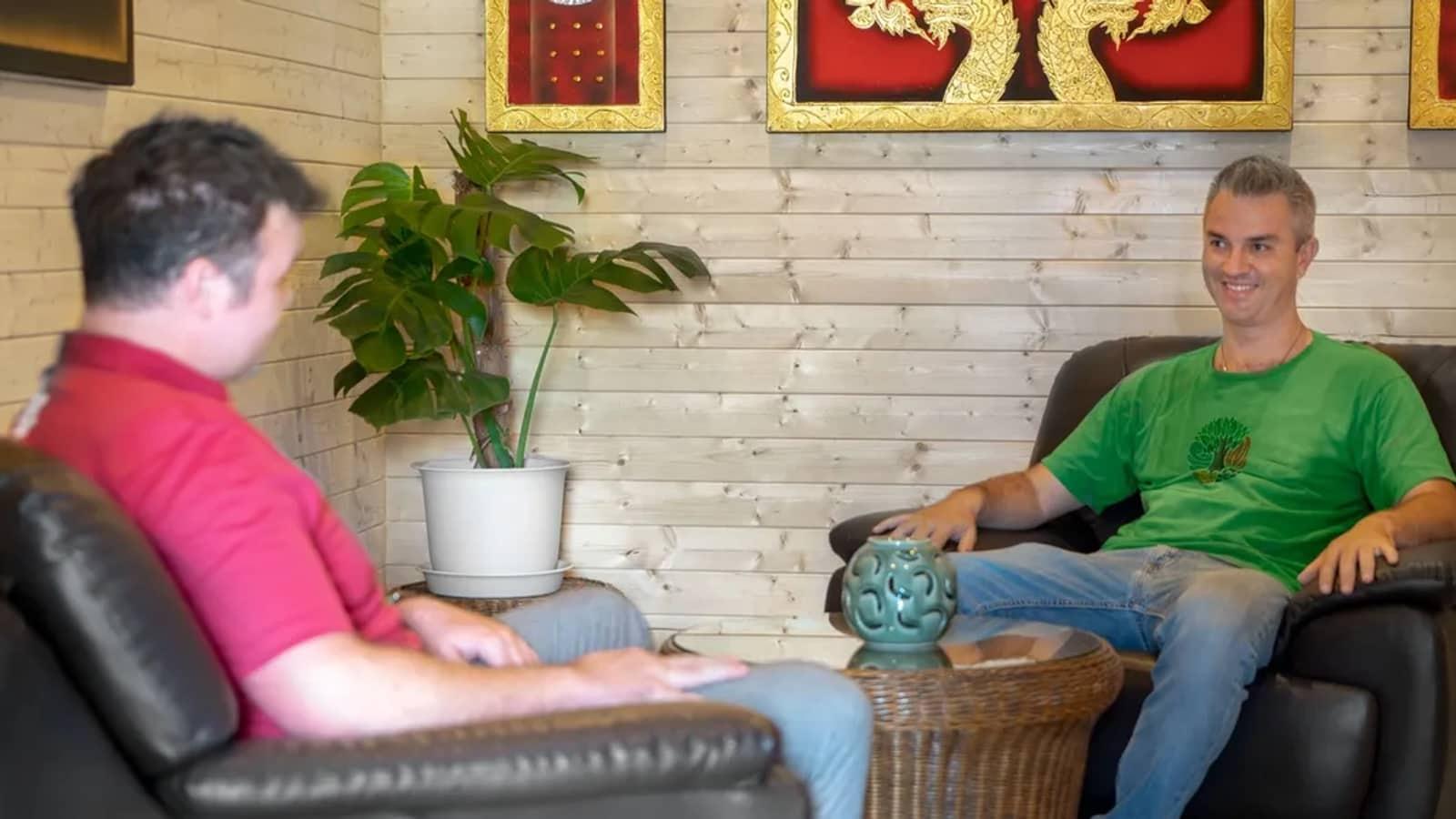
“It's not presentations. It's facilitated discussion. Clients hear someone else describe what they thought was their own private experience. That's where the shift happens.
Small Group Size Creates the Safety That Honest Sharing Requires
Jintara accepts a maximum of ten clients at any time. That limit is not a marketing point. It is the structural condition that makes the group therapy effective.
In a residential program with twenty, thirty or forty clients, group sessions carry a different social risk. A person in early recovery, already anxious and unsure, and often managing social anxiety alongside addiction, is asked to speak candidly about their substance use in front of people they do not know and may not trust. Most will not. They learn to perform participation without genuine disclosure, and the therapeutic value of the session diminishes accordingly.
At Jintara, a group of up to ten people in a residential setting develops familiarity within the first week. Clients are living together, eating together and exercising together. By the time the morning group session begins, the room is not a room of strangers. The 3.2 staff-to-client ratio means clinical staff are present throughout the day, not just during scheduled sessions. The therapeutic community that forms at Jintara is an extension of the physical environment, not separate from it.
Darren Lockie, Founder and CEO, has observed groups of clients who go on to play card games together at ten in the evening. That informal bonding carries directly back into the group room the following morning.
It is worth taking that card game seriously, because it is not a break from the treatment. It is part of it. A person who has spent years drinking or using alone, with a life that narrowed until very little brought any pleasure, sits at a table and laughs at something for the first time in a long while. That ordinary moment, sober, with other people, quietly contradicts one of addiction's deepest claims: that life without the substance is grey, that connection is gone, that this is simply who they are now. Sitting together over a hand of cards can do as much real work as any clever intervention, because it is direct evidence, felt rather than argued, that the capacity for company and for plain enjoyment is still there.
For an overview of the residential setting, see Jintara's facilities.

Group Therapy and Individual Therapy Are Designed as a Working Pair
A common question from prospective clients is whether they can substitute extra individual therapy sessions for group attendance. The answer at Jintara is no, and the clinical reason is straightforward.
Group therapy and individual therapy serve different functions. Group introduces the topics: psychoeducation, relapse warning signs, coping strategies, boundary setting. Individual therapy then takes those topics and applies them to the person sitting in the room. A client who has just spent a morning hearing a group discussion about coping with social pressure arrives at their one-on-one session with the concept already activated. The individual session can move directly to how that person specifically experiences the same pressure, rather than spending time establishing what it is.
There is also something the group does that no amount of individual time can substitute. Hearing your own private experience described, almost word for word, by someone else in the room reaches a person differently than being told they are not alone. Being told is a fact. Hearing it is an experience. A therapist can say the shame is common and that may be believed intellectually. Watching another person name the same shame, and watching the room receive it without flinching, dismantles the belief at the level it actually lives, the level where a person had quietly decided they were uniquely broken. That is why the two are not interchangeable, and why extra one-to-one hours cannot stand in for the room.
Denise O'Leary, Clinical Director, described this as the group setting treatment goals and the individual sessions building on them. Across a 30-day program, clients receive 65 to 70 hours of combined individual and group therapy, consistent with the intensive integrated approach described in SAMHSA's guidance on treating co-occurring disorders. That volume is not achievable through individual sessions alone and would not produce the same result if it were. The peer dimension of the group, the experience of hearing one's own situation reflected back by others, is a clinical input that individual therapy does not replicate.
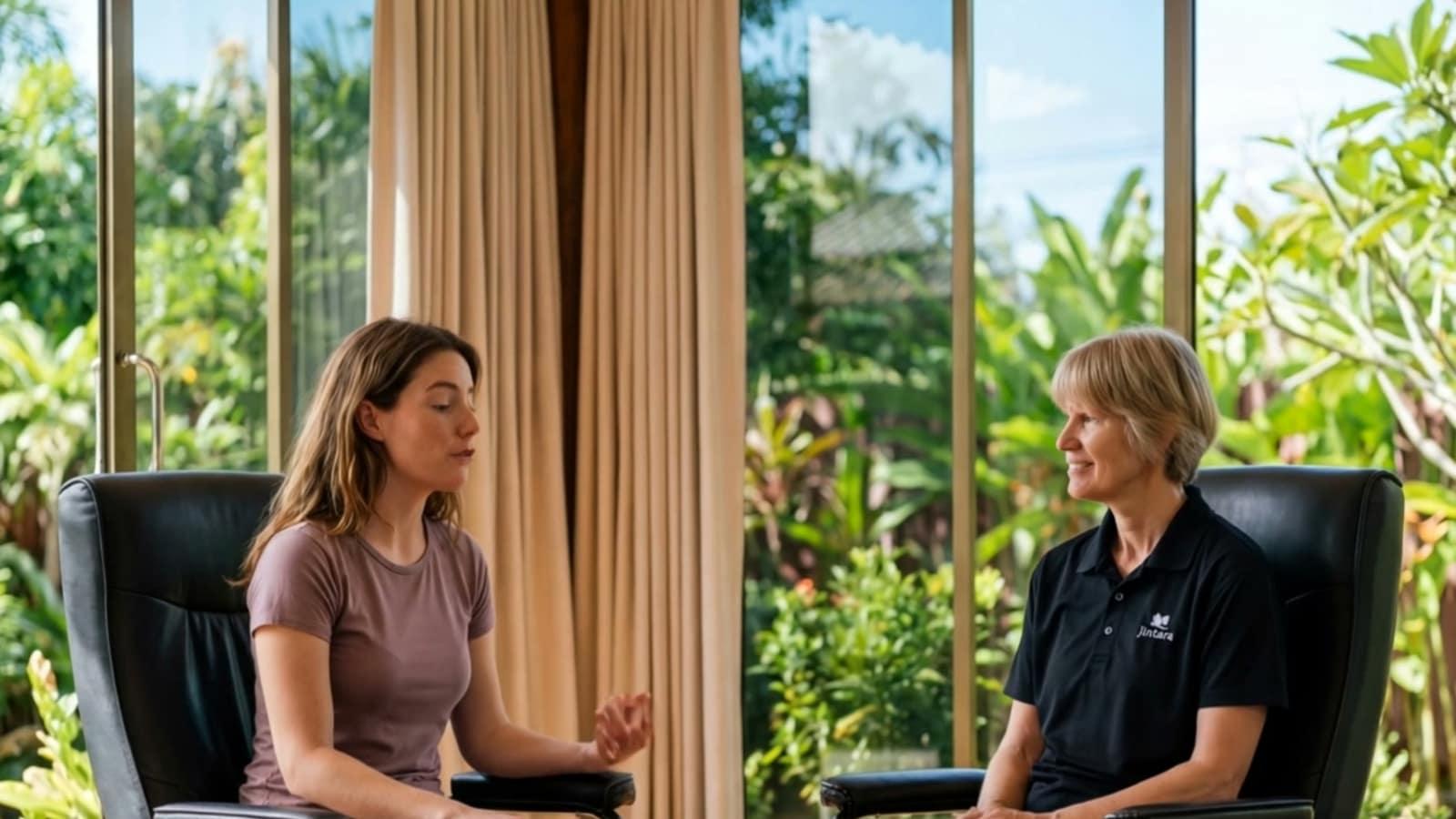
“Getting clean, getting sober, is one thing. Staying clean, staying sober, these are completely different things.
Trauma Work Stays in Individual Sessions to Protect Every Person in the Room
One distinction that matters for clients with trauma or post-traumatic stress is this: trauma processing at Jintara is never conducted in a group setting.
Group sessions cover recovery skills and psychoeducation. They are not the forum for exploring or processing traumatic experience. If a client's history includes trauma or PTSD, that work happens in individual sessions only, with the clinical team member most qualified to hold it.
The reason is protective. A group of people in early recovery, however well-intentioned, cannot provide a reliable holding environment for another person's trauma disclosure. Comments that feel neutral to the speaker can land as minimising or destabilising for someone sitting across the room. Keeping trauma work in individual sessions protects both the person disclosing and every other person in the group.
This means clients can attend group sessions knowing that no one will be asked to share something they are not ready to share, and that the space will not unexpectedly enter trauma territory. The group remains a place for skills learning, peer accountability and community.
For someone carrying trauma, that boundary is what makes the room usable at all. The fear of being cornered into disclosing too much, too soon, in front of people, is precisely what keeps many people out of group settings their whole lives. Knowing in advance that the deepest material is held elsewhere, in a one-to-one session with the person most qualified to hold it, takes that fear off the table. It lets a person be present in the group without bracing, and it is that sense of being safe enough to stay that allows the slower, steadier work of connection to happen. Feeling held rather than exposed is the difference between enduring the room and actually being in it.
For more on how Jintara approaches co-occurring mental health conditions, see dual diagnosis treatment.

Attendance Is Expected and Structured to Support You From Your First Day
Group therapy at Jintara is a required part of the program, not an optional add-on. Exemptions require a formal nursing assessment and are reserved for situations where a client is medically unable to attend. The expectation is communicated clearly before admission.
This is not a rigid rule for its own sake. Darren Lockie has noted that if a client cannot sit in a group of up to ten people in a supported residential setting, they will face greater difficulty in work meetings, social situations and family interactions after discharge. Group attendance is, in part, practice for re-engagement with ordinary life.
The clinical team also recognises that the first group sessions can be uncomfortable. People arrive in varying states of detox, anxiety and exhaustion. Denise O'Leary described a client who attended group sessions during an opioid withdrawal, sitting wrapped in a blanket and alternating between chills and sweating. She came anyway. The response from the group around her was one of respect, and her commitment influenced the motivation of other clients that week.
Showing up like that, on the days it is hardest, does something the person often does not register until later. It is a small, repeated act of staying steady when everything in the body is asking to retreat, and over a few weeks it quietly rewrites the belief that they cannot cope with discomfort without reaching for something. This is also why attendance is watched so closely. When a client who was present and engaged starts to pull back, the team treats it as a signal rather than a discipline problem, because withdrawing from the group is often the first visible sign that something underneath is slipping. The expectation to attend is not about compliance. It is about not letting anyone quietly disappear at the exact moment connection matters most.
The morning group block at Jintara runs from 09:30, following yoga or walking and a rest period. For clients managing early withdrawal symptoms, the clinical team coordinates attendance with medical detox oversight to support comfort and safety during sessions.
Families coordinating care from overseas sometimes want to know whether the clinical arrangements are independently verified. They are. Jintara holds hospital-grade accreditation under certificate 25/2569, jointly issued by the Healthcare Accreditation Institute, the Princess Mother National Institute on Drug Abuse Treatment, and the Department of Medical Services, Ministry of Public Health. The clinical protocols governing group attendance during medical detox were assessed against Thailand's national hospital-grade standard by those three bodies. Proven to a hospital's bar, and still small enough that the nursing team knows exactly how each client is doing before the morning session begins.

The Skills Practised in Group Sessions Prepare You for Daily Life After Discharge
The skills practised in group sessions accompany clients home: trigger recognition, coping strategies, boundary habits and the self-awareness to act on early warning signs. Recovery does not end when the 30-day program does, and group therapy is where clients begin practising these skills under clinical supervision.
The four-week curriculum deliberately includes aftercare planning as a group topic. On Wednesday mornings, the session focuses on what discharge will look like, what has to change at home, and how to maintain the recovery structures built during the program. These are conversations that benefit from peer input. Other clients in the room have faced the same questions and can offer perspectives that the clinical team alone cannot.
SMART Recovery tools are available as a free ongoing resource after discharge. Clients who practice the framework in group sessions are familiar with its language when they encounter it in a local or online meeting after leaving Jintara.
Underneath the practical skills, something quieter goes home with people. The person who walked in convinced they were uniquely broken has spent weeks discovering they are not, and that they can sit in a room, be honest, and be met rather than judged. They leave with a lived reminder of what they are capable of: of staying when it is hard, of letting other people in, of being a participant in their own recovery rather than a problem being managed. None of this is about leaving relentlessly positive or pretending the road ahead is easy. It is about leaving as the main character in your own story rather than a passenger, with the steadiness to look at what comes honestly and the experience of having done exactly that, in company, already behind you.
The goal of group therapy at Jintara is not to produce people who managed 30 days. It is to produce people who have the skills, the self-awareness and the peer experience to maintain their recovery once they leave. See the relapse prevention program for more on how Jintara structures aftercare planning.


Talk with Our Admissions Team
Your enquiry is confidential and goes only to our admissions team.
Common questions about group therapy at Jintara
A therapist with post-graduate qualifications facilitates a guided discussion lasting approximately one hour. Sessions are not lectures. The facilitator poses questions and clients work through recovery topics including coping skills, relapse warning signs, CBT techniques and boundary setting. The format varies by session type, from psychoeducation to process group to SMART Recovery.
Yes. Confidentiality is a condition of the group. Clients are asked to respect the privacy of what others share, and the clinical team maintains the same standard. The small group size at Jintara, up to ten clients, supports this. Familiarity develops quickly, which makes the expectation of confidentiality feel shared rather than imposed.
This is one of the most common concerns before arrival, and one that resolves faster than most clients expect. The facilitator does not put individuals on the spot, and there is no requirement to disclose sensitive personal history. As the week progresses and the group develops familiarity, participation tends to increase naturally.
The two work in sequence. Group sessions introduce a topic, such as coping with cravings or setting boundaries. Individual therapy then applies that topic to your specific situation and goals. Arriving at a one-on-one session with the concept already active from the morning group makes individual work more focused and personal.
In most cases, yes. The clinical team coordinates group attendance with your medical detox plan. If withdrawal symptoms are significant, the nursing team will assess and adjust accordingly. Clients in early detox who do attend often find that the group environment provides both distraction and connection during the harder hours.
Prior treatment experience is common at Jintara. The four-week curriculum approaches familiar topics from different angles, new facilitation, new peers, new circumstances. Clients who have stayed two or three months have returned to sessions they attended previously and found them substantively different because what they are ready to hear has changed.
No. Jintara does not use the 12-step framework. Group sessions draw on SMART Recovery, CBT, psychoeducation and process-oriented approaches. There is no sponsor assignment, no step work, and no requirement to identify with a particular label.
Yes. Jintara's setting is designed with confidentiality at its core. The group is small, up to ten people, and all participants are asked to respect what is shared within sessions. There is no requirement to disclose your profession, your employer, or any sensitive personal history. Many clients at Jintara are professionals or executives who had the same concern before arrival and found the small, facilitated format workable within days of the first session.
Yes. Jintara holds hospital-grade accreditation, certificate 25/2569, jointly issued by the Healthcare Accreditation Institute, the Princess Mother National Institute on Drug Abuse Treatment, and the Department of Medical Services, Ministry of Public Health. The accreditation covers the full clinical program, including the standards applied to group therapy delivery, and is valid from May 2026 to May 2029. Jintara is one of only six private rehabs in Thailand to hold this accreditation.
Jintara is certified against Thailand's national quality standard for drug treatment and rehabilitation facilities. The assessment was conducted jointly by the Healthcare Accreditation Institute (the body that accredits Thailand's hospitals), the Princess Mother National Institute on Drug Abuse Treatment, and the Department of Medical Services. The same rigorous standard applied to Thailand's hospitals was applied to Jintara's program, and the facility met it. Certificate 25/2569 confirms accreditation from 20 May 2026 to 19 May 2029.
Jintara is a small adult residential rehab in Chiang Mai. Group therapy runs daily, Monday to Friday, in a setting of up to ten clients.
Jintara Rehab is licensed by the Thai Ministry of Public Health as a rehabilitation centre. The clinical information on this page describes Jintara's general approach to supporting clients during the early recovery period. Medical decisions, including medication protocols, are determined by addiction-specialist psychiatrists through our partner hospital pathway. Individual treatment varies based on clinical assessment. This content is for informational purposes and does not constitute medical advice.