

Your program is built around your history, not a template.
At Jintara, treatment planning begins before you arrive. The admissions call is the first clinical contact, assessment continues through Day 2 at our hospital partner, and the plan is reviewed every week of your stay. This is what personalised addiction treatment looks like when it starts from a 10-client census rather than a 200-bed unit.
- Darren personally takes every admissions call, with no intake coordinators involved.
- Validated screening tools used from Day 1: PHQ-9, GAD-7, CIWA-Ar, COWS.
- Full hospital workup at Day 2, included in the program fee.
- Weekly clinical team review; your plan adjusts as recovery progresses.


Fully Licensed and Hospital Accredited
A personalised treatment plan begins with the admissions call, not the front door.
A personalised treatment plan is the clinical blueprint for your substance history and mental health.
At most facilities, the person who takes your first call is an admissions coordinator working from a standard intake script. At Jintara, that call is taken by Darren Lockie, founder and CEO, with 15 years building addiction treatment in the Asia-Pacific region. The clinical picture begins forming in that conversation, and so do the practical worries, including how professionals protect their jobs during rehab while they take the time to recover. Fit is assessed honestly, including whether Jintara is the right place. If it is not, Darren will say so.
By the time a client arrives, the team already has a preliminary clinical impression: the primary substance, any known co-occurring conditions, medical history flags, and the client's own goals for treatment. That context shapes the admissions intake process from the first hour.
Every detail shared in that first conversation becomes clinical information, not marketing data.

“Everyone who comes in that front door, I've already spoken with them, probably their family. The owner taking your call, that's one of the things that's different about this place.
The clinical assessment on arrival covers every domain relevant to your recovery.
On the first day of arrival, every client meets with the psychiatrist. This is not a brief intake interview. It is a full psychiatric evaluation that may require five to seven follow-up appointments if medication adjustment becomes necessary, and it is included in the program fee at no additional charge.
Simultaneously, Lertkhwan Sukpia (Khun Khwan), Jintara's head nurse, leads the nursing intake. For clients withdrawing from alcohol, CIWA-Ar is a validated 10-item clinical scale for quantifying alcohol withdrawal severity (Sullivan et al., 1989). It is scored immediately on arrival and documented. For clients withdrawing from opioids, the Clinical Opiate Withdrawal Scale (COWS) is used. There is no equivalent scale for benzodiazepine withdrawal; clinical assessment via vitals and presentation is used instead.
The assigned therapist meets the client within the first 24 hours to begin building the therapeutic relationship before the formal plan is constructed. The goal of the arrival assessment is not to complete a checklist but to understand what the person in front of the clinical team actually needs through the inpatient detox phase and beyond.
Families choosing from overseas carry a particular worry about those first hours: whether the clinical depth on arrival will match what was promised before the flight. The assessment Jintara runs, from CIWA-Ar or COWS scoring on admission to a full psychiatric evaluation on the first day, was independently assessed against the national clinical standard applied to Thailand's hospitals, and met it. Held to that bar, and still small enough that the nursing team already knows your family member by name.
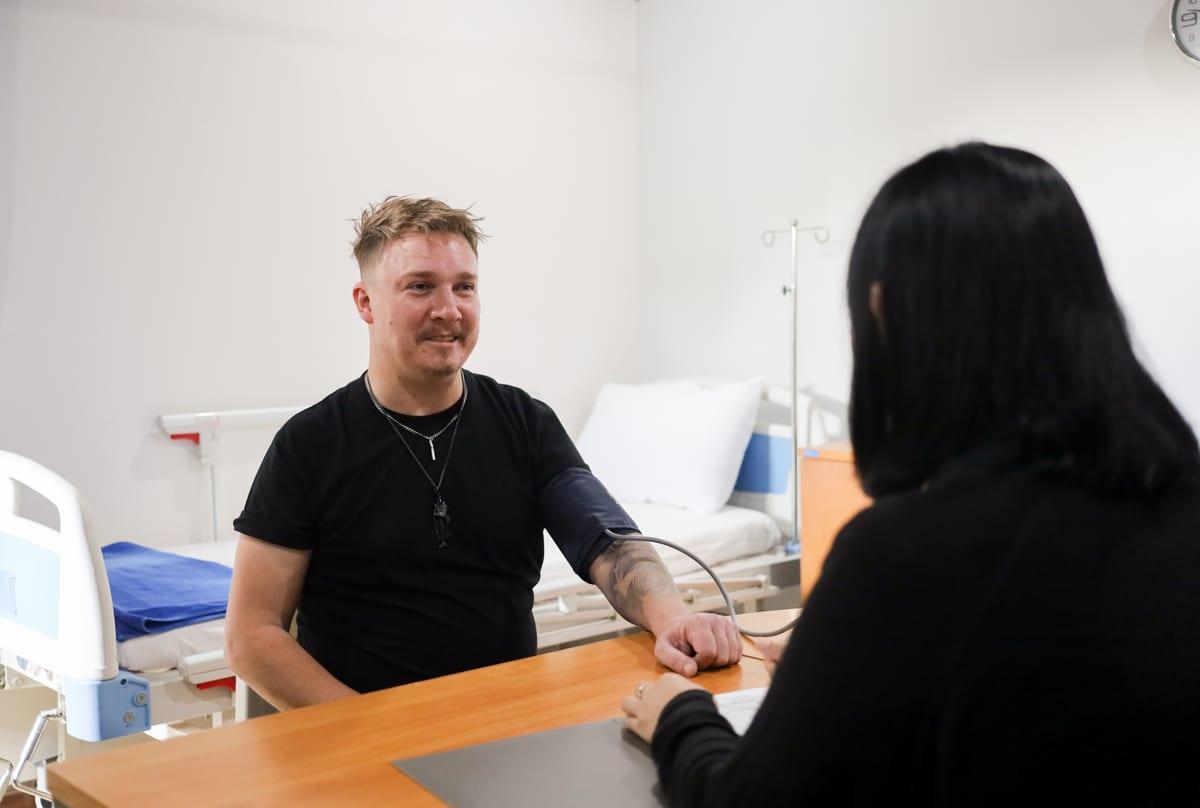
The Day 2 hospital workup reveals what substance use has done to the body.
On Day 2 of treatment, in 90% of cases, clients attend a full medical workup at Bangkok Hospital Chiang Mai or RAM Hospital, both confirmed partner facilities. This workup is paid for by Jintara as part of the standard program fee.
The standard package covers: full blood spectrum, liver function test, kidney function test, urine test, ECG (electrocardiogram), and chest X-ray. Liver enzyme irregularities, anemia, cardiovascular concerns, and pulmonary findings from long-term cannabis or tobacco use are all routinely picked up. Where clinically indicated, additional tests are added: testosterone for male clients over 40 where there may be a hormonal factor in low mood or low motivation, and detailed urinary tract analysis for clients presenting with ketamine use.
The timing is deliberate. Waiting until Day 6 or Day 7 for a medical baseline when a client has been in residence for that long creates a gap in clinical safety information. Day 2 closes that gap early. Findings from the workup are reviewed by the psychiatrist and nursing team that same day, feeding directly into the developing treatment plan and informing decisions about medication during what happens in the first week.

Validated screening tools give the clinical team measurable baselines to track change.
Most rehabs describe their assessment process as "clinical." Jintara names the tools. The PHQ-9 measures depression severity. The GAD-7 measures generalized anxiety. The PCL-5 is used case-by-case for trauma screening where trauma history is disclosed or suspected. The SPIN and SADS screens are used occasionally for social anxiety. The 8Q is administered when the PHQ-9 flags elevated suicidality risk.
CIWA-Ar and COWS are used for withdrawal monitoring and scored on a cadence tied to severity: a CIWA-Ar score above 14 triggers re-scoring every one to two hours; a moderate score of 8 to 14 moves to every four to six hours; a stabilised score below 8 reduces to every eight to twelve hours, tapering toward once daily.
These screens are not administered once at intake and filed. PHQ-9 and GAD-7 are repeated every one to two weeks throughout the stay so the clinical team has a longitudinal picture of whether depression and anxiety are tracking in the right direction. That data, combined with therapist session notes and nursing observations, informs the weekly treatment plan review. The SAMHSA Treatment Improvement Protocol on co-occurring disorders identifies this kind of integrated, validated assessment throughout treatment as the clinical standard of care for clients presenting with both substance use disorder and mental health conditions.

The substance driving the addiction shapes the clinical emphasis from week one.
The same treatment program does not fit an alcohol withdrawal client and a stimulant-dependent client. Jintara builds distinct emphasis based on what the client is withdrawing from and what that substance does to the body and brain.
For alcohol clients, the acute medical priority is withdrawal safety. CIWA-Ar scoring drives every nursing decision in the first 72 hours. Benzodiazepines may be used as part of the alcohol detox protocol where clinically indicated. For clients with a concurrent benzodiazepine dependency, the taper follows after alcohol detox completes, and can extend up to two to three months post-program, with a minimum three-week post-zero window for rebound anxiety to settle.
For opioid clients, COWS scoring guides the detox plan. Methadone taper is available in Thailand and is used where clinically appropriate to manage withdrawal safely. The position at Jintara is that people withdraw from opioids, not onto a long-term maintenance substance. For stimulant clients, the clinical emphasis in early weeks shifts toward sleep regulation, appetite restoration, and fitness re-engagement, given how methamphetamine and cocaine affect energy systems and mood.
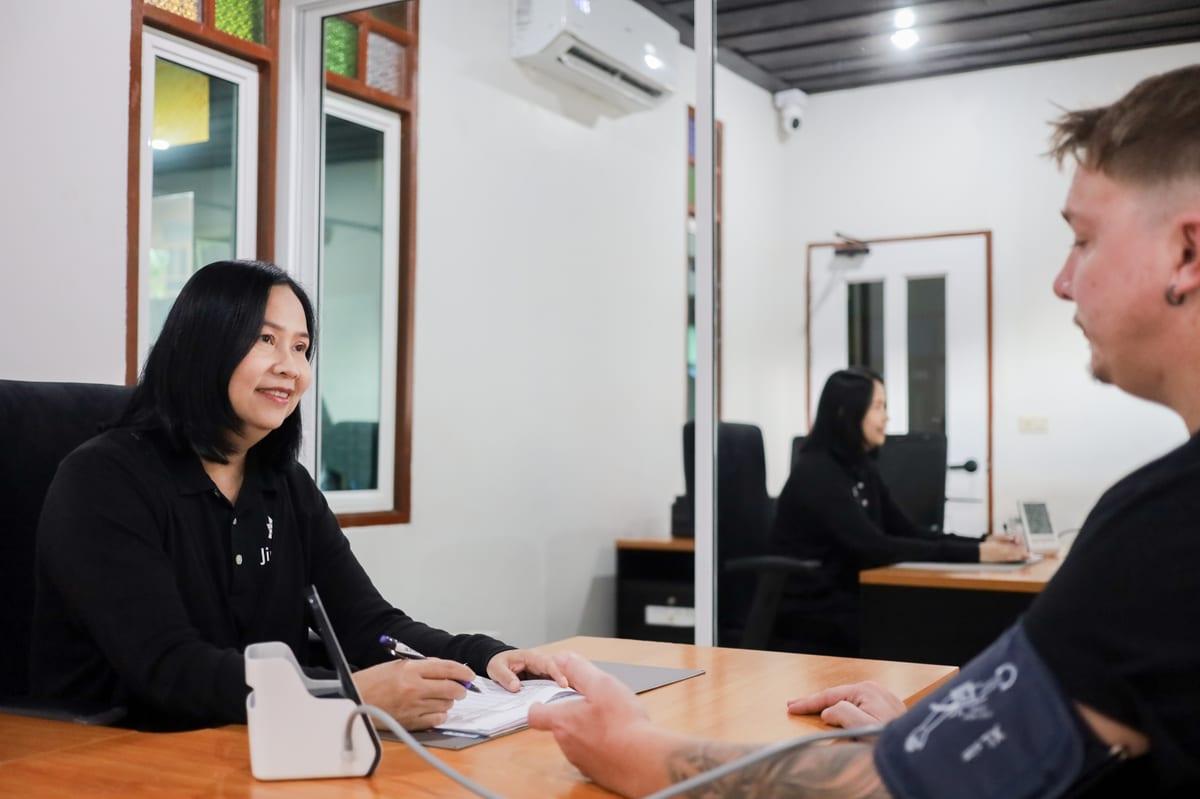
The treatment plan is reviewed every week because recovery rarely follows a fixed schedule.
On first admission, a 30-day stay can feel like a long time. By the end of week two, most clients on the four-week program are asking whether they can extend. Darren's observation, from years of running Jintara at a 10-client capacity, is that the average stay has shifted to around six weeks, with many clients choosing two- or three-month programs once they reach stabilisation and start to see what the work involves.
The formal weekly review brings the therapist, nursing lead, and fitness lead together. Notes are compared. The clinical picture from the previous week is assessed against the current week. Medication adjustments are made not on fixed dosing schedules but on clinical scores, vitals, and the therapist's qualitative account of how the client is responding, following the same seven-domain framework described in how we measure your progress. Extensions are discussed early, typically by week two or week three, when clients reach what Darren describes as the point where they understand how short 30 days actually is.
Extensions are available in increments as small as one week at Jintara's published pricing structure, without a requirement to commit to a full additional month. The flexibility matters because the right length of stay is not determined at booking.

Therapy activates in a sequence matched to where the brain can absorb it.
There is a clinical reason that deep trauma processing does not happen in week one. A brain in active withdrawal, managing acute anxiety, disrupted sleep, and unpredictable mood, is not ready for trauma reprocessing. Attempting it too early is not just ineffective; it is contraindicated.
Week one is stabilisation, support, and orientation. The therapist meets the client, listens, and holds the clinical picture without pressing. Week two is the start of structured group work: psychoeducation, CBT-based cognitive skills for anxiety and depression, relapse prevention foundations, and weekly individual sessions with a developing therapeutic relationship. By weeks three and four, clients are typically past acute withdrawal, sleeping better, and capable of deeper therapeutic engagement.
EMDR therapy is introduced at the earliest in month two, and only for clients who will be staying 60 days or more. Denise O'Leary, who leads the therapy team and holds EMDRIA certification, does not offer EMDR to 30-day clients because the preparation work alone requires time that a short stay does not provide. For clients for whom EMDR is appropriate, the EMDR therapy preparation phase begins in month one and the processing work in month two. NIDA's treatment overview describes behavioural therapies such as cognitive behavioural therapy, and says co-occurring conditions are usually better treated at the same time.

“EMDR is trauma therapy, so we're not doing that until month two. What happens first is we let the person stabilise, feel safe, and feel heard.
Jintara accepts a narrow range of presentations because clinical depth requires focus.
The Jintara model requires that the primary presenting diagnosis is substance use disorder. That constraint is not a commercial one; it reflects what the clinical team is built to treat well and what the group therapy model requires to function.
Conditions that make Jintara unsuitable as a primary placement include: unmedicated schizophrenia, unmedicated bipolar disorder, borderline personality disorder as a primary presenting condition, eating disorders as a primary diagnosis, and gambling or behavioural addiction as the primary concern without a concurrent substance use disorder. For any of these, Darren and Denise will say so during the assessment conversation and, where possible, refer to a facility with a better clinical fit.
Within the substance use disorder remit, the model accommodates a wide range of presentations. Dual diagnosis with anxiety, depression, and trauma is extremely common, and a significant part of the clinical team's expertise. The 32-staff-for-10-clients ratio, the named therapists, the EMDRIA-certified clinician, and the daily availability of the founder give the team room to hold complexity without compromising the group. Darren Lockie describes the small census as the core design decision: the quality of individual attention available at 10 clients is simply not possible at 50. The NIMH's overview of psychotherapies describes CBT among evidence-based therapies shown to reduce symptoms of depression and anxiety.


Talk with Our Admissions Team
Your enquiry is confidential and goes only to our admissions team.
Common Questions About Personalised Treatment Planning
Who conducts my first clinical assessment?
Darren Lockie, founder and CEO, takes every admissions call personally. That conversation is the first clinical contact. On arrival, a psychiatric assessment is conducted by the psychiatrist, nursing intake is led by Khun Khwan, and your assigned therapist meets with you within the first 24 hours. No intake coordinators are involved at any stage.
What happens during the Day 2 hospital workup?
On the second day of your stay, Jintara takes you to Bangkok Hospital Chiang Mai or RAM Hospital for a full medical workup, paid for by the facility. This includes full blood spectrum, liver and kidney function tests, urine analysis, ECG, and chest X-ray. Additional tests are added based on your individual presentation. Results are reviewed by the psychiatrist the same day.
What screening tools are used to assess my mental health?
Jintara uses the PHQ-9 for depression, the GAD-7 for anxiety, and the PCL-5 for trauma where indicated. For withdrawal monitoring, the CIWA-Ar is used for alcohol and the COWS for opioids. These are not one-off intake screens; the PHQ-9 and GAD-7 are re-administered every one to two weeks so the team can track whether your mental health is improving.
How often is my treatment plan reviewed?
Weekly. The therapist, nursing lead, and fitness lead compare notes and assess your progress against the previous week. Medication is adjusted based on clinical scores and your therapist's account of your progress, not on a fixed schedule. If extending your stay becomes relevant, that conversation typically happens by week two or three.
What if I need to extend my stay?
Extensions are available in increments of one week without committing to a full additional month. The average stay at Jintara is around six weeks. Most clients reach week two and realise how much work is still ahead of them. Darren's view is that 30 days is a starting point, and the brain needs longer than that to establish new patterns and feel genuinely well again.
When does EMDR become part of my program?
EMDR enters the program at the earliest in month two, and only for clients staying 60 days or longer. Denise O'Leary, who is EMDRIA-certified, does not deliver EMDR processing to 30-day clients because the preparation phase alone requires more time than a short stay allows. For clients with significant trauma history who are staying longer, EMDR is planned in from the start with a structured sequencing approach.
What conditions make Jintara unsuitable as a placement?
Jintara is built around substance use disorder as the primary diagnosis. Clients presenting primarily with eating disorders, gambling addiction, unmedicated schizophrenia, unmedicated bipolar disorder, or borderline personality disorder as the primary condition are not the right fit. If a condition is disclosed during the admissions call that falls outside this scope, Darren will say so and, where possible, suggest a more appropriate facility. More information about the admissions process is at Jintara Rehab.
Is the treatment planning and care process at Jintara independently accredited?
Yes. Jintara holds joint accreditation (certificate 25/2569, valid May 2026 to May 2029) issued by three national bodies: the Healthcare Accreditation Institute, which accredits Thailand's hospitals; the Princess Mother National Institute on Drug Abuse Treatment; and the Department of Medical Services, Ministry of Public Health. The accreditation covers clinical care processes including assessment protocols, treatment planning, medication management, and nursing standards. Jintara is one of only six private rehabs in Thailand to hold this standard.
How does accreditation relate to the way Jintara builds a treatment program?
Accreditation is an independent audit of clinical process, not just facility standards. The three national bodies that jointly issued Jintara's certificate assessed how care is planned, how it is documented, how it responds across a client's stay, and how medication is handled and adjusted. A treatment plan that is built on validated screening tools, reviewed weekly, and adjusted on clinical scores reflects the same integrated care process the accreditation requires. Certificate 25/2569 is publicly verifiable.
Jintara is a small adult residential rehab in Chiang Mai. Treatment planning starts with your first call, assessment continues through Day 2, and the plan is reviewed every week you are here.
Jintara Rehab is licensed by the Thai Ministry of Public Health as a rehabilitation centre. The clinical information on this page describes Jintara's general approach to supporting clients during the early recovery period. Medical decisions, including medication protocols, are determined by addiction-specialist psychiatrists through our partner hospital pathway. Individual treatment varies based on clinical assessment. This content is for informational purposes and does not constitute medical advice.