

Seven areas of measurement, updated daily, personalised to you.
Progress in addiction treatment is more than a feeling. It is a set of measurable changes the clinical team tracks across the full length of your stay, and it is the slow return of the person underneath the addiction. Early on, your own read on how you are doing cannot be trusted, because the mind that drove you here still tells stories. At Jintara's treatment program, measurement gives you an honest mirror from the first morning of your admission, so what you are capable of becomes something you can see, not just hope for.
- Psychological assessments repeated every one to two weeks throughout your stay.
- Fitness tested on arrival and again before you leave.
- Sleep quality observed and recorded by nursing staff every shift.
- Individual progress reviewed and updated in a meeting each week.


Fully Licensed and Hospital Accredited
Progress at Jintara is tracked across seven measurable areas, not estimated.
Progress in addiction treatment is the sum of specific, documented changes across seven clinical domains: psychological state, physical fitness, sleep quality, withdrawal resolution, cravings, group engagement, and medication response. Each domain is tracked by a different member of the team, coordinated through a shared individual file that every clinician reviews at handover. No single number defines progress. The combination of all seven gives the clinical team, and you, an honest picture of where you are and where you are going.
This matters because, early on, your own sense of how you are doing is the least reliable instrument in the building. The same mind that talked you into one more drink still narrates your day, and on a hard morning it will tell you that nothing has changed and nothing will. Measurement is the answer to that voice. When the team can show you that your sleep has lengthened, your blood pressure has settled, and your anxiety score has come down, you are no longer at the mercy of how a single bad hour feels. You get to see the version of you that is quietly returning, even on the days you cannot feel it.
Most programs measure progress at intake and again at discharge. The gap between those two points tells you something, but not much about what happened in between. At Jintara, assessment is continuous. If a score drops in week two, the team knows about it in week two, not on the day you leave.
None of it is measured against anyone else. Your scores are compared only to the person who arrived on day one, not to the client in the next room or a standard completion profile. Darren's approach starts with individual planning, and you can read more about how your program is built at Jintara.

Psychological screening with the PHQ-9 and GAD-7 gives you an objective baseline.
Jintara uses two validated clinical screening tools to track psychological state: the Patient Health Questionnaire-9 (PHQ-9) and the Generalised Anxiety Disorder-7 (GAD-7). The PHQ-9 is a validated measure of depression severity and the GAD-7 is a validated measure of anxiety severity. Both produce a numerical score that can be compared directly across multiple time points. Denise O'Leary, Jintara's Clinical Director, administers both tools and repeats them every one to two weeks.
The value of these tools is not their complexity. They are straightforward, validated instruments. The value is that they give an objective number that sits alongside clinical observation and the client's own report. When the PHQ-9 score drops from 18 to 11 across three weeks, that is a change you can see, not just feel. If a score does not improve despite clinical optimism, that signals a need to look harder at the treatment plan.
There is a reason an objective number matters so much here. As the substances come away, the emotions they were holding down come back online, sometimes with a vengeance, and for many people the fear of those emotions is worse than the emotions themselves. The inner voice gets loud. It says you are the only one struggling this badly, you should be further along, do not let anyone see. A score does not shout. When your own head insists you are getting nowhere, a GAD-7 that has fallen week on week is a calmer and more honest witness than the critic in your mind. It lets you start to separate what is actually happening from what your anxiety is telling you is happening.
Assessments are conducted in individual therapy sessions. Results are documented in the client's file and discussed with Darren and, where relevant, the consulting psychiatrist.
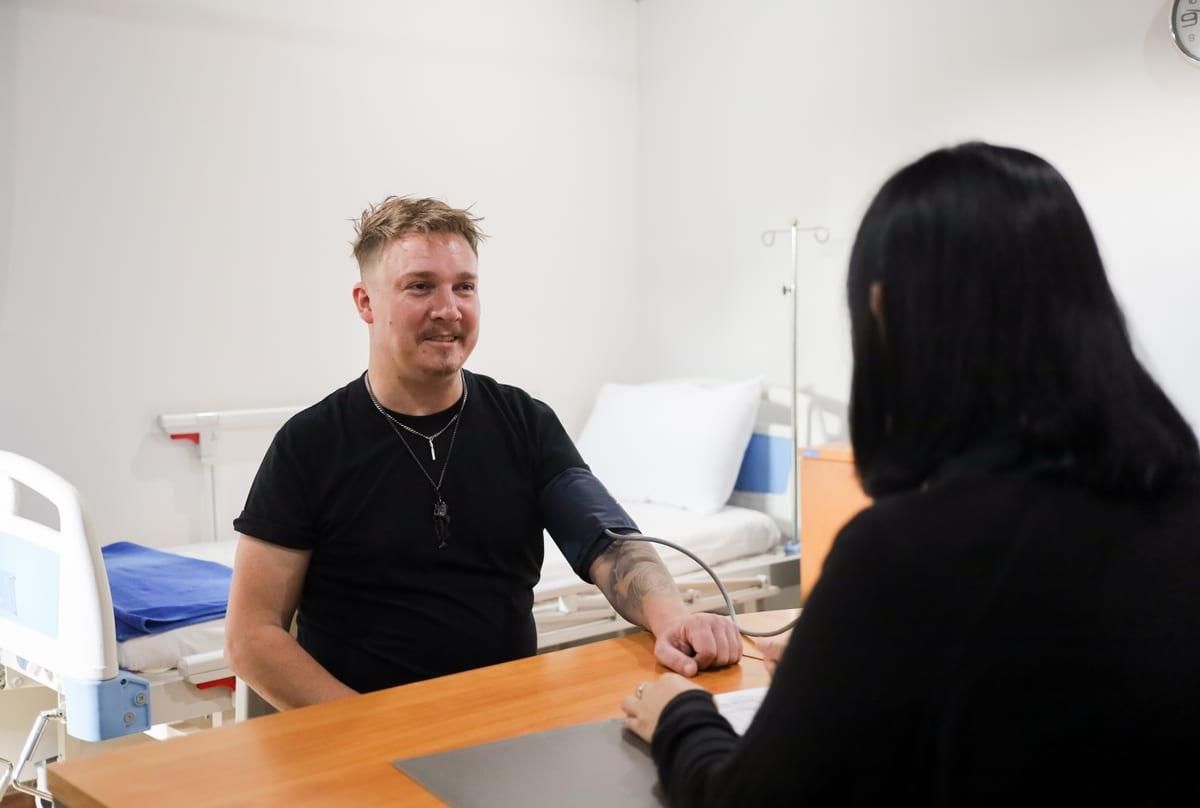
“The PHQ-9 and GAD-7 give us a number we can track week to week. Progress does not always feel obvious from the inside. That is exactly why we measure it.
Fitness testing measures real physical gains from week one to week four.
Physical recovery is part of addiction treatment at Jintara, not an optional add-on. Tong, Jintara's Fitness and Recovery Coach, conducts a formal physical assessment on arrival covering three areas: muscular strength, cardiovascular endurance, and flexibility. The same assessment is repeated in the final days of the stay. The comparison gives both the client and the clinical team a documented record of physical change across the program.
Week one activities are light and assessment-based. No client is pushed into high-intensity exercise while withdrawal is still resolving. As medical stability improves, the fitness schedule builds progressively. Clients who are physically deconditioned on arrival see measurable improvement in all three areas by the final assessment. Tong also writes brief progress notes after group fitness sessions, noting mood, isolation signals, and engagement levels.
For a lot of people, the body is where they first feel like themselves again. Addiction narrows life down until very little brings any pleasure, and the early days can feel flat and grey while the brain's reward system slowly comes back to life. Then something shifts. The walk gets easier, the weight starts to move, the round on the bag that left you winded in week one is manageable by week four. That is not a small thing. It is physical, undeniable proof that you are not finished, that the body you had quietly given up on is still capable of getting stronger. People often feel that change before they can put it into words, and the assessment numbers give them permission to believe it.
The fitness assessment connects directly to the broader fitness and nutrition program at Jintara.

Sleep quality is observed and recorded from the first night of your stay.
Sleep is one of the clearest early indicators of how withdrawal is progressing. The nursing team at Jintara, who are awake and active through the night, observe and record sleep quality as part of every shift handover. Self-reported sleep quality is also collected from clients each morning. These two data points, nursing observation and client report, are compared across the first week to identify any disconnect worth investigating.
Those first nights are some of the hardest hours of the whole stay. Lying awake in early withdrawal means meeting your own nervous system without the chemical floor you have stood on for years, and it can be frightening. This is exactly why the observation is not left to a form. The nursing team is awake through the night, which means nobody rides those hours out alone. As the nights begin to lengthen and the sleep comes back, it is often the first concrete sign the body trusts that it is becoming safe again. Many people describe the first genuinely good night of sleep as the moment they first believed recovery might actually be possible.
In the first nights of alcohol or benzodiazepine withdrawal, broken and disrupted sleep is common. Through the first week, sleep duration and continuity improve as the nervous system stabilises. When sleep quality does not improve on this trajectory, it signals either an unresolved physiological issue or an underlying anxiety pattern that needs clinical attention. No nursing observation is recorded in isolation. Every note feeds into the individual file that the incoming shift reads at handover. From medical detoxification through to the final week of the program, sleep remains a tracked variable.

Cravings and withdrawal symptoms are documented and responded to daily.
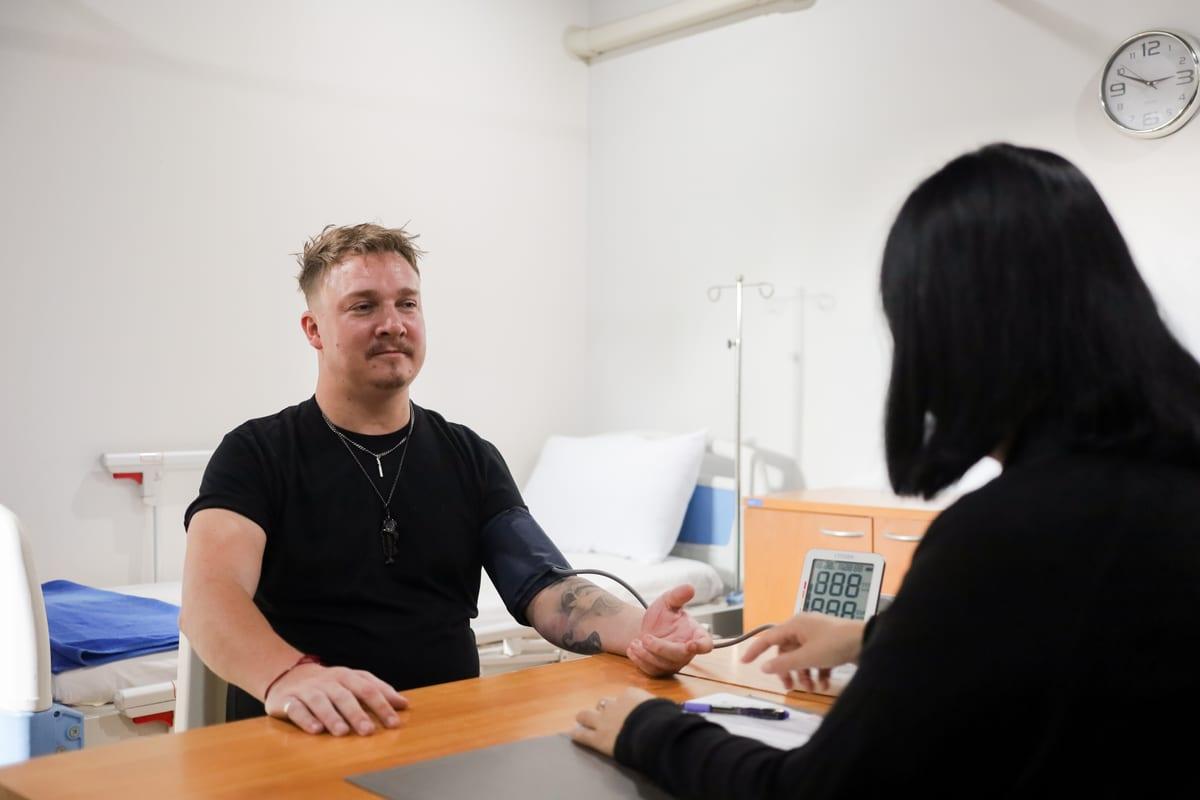
Withdrawal symptoms and cravings are scored, tracked against expected timelines for the specific substance, and used to adjust medication and therapy intensity in real time. Lertkhwan Sukpia (Khun Khwan), Head Nurse & Operations Manager, coordinates the nursing team's documentation of physical symptoms including tremors, sweating, agitation, and blood pressure readings. These are updated on each shift.
Alongside the physical picture, clients are asked about cravings during daily nursing check-ins and in individual therapy. Craving intensity, triggers, and duration are noted. In the context of the first week of treatment, cravings are expected, documented without alarm, and used to inform which coping tools are practised in therapy. Most clients report a marked reduction in craving intensity over the course of treatment. When cravings remain elevated or return after a period of reduction, that flags a need for further clinical review rather than reassurance.
What changes most here is not just the craving, it is your relationship to it. People often arrive believing a craving is a verdict, proof that they are weak or about to fail. The nursing team treats it as neither. A craving is recorded the way a temperature is recorded, calmly, without alarm, as information. Watching the staff stay steady in the face of something that frightens you teaches the nervous system that the wave can be ridden out, and that it always, eventually, passes. That is the quiet skill underneath recovery: staying in control of yourself when a feeling is loud, rather than letting it run the day. You learn it by doing it, alongside people who are not frightened of it, until the craving stops being the thing in charge.
Group participation gives the clinical team a daily read on your social engagement.
Group therapy at Jintara runs daily. The therapist running each group writes a brief note afterward covering which clients participated actively, which withdrew, and any interpersonal dynamics worth noting. These observations are not assessments of character. They are clinical signals. A client who was engaged in week one and has become withdrawn in week two is showing a pattern that the team needs to explore.
Group participation also reflects something individual therapy cannot always reach: how a person behaves in a social context when they are not in a one-to-one clinical relationship. Isolation, poor impulse regulation, and avoidance are all detectable in group settings before they surface in individual sessions. For clients managing co-occurring conditions alongside addiction, group participation data helps the clinical team calibrate the pace of dual diagnosis work. Progress in group is not graded. It is observed, noted, and used as one layer of the broader progress picture.
The data is one thing. What it is quietly measuring is whether a person is letting other people back in. Most clients arrive certain they are the only one this bad, carrying a shame that says hide, stay in your room, do not let them see. Then they sit in a group, someone says the thing they have never said out loud, and a few other people nod and say, that is exactly me. Something loosens. The belief that formed in isolation cannot survive contact with people who turn out to understand it from the inside. Withdrawing from the group is worth noticing precisely because connection is where so much of the healing actually happens, often more than in any single clever intervention.
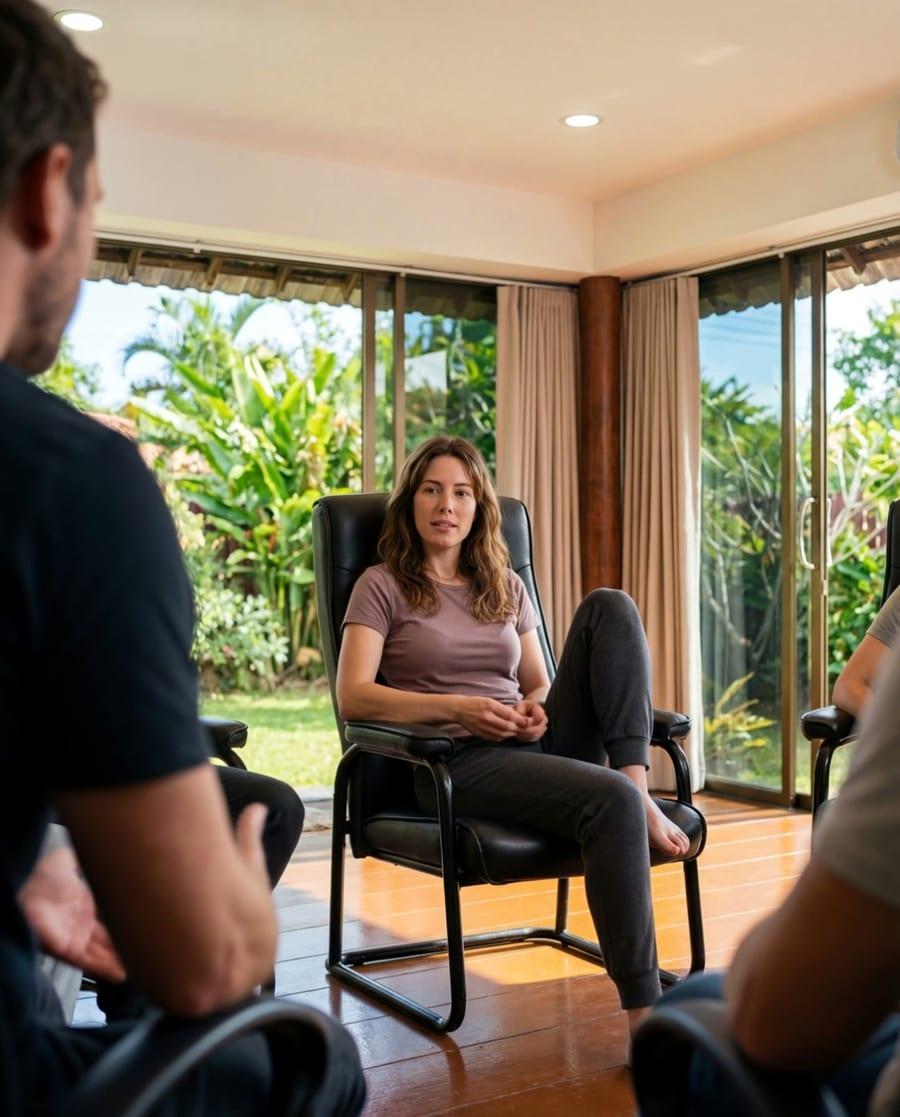
Your progress plan is reviewed and adjusted every week.
All seven domains, psychological scores, fitness data, sleep quality, symptom records, craving logs, group participation notes, and medication response, come together in a weekly review. Darren meets with the clinical team to discuss each client individually. The same weekly picture is what shapes the discharge plan, and what happens after you go home is tracked on its own schedule once you leave. The review is not a checklist. It is a clinical conversation about what the data shows, what the team is observing, and what needs to change.
It is worth pausing on what that meeting actually means for the person at the centre of it. Once a week, a room full of experienced clinicians sits down and thinks hard about one life, yours, and how to help it open back up. Many people arrive convinced they are a burden, a problem other people have to manage. Being the sole subject of that level of careful attention, week after week, quietly contradicts that belief. Recovery is not about becoming relentlessly positive or pretending nothing is wrong. It is about getting back in the driving seat of your own life, looking at things honestly from every angle, and staying steady whatever the week has thrown at you. The review is where the team holds that bigger picture on your behalf until you can hold it for yourself.
For families following a loved one's progress from a distance, the doubt that surfaces is not always about the measurement itself. It is about the people doing the measuring: are they actually qualified for this kind of work? Three national authorities have already answered that question. The Healthcare Accreditation Institute (HAI), the body that accredits Thailand's hospitals, together with the Princess Mother National Institute on Drug Abuse Treatment (PMNIDAT) and the Department of Medical Services, Ministry of Public Health, independently surveyed Jintara's clinical protocols and confirmed they meet the hospital-grade national standard, certificate 25/2569. The same standard Thailand's hospitals are held to. And still a team small enough that everyone in that weekly review knows your loved one by name.
Changes to the treatment plan are documented and communicated to the client in their next individual therapy session. If a medication dose needs adjustment, the psychiatrist is contacted. If a therapy modality is not producing measurable change, the plan is revised. The weekly review cycle means no client spends more than seven days on an approach that is not working. Progress at Jintara is individual by design. The data tracked is not compared against a population average or a standard completion profile. It is compared against the person who arrived in week one. For a transparent view of what this level of care costs, visit our treatment costs page.

“We track your blood pressure, your sleep, your mood, your cravings. All of it, every day. Not compared to anyone else. Compared to the version of you that walked in the door.

Talk with Our Admissions Team
Your enquiry is confidential and goes only to our admissions team.
Common questions about tracking progress in addiction treatment
How does Jintara measure progress in addiction treatment?
Jintara tracks seven areas: psychological assessment scores (PHQ-9 and GAD-7), physical fitness testing, sleep quality, withdrawal and craving records, group participation, medication response, and clinical observation. Each is documented separately and reviewed weekly as a complete picture. No single number defines your progress.
What are the PHQ-9 and GAD-7 and how often are they used?
The PHQ-9 is a validated nine-question screening tool for depression. The GAD-7 is a seven-question tool for anxiety. Both are internationally recognised and widely used in clinical settings. At Jintara, they are administered by Denise O'Leary and repeated every one to two weeks so changes can be tracked across your stay.
What counts as a realistic sign of progress in the first two weeks?
In weeks one and two, realistic progress looks like improved sleep continuity, reduction in tremors and physical withdrawal symptoms, stabilised blood pressure and vitals, and an ability to attend and engage in group sessions. Significant mood shifts are less reliable this early because the nervous system is still stabilising.
Can progress be nonlinear? What happens if my scores go up before they come down?
Yes. Progress in addiction treatment is rarely a straight line. A client may feel noticeably better in week two, then more anxious in week three as therapy reaches deeper material. Denise calls week three to four the point where underlying patterns often surface. The clinical team expects and plans for this. A temporary rise in a PHQ-9 score is not cause for alarm. It is information.
What happens if I am not making progress?
If assessment scores are not improving or symptoms are not resolving on the expected timeline, the weekly review triggers a clinical conversation. Medication may be adjusted, therapy approaches revised, or additional specialist input requested. The review cycle means any plateau is identified within a week, not at discharge.
How is fitness progress measured and why does it matter in addiction treatment?
Tong conducts a formal physical assessment on arrival covering strength, cardiovascular fitness, and flexibility. The same test is repeated before departure. Physical recovery and psychological recovery are not separate. Regular exercise reduces anxiety, improves sleep, and supports mood regulation. The fitness data reflects changes that clients sometimes feel before they can articulate them.
Can my family receive updates on my progress?
Information about a client's progress is shared with family members only with the client's explicit consent. Jintara's policy is that progress information comes from the client to the family, not from the clinical team directly. This protects confidentiality and avoids situations where family contact disrupts the therapeutic process. If you have questions about what Jintara offers and how the program supports long-term recovery, speak with the team at Jintara. Admissions can walk you through the full process before you commit to anything.
Is the weekly clinical review at Jintara independently verified?
The weekly review process, together with the documentation and clinical handover protocols that support it, was assessed as part of the independent survey conducted by the Healthcare Accreditation Institute (HAI), the Princess Mother National Institute on Drug Abuse Treatment (PMNIDAT), and the Department of Medical Services, Ministry of Public Health. All three national bodies confirmed Jintara's processes meet the national accreditation standard, certificate 25/2569. The review structure described on this page was externally assessed, not self-reported.
Does Jintara hold any national accreditation for its addiction treatment program?
Yes. Jintara holds joint accreditation from three national authorities: the Healthcare Accreditation Institute (HAI), the Princess Mother National Institute on Drug Abuse Treatment (PMNIDAT), and the Department of Medical Services, Ministry of Public Health, certificate 25/2569, valid from 20 May 2026 to 19 May 2029. Jintara is one of only six private rehabs in Thailand to hold this accreditation. The facility can be verified through official national records.
Jintara Rehab is licensed by the Thai Ministry of Public Health as a rehabilitation centre. The clinical information on this page describes Jintara's general approach to supporting clients during the early recovery period. Medical decisions, including medication protocols, are determined by addiction-specialist psychiatrists through our partner hospital pathway. Individual treatment varies based on clinical assessment. This content is for informational purposes and does not constitute medical advice.