
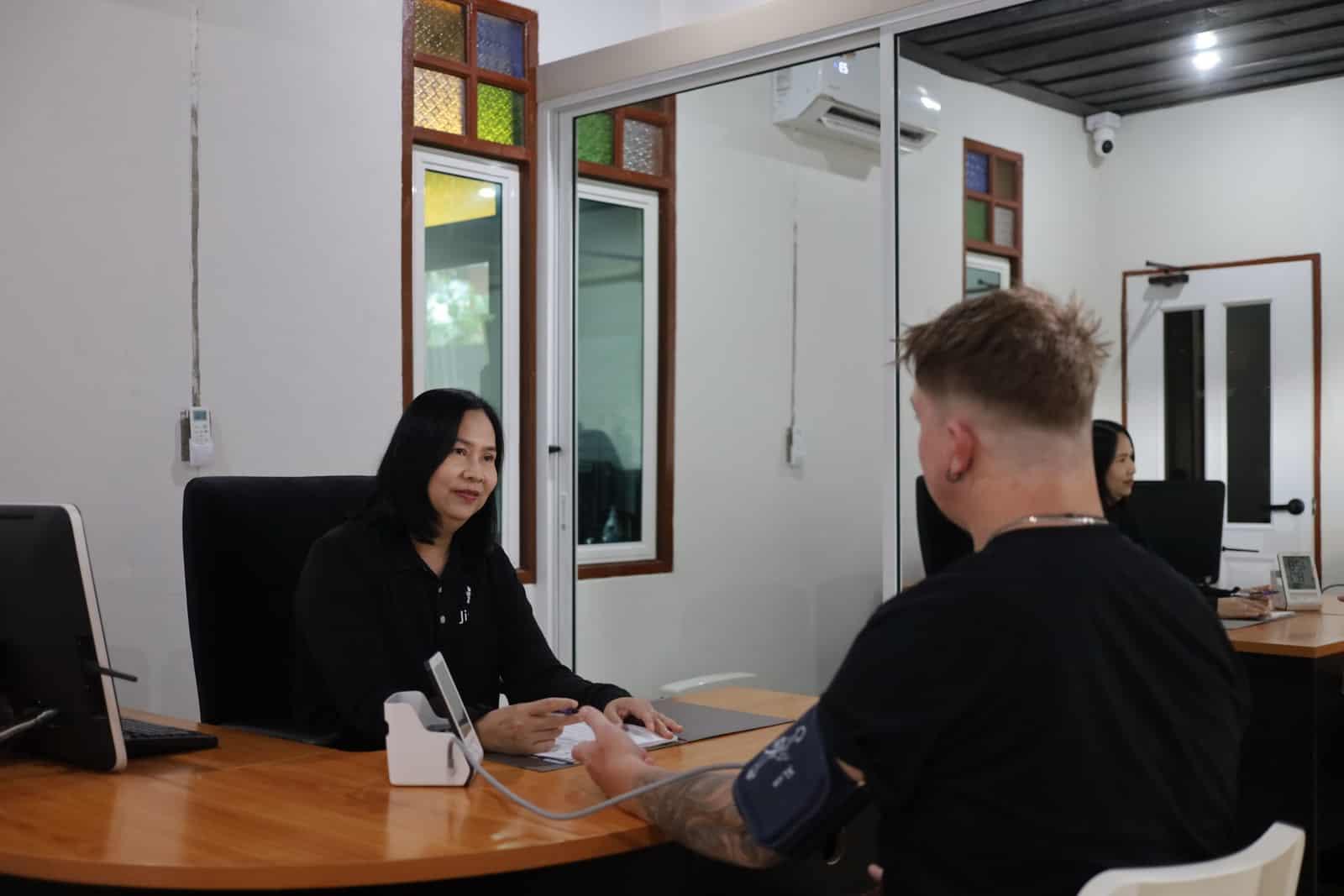
Clinical Governance, Safety and Oversight Framework at Jintara
Jintara is a residential addiction treatment centre in Chiang Mai, Thailand, registered with the Thai Ministry of Public Health as a drug rehabilitation centre (certificate SFT.50.13-11116, issued 8 September 2023) and run by Lanna Health Care Company Limited. Psychiatric oversight runs through our partner hospitals, with 24/7 on-site nursing and a no-compromise hospital escalation pathway. If you have a question about safety before you decide, call or WhatsApp Darren on +66 94 095 4142.
- Registered with the Thai Ministry of Public Health under the Narcotics Act, 8 September 2023
- Psychiatric oversight through Bangkok Hospital Chiang Mai and Chiang Mai Ram Hospital
- 24/7 awake nursing, CIWA-Ar and COWS monitoring on active detox
- Published limits of practice covering who the facility does and does not admit
Fully Licensed and Hospital Accredited
Is Jintara Rehab Licensed by the Thai Ministry of Public Health.
Jintara Rehab is a private, adult-only residential addiction treatment and dual-diagnosis centre operated by Lanna Health Care Company Limited, registered with the Thai Ministry of Public Health as Jintara Wellness Center and Rehab, a drug rehabilitation centre under the Narcotics Act. Registration certificate SFT.50.13-11116 was issued on 8 September 2023. The current Jintara program opened in January 2022.
The registered address is 76 Moo 5, Pa Daet, Mueang Chiang Mai, Chiang Mai, Thailand. Tax ID and legal-entity details are published in the site footer.
Clinical governance claims are straightforward to publish and difficult for a family to verify independently. The hospital-grade accreditation changes that. In May 2026, Jintara Wellness Center and Rehab was assessed against Thailand's national quality standard for drug treatment and rehabilitation facilities and met it, certified jointly by the Healthcare Accreditation Institute, the body that accredits Thailand's hospitals; the Princess Mother National Institute on Drug Abuse Treatment; and the Department of Medical Services, Ministry of Public Health. Certificate no. 25/2569, valid 20 May 2026 to 19 May 2029. Three independent national authorities confirming the same standards documented throughout this page.
How Is Medical and Psychiatric Oversight Structured at Jintara.
Jintara structures psychiatric oversight through addiction-specialist psychiatrists at Bangkok Hospital Chiang Mai and Chiang Mai Ram Hospital rather than holding psychiatrists on staff, keeping oversight independent with no single-physician dependency.
On-site clinical operations are led by Khun Khwan, Head Nurse and Operations Manager, who runs the 24/7 awake nursing rota and co-signs hospital referrals. Jintara holds formal medical care agreements with two partner hospitals in Chiang Mai, dated February 2026 and May 2025 respectively, both compliant with the Thai Personal Data Protection Act (PDPA 2562/2019). The medical-oversight approach follows NIAAA's account of medical detoxification, in which doctors can prescribe medications to address withdrawal symptoms and make the process safer. Some clients see the psychiatrist five, six or seven times across a single program because the plan keeps needing adjustment, and where a review falls on a weekend the team uses clinic pathways so oversight does not pause.
What Clinical Assessment Tools Does Jintara Use During Detox.
Jintara uses five validated clinical instruments at admission and throughout detox to quantify withdrawal severity and mental-health acuity: CIWA-Ar, COWS, PHQ-9, GAD-7, and 8Q. The CIWA-Ar scale, validated by Sullivan et al. in the British Journal of Addiction, remains the standard measure for alcohol withdrawal monitoring.
- CIWA-Ar: Clinical Institute Withdrawal Assessment for Alcohol, Revised. Ten indicators scored 0 to 67. In early alcohol detox the nurses check on each client every one to two hours, through the night.
- COWS: Clinical Opiate Withdrawal Scale. Eleven items scored 0 to 48. Tracks opioid withdrawal through the methadone taper the psychiatrist sets.
- PHQ-9: Patient Health Questionnaire-9. Nine items scored 0 to 27. Measures depression severity at intake, through treatment, and at discharge.
- GAD-7: Generalized Anxiety Disorder-7. Seven items scored 0 to 21. Screens for anxiety disorders alongside primary substance assessment.
- 8Q: Thai-language suicide-risk screening questionnaire used where clinically indicated, with SAMHSA-aligned escalation protocols if any item triggers positive.
What Detox Protocols Does Jintara Follow for Each Substance.
Every detox plan at Jintara is written by the admitting psychiatrist on Day 1, informed by substance history, physical examination, and Day 2 hospital workup at Bangkok Hospital Chiang Mai. SAMHSA TIP 45 residential detox protocols guide individual plan adjustments for polysubstance use, co-occurring conditions, and psychiatric risk factors. Therapy starts alongside detox, not after it: the medical detox program brings therapy in from Day 1.
- Alcohol: Benzodiazepine taper under CIWA-Ar monitoring, Day 2 hospital workup at Bangkok Hospital Chiang Mai, and nursing cadence driven by score thresholds. Clinical framework follows SAMHSA TIP 45.
- Opioid: Methadone taper set by the psychiatrist, with COWS scoring through the acute window. Buprenorphine is not used. Monitoring follows NIDA guidance on medically supervised opioid withdrawal.
- Benzodiazepine: Slow taper, usually around two months, with seizure-risk management and careful cross-tapering when long-acting benzodiazepines are substituted.
- Polysubstance: Individualised assessment on arrival, with the psychiatrist deciding the order of detox. Where alcohol is part of the picture, alcohol comes first.
What Happens When a Client Needs Emergency Hospital Care.
Jintara holds formal hospital care agreements with Bangkok Hospital Chiang Mai (signed February 2026, credit-backed emergency referral) and Chiang Mai Ram Hospital (signed May 2025, two-year term), both governed by the Thai Personal Data Protection Act 2562. SAMHSA TIP 45 identifies documented hospital escalation pathways as a requirement for facilities managing medical withdrawal risk.
When symptoms go beyond what is safe to manage on site, the nursing team follows its emergency protocol and takes the client to a partner hospital straight away, at any hour. The hospital transfer protocol page details each escalation trigger and the process that follows.
Darren Lockie, Jintara's owner, has described the approach in plain terms: “We have a no compromise strategy. If a client complains of headaches or pain, we go immediately to the hospital.”
What Are the Staff Credentials and Nursing Ratios at Jintara.
Jintara maintains approximately 3.2 staff per client, with 32 staff supporting a maximum of ten clients at any time. SAMHSA TIP 45 guidelines for residential detox recommend around-the-clock awake nursing for facilities managing medical withdrawal. At Jintara, nurses check on each client every one to two hours in early detox, day and night, and less often as withdrawal settles.
- Darren Lockie: Owner of Jintara Rehab and Managing Director of Lanna Health Care Company Limited. Working in Thai addiction treatment since 2008, previously at DARA Rehab.
- Denise O'Leary: Treatment Manager and EMDR Therapist. MA Counselling Psychology, EMDRIA-certified, Beck Institute CBT trained. To our knowledge, the only therapist in Thailand with EMDR International Association certification.
- Khun Khwan: Head Nurse and Operations Manager. Focused on substance use treatment since 2017, at Lanna Rehab, DARA Rehab and now Jintara. Co-signs hospital referrals.
- Tong: Fitness and Recovery Coach. BSc Sports Science, Master's in Counselling Psychology in progress, certified fitness instructor. More than ten years in rehab and wellness.
Addiction-specialist psychiatrists are supplied through the partner-hospital relationships and are not listed as in-house staff, which keeps psychiatric oversight independent of any single Jintara employee.

How Does Jintara Handle Informed Consent and Client Confidentiality.
Jintara obtains informed consent on admission covering the program structure, medication plan, Thai PDPA data handling, confidentiality limits, and the right to leave except where clinically contraindicated. Consent at Jintara is revisited whenever the treatment plan materially changes.
Confidentiality is governed by the Thai Personal Data Protection Act 2562 (2019). Family contact during treatment is permitted only with the client's written consent, and third-party disclosures (employers, referrers, legal counsel) are routed through the Treatment Manager. Co-occurring medical and psychiatric conditions are documented at admission and managed jointly with the partner-hospital teams. Where a condition falls outside Jintara's operational scope, referral out is preferred to accepting a poor clinical fit.
Which Clients Does Jintara Refer Out Rather Than Admit.
Transparency about scope is a core part of Jintara's clinical governance. The facility operates within a defined clinical envelope, and admissions will refer when a prospective client's needs fall outside it. NIDA's treatment overview describes several treatment settings, from outpatient counselling to residential programs, so a person can be referred to the setting that fits their needs.
- Clients under 18: Jintara is adult-only. Younger clients are directed to appropriate adolescent services.
- Severe acute psychiatric emergencies: Active psychosis or severe suicidality requiring psychiatric inpatient care is outside scope. Clients are directed to hospital psychiatric services.
- Acute medical conditions requiring hospital-first care: Where a prospective client needs stabilisation in a hospital before any residential program is safe, the admissions team coordinates directly with the partner hospitals.
- Court-mandated supervision: Programs requiring continuous legal supervision or custody conditions are outside operational scope, though case-by-case review is possible for non-custodial referrals.
- Eating disorders as primary diagnosis: Eating disorders are addressed when co-occurring with addiction but not accepted as a standalone primary diagnosis. Clients are referred to specialist services.
- Ibogaine-based treatment: Not offered. Jintara has published clinical reasoning on the cardiac and neurological risks and is not a suitable referral for clients seeking this modality.
- Standalone outpatient detox: Detox at Jintara is residential only, integrated with the therapy program. Clients seeking outpatient-only detox are referred to hospital services.
If you or someone you love is in danger right now, call your local emergency number or go to the nearest hospital emergency department first. We can talk once you are safe.
What Are the Regulatory and Clinical References Behind This Page.
The references below support the clinical claims made throughout this page. Where a source applies to a specific section and an English-language target exists, the inline citation points to the same URL. The Thai Ministry of Public Health entry has no English-language target and is left unlinked. Return to the Jintara homepage for the full site navigation.
- Thai Ministry of Public Health: Drug Addict Rehabilitation Center Registration Certificate under the Narcotics Act. Certificate SFT.50.13-11116, issued 8 September 2023.
- NIAAA: FAQs: Searching for Alcohol Treatment. Medical detoxification as medically managed withdrawal, with medications prescribed to make the process safer.
- NIDA: Research on addiction treatment. Evidence base for integrated medical and psychological addiction treatment.
- SAMHSA TIP 45: Detoxification and Substance Abuse Treatment. Core reference for detox clinical protocols.
- SAMHSA TIP 42: Substance Use Disorder Treatment for People With Co-Occurring Disorders. Framework for dual-diagnosis treatment.
- Sullivan et al., 1989: Assessment of Alcohol Withdrawal. The CIWA-Ar Scale. British Journal of Addiction. Original validation of the CIWA-Ar monitoring tool.
- Thai PDPA 2562 (2019): Personal Data Protection Act governing client data handling, consent, and third-party disclosure.
This page describes the clinical governance framework at Jintara Rehab and is for informational purposes. It is not medical advice. Licensed medical professionals make all clinical decisions on a per-patient basis.

Talk with Our Admissions Team
Your enquiry is confidential and goes only to our admissions team.
Independently Verified
Jintara is accredited against Thailand’s national quality standard for drug treatment and rehabilitation facilities, jointly certified by the Healthcare Accreditation Institute, the body that accredits Thailand’s hospitals, with the Princess Mother National Institute on Drug Abuse Treatment and the Department of Medical Services, Ministry of Public Health. Certificate no. 25/2569, valid 20 May 2026 to 19 May 2029.