

Medical Detox in Thailand Is Safe When the Standards Are Right
Detox safety comes down to awake overnight nursing, fast psychiatric access, and a trusted hospital nearby. How Jintara meets those standards in Thailand.
Written by Darren Lockie | Medically reviewed by Denise O'Leary | Published: June 16, 2026 | Last Updated: October 20, 2026
Medical detox safety depends on the standard of supervision, not the country

Medical detox safety is the combination of clinical monitoring, medication oversight, and escalation readiness that protects a person through the withdrawal process. It is not a marketing phrase. It is a measurable standard defined by staffing levels, documentation practices, hospital access, and how quickly a team can act when symptoms change. A facility either has these systems in place or it does not. Verifying those systems against our published clinical standards is what matters. Geography is largely irrelevant once that is done.
The concern that Thailand cannot match Western medical standards is understandable and common. It is also outdated for Chiang Mai specifically. The private hospital infrastructure in Chiang Mai is well-regarded by international patients, and several facilities in the city operate to standards familiar to clients from the UK, Australia, the US, and Europe. What matters for detox safety is not which country the rehab is in. It is whether the nursing is awake overnight, whether a psychiatrist can be reached quickly, and whether there is a hospital the team trusts and can transfer to if the situation changes.
Chiang Mai's private hospital network supports medical detox at a high standard
Chiang Mai is Thailand's second-largest city and a well-established medical destination for international patients seeking residential rehab in Chiang Mai. Bangkok Hospital Chiang Mai and RAM Hospital are two of the city's most recognised private hospitals, both equipped with specialist departments including psychiatry, cardiology, and emergency medicine. Years of running an on-site medical detox program alongside them built the working relationship. Jintara works with both facilities as formal transfer and assessment partners.
This matters for detox specifically because the two situations where hospital access is most critical are psychiatric assessment and emergency escalation. Psychiatrist-led detox planning requires fast and reliable access to a specialist; Jintara's relationship with both hospitals means that access is available quickly, including on evenings and weekends when a standard hospital appointment may not be possible. When a client needs urgent assessment, the pathway is established and the team does not need to locate or negotiate a relationship under pressure. That relationship already exists and is used regularly. The same familiarity means that when a client arrives at the hospital for an emergency review, the nursing team is not explaining Jintara's clinical model from scratch. The handover is clean and the hospital staff understand the context.
Jintara is licensed by Thailand's Ministry of Public Health and audited every year

Jintara Rehab holds a licence issued by Thailand's Ministry of Public Health. The licence process in Thailand is not a formality. It took nine months to obtain and requires documented clinical policies, staffing standards, facility standards, and ongoing compliance. The Ministry of Public Health conducts annual audits. A full list of Jintara's credentials and licences is published on the site for families to review before enquiring.
This licensing context matters for families comparing Thailand with home-country options. In several Western countries, including Australia, private residential rehabilitation facilities are not subject to mandatory national licensing and audit. A Thai Ministry of Public Health licence is a meaningful credential. Since May 2026, Jintara also holds joint national accreditation from the Healthcare Accreditation Institute, the Princess Mother National Institute on Drug Abuse Treatment, and the Department of Medical Services: three national bodies that certify Thailand's standard for drug treatment and rehabilitation facilities. Jintara is listed on the US Consulate General Chiang Mai health facilities reference. Consular staff maintain that list for citizens who need verified care options abroad, and inclusion is not by application.
"The Ministry of Public Health licence took nine months to get. We welcome the audits. They confirm what we already know about how we run this place." - Darren Lockie, Founder and CEO, Jintara Rehab
The medical team combines registered nursing, psychiatrist oversight, and 24-hour awake cover

Jintara's medical model is built around three elements.
- Registered nursing present and awake overnight
- Psychiatrist access through the hospital partnerships
- Structured shift handovers so no clinical detail is lost between nurses
All nurses are fully registered and were recruited from Bangkok Hospital Chiang Mai or RAM Hospital. The nursing licence for the facility is held by Lertkhwan Sukpia, known as Khun Khwan. Her background in hospital nursing informs the clinical rigour of Jintara's overnight monitoring and medication management.
The psychiatrist is not billed as an add-on. Psychiatric assessment is part of the standard detox process, arranged through the hospital partnerships. During detox, if a client is not stabilising with sleep or symptoms, the psychiatrist review can happen more than once. What this means practically is that the medication plan stays responsive rather than static. In early detox, nurses conduct checks every one to two hours, not just at the start and end of a shift. A nurse awake at 2am who notices rising agitation does not wait until morning. She documents what she sees, acts within the plan, and escalates to the psychiatrist if the presentation requires it.
"Observation is the whole picture, not just numbers. We watch mental state, sleep, mood, and how a client responds to support. That is how we catch problems early." - Lertkhwan Sukpia, Head Nurse, Jintara Rehab
On day two, every client attends a full medical workup at a partner hospital
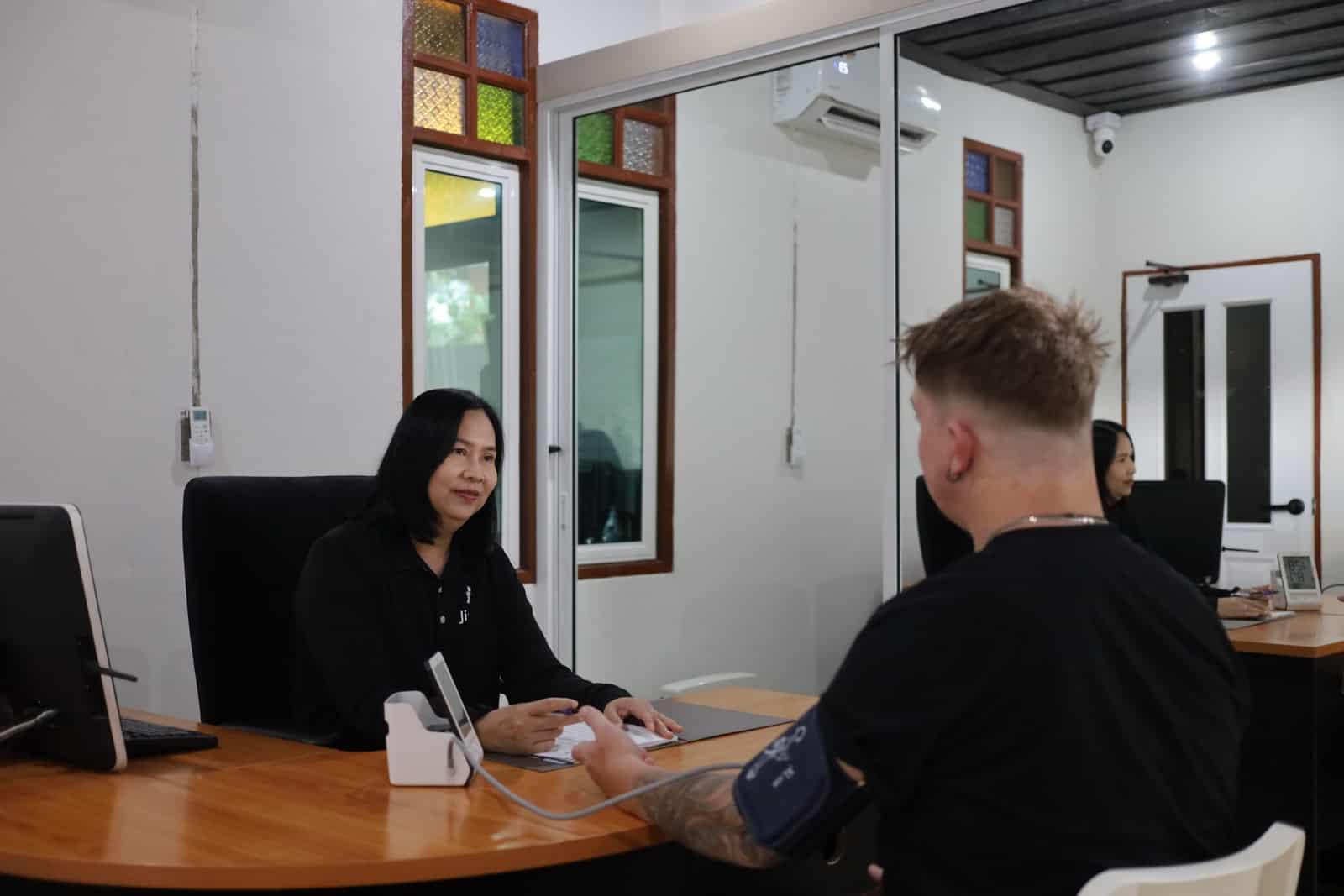
On day two of the program, each client is taken to Bangkok Hospital Chiang Mai for a comprehensive medical assessment at Jintara's expense.
- Full blood spectrum panel
- Liver function tests
- Kidney function tests
- An EKG (electrocardiogram)
- A chest X-ray
This is a baseline safety check that most residential rehabs in Thailand and elsewhere do not conduct as a standard inclusion. The criteria that trigger a hospital transfer follow a separate protocol. The day-two workup is not an emergency measure; it is a scheduled safety baseline for every client.
The reasoning is practical: people who have been using alcohol or other substances heavily often have underlying health issues that have not been assessed. Elevated liver enzymes, cardiac concerns, blood anomalies, and chest issues have all been identified through this day-two process. When something is found, the team coordinates specialist follow-up rather than waiting for symptoms to worsen. When results come back clear, it reduces fear for the client and their family and gives the team a reliable clinical baseline for the rest of the program. The assessment happens early because waiting until day six or seven does not achieve the goal: confirming the client is safe to be in the program and that there are no hidden risks.
When escalation is needed, the pathway is clear and does not wait for office hours

Escalation from the Jintara facility to hospital is treated as responsible clinical care, not as a failure. The nursing team is awake throughout the night specifically because withdrawal does not follow a schedule. When a client's symptoms suggest emergency risk at 2am, the team responds the same way it would during the day.
- A quick decision
- A clear explanation to the client
- Direct transport to Bangkok Hospital Chiang Mai or RAM Hospital for assessment
Families who want to understand the escalation criteria before admission can discuss them through the pre-admission conversation before committing. The team provides clear answers rather than vague reassurances.
The team's philosophy is to act before a situation becomes a crisis. Early detox from alcohol or benzodiazepines in particular can produce sudden escalation, and the nurses are trained to distinguish between uncomfortable but stable and uncomfortable and worsening. Red-flag symptoms, including severe or unusual headaches, abnormal vital sign patterns, and symptoms that do not fit the expected withdrawal picture, are never held overnight on the assumption that things will settle. Jintara's nurses use the CIWA-Ar scale, a validated scoring tool for alcohol withdrawal severity, to guide monitoring frequency and medication decisions throughout detox. Darren Lockie, Founder and CEO, is direct on this point: a rehab that does not have genuine hospital relationships and a clear escalation pathway is not providing safe medical detox. It is providing accommodation during a medical process.
Detox is the first step in treatment, not the whole thing
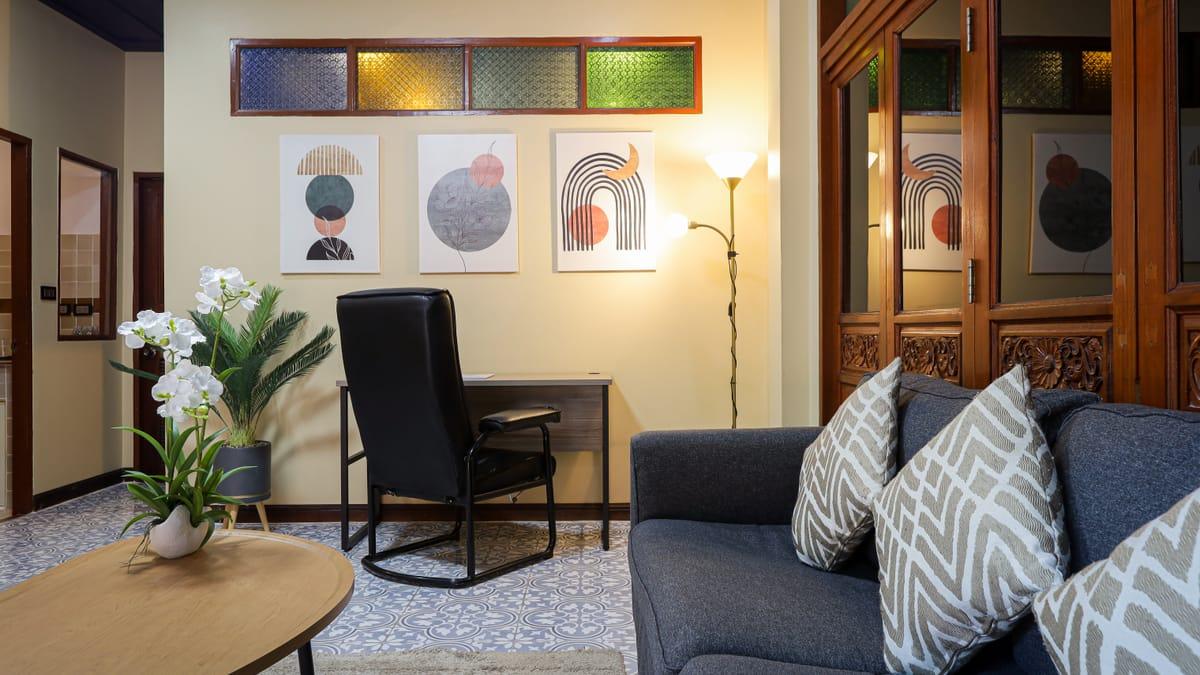
One of the most important safety factors is not clinical at all. It is continuity. Detox that happens separately from therapy, in a different facility, creates a gap where motivation and engagement can collapse. At Jintara, detox and therapy happen in the same place, with the same team observing the client's physical and emotional state from day one. Therapists make contact within the first 24 to 48 hours, not to do deep processing, but to establish a connection, reduce fear, and help the client stay in the program when early withdrawal is at its hardest.
The medical team and the therapy team communicate through daily handovers. What the nurse observes overnight, including sleep quality, agitation, vitals, and medication response, informs what the therapist does in their first session. This coordination reduces the risk that a client receives conflicting signals from different parts of the team. From very early in the stay, recovery planning is already beginning in a quiet, stabilising way. Detox safety is not only about surviving withdrawal. It is about staying engaged long enough for the rest of the program to do its work.
Frequently asked questions
- Is medical detox safe to do in Thailand? Yes, when the facility holds the right licence and has the right systems in place. In Chiang Mai, both Bangkok Hospital Chiang Mai and RAM Hospital provide specialist services including psychiatry to international patients, and the city's private hospital infrastructure is well-established. What matters is whether the rehab has 24-hour awake nursing, psychiatrist access, and a clear escalation pathway to a trusted hospital. Jintara has all three.
- Is Jintara Rehab licensed to run medical detox in Thailand? Yes. Jintara holds a licence issued by Thailand's Ministry of Public Health, which involves a documented application process and annual audits. Since May 2026, the facility also holds joint national accreditation from three national bodies: the Healthcare Accreditation Institute, the Princess Mother National Institute on Drug Abuse Treatment, and the Department of Medical Services (certificate 25/2569, valid May 2026 to May 2029). Jintara is listed in the rehabilitation section of the US Consulate General Chiang Mai health facilities reference. Consular staff maintain the list for citizens who need verified care options in northern Thailand, and inclusion is not by application. The nursing licence for the program is held by Lertkhwan Sukpia, Jintara's head nurse.
- What happens if something goes wrong during detox at night? The nursing team is awake throughout the night, not on call while sleeping. If a client's symptoms suggest emergency risk at any hour, the standard response is direct transport to Bangkok Hospital Chiang Mai or RAM Hospital for assessment. The team does not wait until morning. This is one reason 24-hour awake nursing is a non-negotiable part of how Jintara runs its detox service.
- Does Jintara have a psychiatrist on site? Jintara does not have a psychiatrist resident on site, but the team has an established working relationship with psychiatrists at Bangkok Hospital Chiang Mai and RAM Hospital. Clients see a psychiatrist as part of the detox process. If symptoms are not stabilising with sleep or withdrawal management, the psychiatric review can happen more than once. Access to a psychiatrist is treated as part of standard detox care, not as an optional extra.
- What does the day-two hospital test include? On day two, each client is taken to Bangkok Hospital Chiang Mai for a full blood spectrum panel, liver function tests, kidney function tests, an EKG, and a chest X-ray. This is done at Jintara's expense. The purpose is to confirm there are no underlying health issues that could make detox unsafe and to give the team a reliable clinical baseline for the rest of the stay.
- Is Thailand's Ministry of Public Health licence the same standard as a UK or Australian licence? In some respects the Thai standard is stricter. Australian private residential rehabilitation facilities are not subject to mandatory national licensing. The Thai Ministry of Public Health licence requires documented staffing standards, clinical policies, and facility compliance, and it is subject to annual audit. It is a meaningful accreditation, not a reduced one.
- Where can I find out more about Jintara's medical detox program and what it includes? The full medical detox service is described at Jintara including what is covered in the fee, how the program is structured, and what to expect in the first week. You can also contact the admissions team directly to ask specific questions about your situation or the situation of someone you care about.

Talk with Our Admissions Team
Your enquiry is confidential and goes only to our admissions team.