

Panic disorder and addiction are treatable when they are treated together.
Most people reaching for alcohol or benzodiazepines to stop a panic attack did not set out to become dependent. They found something that worked, at least for a while. Our anxiety and dual diagnosis program treats both conditions from day one, because ending the chemical suppression and understanding why the panic started are two halves of the same job.
- Psychiatric assessment on day two separates panic disorder from withdrawal anxiety
- CBT groups teach you to interrupt the panic cycle without a substance
- Nursing staff awake around the clock, trained to de-escalate a panic attack
- No benzodiazepines prescribed for anxiety management in recovery


Licensed by the Ministry of Public Health.
Accredited under Thailand’s national standard for drug treatment and rehabilitation facilities.
Panic disorder and addiction co-occur far more often than most people realise.
Panic disorder is a clinical condition marked by recurring, unexpected panic attacks. These attacks bring intense physical symptoms: a racing heart, chest tightness, shortness of breath, dizziness, and an overwhelming sense that something is badly wrong. The brain reads those sensations as danger, which produces more fear, which sharpens the symptoms. That self-reinforcing loop is what makes panic disorder so frightening to live with, and so hard to sit through unmedicated.
If you have been drinking to stop that feeling, you are not weak and you are not unusual. According to NIMH's panic disorder statistics, an estimated 2.7% of US adults had panic disorder in the past year. NIMH also notes that panic disorder is commonly associated with alcohol and substance misuse. The reason is not complicated. Panic attacks are terrifying, alcohol slows the nervous system within minutes, and benzodiazepines stop an attack almost completely. When something reliably ends the experience you fear most, the association forms fast and deepens quietly.
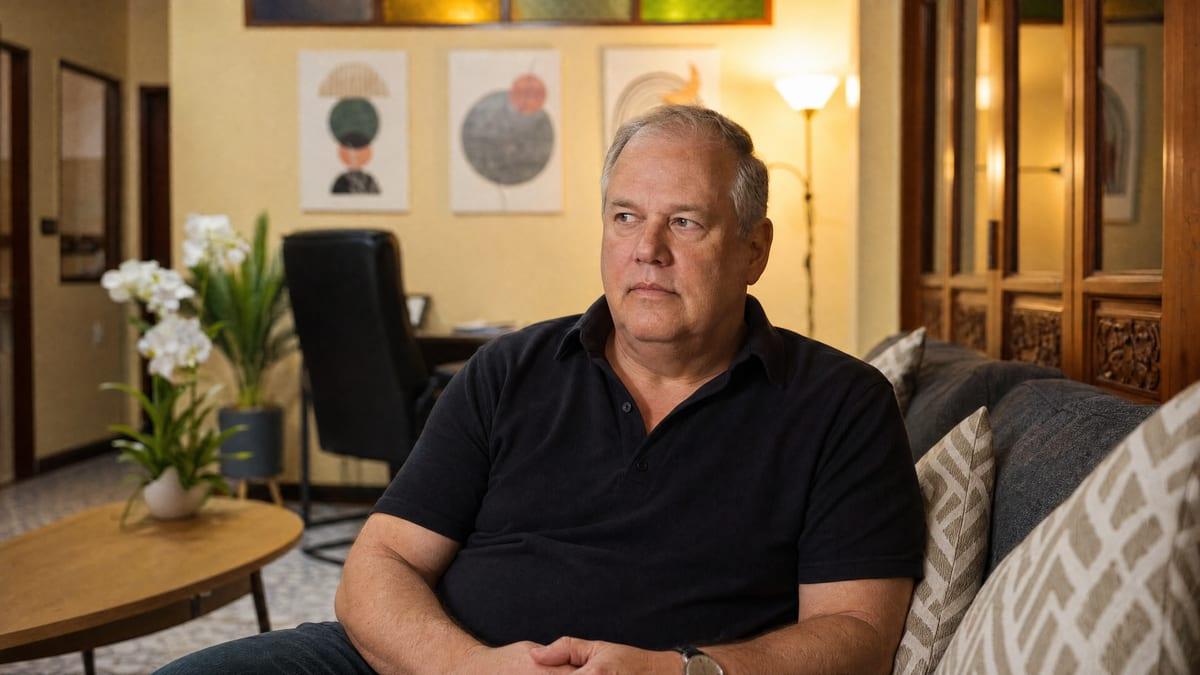
Panic disorder often goes undiagnosed in people who are also using substances.
Panic disorder is frequently invisible during active substance use, which is why it often stays untreated until recovery begins. The person and their doctor focus on the drinking or the tablets, and nobody names the panic underneath. Someone arriving at Jintara with alcohol or benzodiazepine dependence almost always presents with significant anxiety. The open question is whether that anxiety is substance-induced or a pre-existing condition that the substance was managing, badly.
Denise O'Leary, Jintara's Clinical Director, treats this as discovery rather than immediate labelling. The team runs the PHQ-9 for depression and the GAD-7 for anxiety at admission to set a baseline, and the psychiatric assessment process builds on those scores over the following fortnight. After one to two weeks of stabilisation and sobriety they reassess. If the scores fall away sharply, the symptoms were most likely substance-induced; if they hold or climb, that points to an underlying condition needing its own therapeutic track. The staged approach avoids saddling someone with a chronic diagnosis they do not have, while still catching genuine panic disorder.
Alcohol and benzodiazepines suppress panic and accelerate dependence at the same time.
The substances people reach for to stop panic attacks are the same ones that produce the most complex withdrawal syndromes. Alcohol hits peak anxiety-reduction within 30 to 60 minutes, and benzodiazepines work faster still. Both increase GABA activity in the brain, which is exactly what makes them calming. The brain then adapts by producing less GABA of its own and raising excitatory activity to compensate, so when the substance wears off the nervous system rebounds into heightened activation, which frequently triggers the panic it was taken to prevent.
Jintara's clinical team calls this the anxiety-dependence loop, and it closes quickly. Someone takes a drink or a tablet to stop an attack, it works, and they take it again next time. Within weeks their baseline anxiety sits higher than before they started, because the nervous system has recalibrated around the substance being present. At that point they need it not to feel calm but to feel normal, and stopping produces withdrawal anxiety far more intense than the original panic disorder. Treating benzodiazepine dependence alongside an anxiety disorder is a compounded clinical problem, and NIDA's research on co-occurring substance use and mental illness is clear that both have to be addressed at once. Neither condition settles on its own while the other is left in place.

“Getting clean, getting sober, is one thing. Staying clean, staying sober, these are completely different things. When panic disorder is driving the use, we have to treat the panic or the pull back to using never goes away.
Day two diagnostics show whether panic disorder is present or withdrawal is driving it.
On day two of every stay, each client has a full medical workup at the clinic: bloods, liver and kidney function, chest X-ray, and an EKG. That rules out cardiac causes of chest pain and a racing heart, which are among the most distressing symptoms shared by panic attacks and alcohol withdrawal. For someone with panic disorder, knowing the heart is sound removes one of the fears that feeds anticipatory anxiety before the therapy has even started.
The psychiatric assessment follows. The psychiatrist reviews the history, the substances used, the timeline of panic symptoms, and any previous diagnoses. Withdrawal-related anxiety is temporary and resolves as detox progresses, whereas true panic disorder has a distinct cognitive behavioural therapy pathway and needs specific clinical intervention. The distinction is not academic. It decides the shape of the entire therapeutic plan for the stay, and the table below sets out the pattern the team is reading against.
Withdrawal Anxiety and Panic Disorder Side by Side
| Withdrawal anxiety | Panic disorder | |
|---|---|---|
| Onset | Within hours of the last drink or dose | Predates the substance use, often by years |
| Peak | First 72 hours | No fixed peak, attacks arrive unexpectedly |
| Direction | Eases week by week as the body clears | Holds steady or worsens after early sobriety |
| Trigger | Falling blood levels of the substance | Physical sensations read as danger |
| Two-week retest | GAD-7 score drops markedly | GAD-7 score stays elevated |
Onset
Withdrawal anxiety: Within hours of the last drink or dose
Panic disorder: Predates the substance use, often by years
Peak
Withdrawal anxiety: First 72 hours
Panic disorder: No fixed peak, attacks arrive unexpectedly
Direction
Withdrawal anxiety: Eases week by week as the body clears
Panic disorder: Holds steady or worsens after early sobriety
Trigger
Withdrawal anxiety: Falling blood levels of the substance
Panic disorder: Physical sensations read as danger
Two-week retest
Withdrawal anxiety: GAD-7 score drops markedly
Panic disorder: GAD-7 score stays elevated
CBT is the primary therapy for panic disorder at Jintara.
Cognitive Behavioural Therapy is the most studied and most consistently effective non-medication treatment for panic disorder. It works by helping people identify the automatic thoughts that amplify panic, challenge the catastrophic reading they have learned to attach to physical sensations, and build a different relationship with the bodily experiences that previously triggered avoidance or use. CBT groups run through the week at Jintara and matter to every client managing anxiety, not only those carrying a formal panic disorder diagnosis.
The model taught is deliberately plain. It is the ABC model that Denise O'Leary teaches, tracing an Activating event through the Belief attached to it to the Consequences that follow. For someone with panic disorder the activating event might be a slightly raised heartbeat after climbing stairs, the automatic belief is that a heart attack is starting, and the consequence is a full attack. CBT teaches you to interrupt that chain before it escalates. People leave with it as a usable mental tool rather than a worksheet destined for a drawer, and the goal throughout is skill acquisition, not dependence on a technique.
Movement and routine are adapted so they do not trigger panic sensations.
People with panic disorder often develop a strong fear of the physical sensations that resemble an attack: a fast heartbeat, breathlessness, lightheadedness. That means not all exercise is appropriate in early recovery. Jintara's fitness team works from clinical notes and nursing input to avoid anything that might set those sensations off, so high-intensity cardio that spikes the heart rate is generally kept back for clients with anxiety or panic presentations. Weight training, golf at the driving range, and other concentration-based activities take its place, giving real physical effort and focus without the cardiovascular spike that can mimic the opening seconds of an attack.
Beyond exercise, the shape of the day is itself part of the treatment. For a nervous system stuck in panic mode, predictability is therapeutic. Meals at consistent times, groups with consistent facilitation, a 10 PM curfew and nursing staff present around the clock combine into an environment where the body can start to recalibrate, and the psychiatrist overseeing medical detox reviews medication and presentation each week as stabilisation progresses. Most clients with panic disorder notice sleep settling in the first fortnight, often well before they feel any psychological improvement. Physical stabilisation arrives first and the psychological shift follows it.
Trauma-linked panic disorder needs a longer treatment runway.
For some people panic disorder has a clear trauma origin: a frightening medical event, a stretch of extreme stress, or repeated experiences of not being safe. Where that is the case, EMDR therapy may form part of the longer-term plan. It is not a standard component of every 30-day stay at Jintara. It is a specialist clinical decision, introduced in the second month for clients who have been assessed as ready, who have reached physical and psychological stabilisation, and who have a trauma history that genuinely warrants processing.
On a 30-day program the focus in trauma-linked panic disorder is preparation rather than processing. That means stabilising the nervous system, teaching grounding and regulation skills, and identifying the trauma history so the work can continue at home. Denise writes a detailed handoff report at discharge covering the memories identified, the tools learned, and exactly how far preparation reached, so a continuity-of-care therapist can pick the thread up without the client retelling their history from the beginning. The work does not end at discharge. The 30 days are the foundation, not the finish.
Benzodiazepine dependence with panic disorder requires a supervised medical taper.
If someone arrives having used benzodiazepines to manage panic attacks, the detox needs particular care. Benzodiazepine withdrawal cannot be managed by stopping abruptly, because the brain has come to depend on the external GABA suppression those drugs provide, and abrupt cessation carries a genuine risk of seizures (SAMHSA's TIP 45 chapter on physical detoxification). A gradual clinical taper run by Jintara's medical team and monitored daily by nursing staff is the only safe route through. Taper length depends on the dose, the specific benzodiazepine, and how the person is presenting.
Once the taper reaches zero, rebound anxiety is expected and normal. The nervous system, no longer receiving chemical suppression, temporarily overshoots into a level of anxiety that can feel worse than the original panic disorder. The nursing team prepares people for this in advance, because the rebound is a known and manageable phase rather than a sign of failure. At Jintara that phase is planned as lasting around three weeks. Knowing that in advance is what stops someone reading the rebound as proof they cannot cope without medication. They can. The rebound passes, and the CBT skills learned during the stay are what carry them across it.

Talk with Our Admissions Team
Your enquiry is confidential and goes only to our admissions team.
Common Questions About Panic Disorder and Addiction Treatment
What is the difference between a panic attack and a heart attack?
The physical symptoms overlap heavily: chest pain, racing heart, shortness of breath, and a sense that something is seriously wrong. The key difference is that a panic attack resolves within minutes and leaves no cardiac damage. On day two every client receives an EKG and full bloods at the clinic. Once cardiac causes are ruled out, most people find the fear of the next attack loosens its grip. Knowing it is panic and not your heart is itself part of the treatment.
Can I recover from panic disorder and addiction at the same time?
Yes, and treating them together works better than treating them in sequence. Addressing the addiction while leaving the panic disorder in place leaves a powerful driver for relapse untouched. Addressing the panic disorder while the substance is still suppressing it means assessing a moving target. Jintara's integrated model treats both from the first week using psychiatric assessment, CBT groups, and a stable residential structure.
Will I be given medication for panic disorder at Jintara?
The treating psychiatrist reviews your medication needs based on your history, your presentation, and what is clinically safe during detox. Jintara does not prescribe benzodiazepines for anxiety management in recovery. Any medication decision is made by the psychiatrist during your stay rather than promised in advance, and the admissions team can talk through your current prescriptions before you travel.
What happens if I have a panic attack during my stay?
Nursing staff are awake around the clock and trained to de-escalate panic attacks, so you will not be left alone with one. Denise uses a structured technique that typically brings an attack under control within about 15 minutes, and staff work through it alongside you. Over time, having a panic attack in a safe place and coming out the other side is itself part of the recovery.
How do I know if my anxiety is panic disorder or alcohol withdrawal?
This is one of the central questions the assessment process is built to answer. Withdrawal anxiety typically peaks in the first 72 hours and eases progressively across one to two weeks as the body stabilises. Panic disorder runs a different course, often worsening after early sobriety or holding at an elevated baseline well after withdrawal symptoms have resolved. The PHQ-9 and GAD-7 are administered at admission and repeated after two weeks to show which pattern you are dealing with.
Is panic disorder treated in groups or only in individual sessions?
Both. CBT groups address the thinking patterns that drive panic and are structured so you are never required to share personal detail before you are ready. Individual sessions with Denise cover your specific history, your triggers, and your skill development. Group and individual work complement each other and neither replaces the other.
How long does panic disorder take to improve after stopping alcohol or benzodiazepines?
There is no single answer, because some anxiety in early recovery is substance-induced and clears within two to four weeks, while genuine panic disorder needs ongoing therapeutic work beyond detox. What a 30-day program reliably delivers is stabilisation, skill acquisition, and a much clearer picture of what you are actually dealing with. Most clients see meaningful improvement in both sleep and anxiety within the first fortnight.
Jintara is a small adult residential treatment center in Chiang Mai with a 3.2:1 staff-to-client ratio. Panic disorder and addiction are treated as co-occurring conditions, not separate clinical tracks.
Jintara Rehab is licensed by the Thai Ministry of Public Health as a rehabilitation centre. The clinical information on this page describes Jintara's general approach to supporting clients during the early recovery period. Medical decisions, including medication protocols, are determined by addiction-specialist psychiatrists through our partner hospital pathway. Individual treatment varies based on clinical assessment. This content is for informational purposes and does not constitute medical advice.