

FIFO Workers Rehab That Fits a Roster
A four week swing gives you 28 clear days. The residential program at Jintara runs for 30. That two day gap is the real reason most FIFO workers never start, and it is the easiest part of this to solve.
- A 30 day residential program with a maximum of 10 clients and 32 staff
- Medical detox on site, which matters if you drink through every swing home
- Aftercare runs on Zoom, so a rotation does not break it
- Your treatment record stays in Thailand and your company is told nothing


Fully Licensed and Hospital Accredited
Most FIFO workers who look into treatment do the arithmetic once, decide the numbers do not work, and never look again. The numbers are closer than they seem, and the gap is measured in days rather than weeks.

A Four Week Swing Does Not Contain a Thirty Day Program.
Most Australian FIFO rosters give you a block of clear days at home. An even time roster of two weeks on and two weeks off gives you 14. A four and one gives you seven. An eight and six gives you six. The longest clear window most workers get in one piece is four weeks, and four weeks is 28 days.
The residential program at Jintara runs for 30 days. It is 30 because that is what the clinical phases need, not because it fits a booking calendar. The 28 day figure came from an insurance billing cycle in the 1980s rather than from any evidence about what works, which is why 28 days is often not enough for most people, and a rostered worker is no exception. Jintara does not run a 28 day version and will not compress the program to fit a swing.
So the arithmetic is real. A swing window alone does not cover the program. It covers 28 of the 30 days, and you need two more. Travel sits outside the 30 days as well, so allow a day at each end and the true requirement is closer to 32.
Almost nobody publishes that number, which is why the question keeps getting answered badly. A facility that tells a FIFO worker his roster block is enough is either running a shorter program or has not done the arithmetic. There are three ways people find the extra days, and none of them requires telling your employer why you want them.
Work your own roster down this table. The leave figure is what you actually have to ask for: 30 program days minus the clear days your roster already gives you, plus one travel day at each end. Admission dates are set with you, so the start date can be moved to the first day of your break rather than the other way round.
How Much Leave Each Roster Needs
| Roster | Clear days | Leave to ask for | How people usually get them |
|---|---|---|---|
| Two and two | 14 | 18 | Annual leave, or unpaid leave stacked on the back of the swing. The most common combination on an even time roster. |
| Four and one | 7 | 25 | Long service or unpaid leave. Annual leave alone rarely covers a gap this size. |
| Eight and six | 6 | 26 | Long service or unpaid leave, same position as a four and one. Some workers swap to a longer break first. |
| Four week swing or shutdown | 28 | 4 | Two to four days of annual leave at either end. The least disruptive route and the one most workers land on. |
Two and two
Clear days: 14
Leave to ask for: 18
How people usually get them: Annual leave, or unpaid leave stacked on the back of the swing. The most common combination on an even time roster.
Four and one
Clear days: 7
Leave to ask for: 25
How people usually get them: Long service or unpaid leave. Annual leave alone rarely covers a gap this size.
Eight and six
Clear days: 6
Leave to ask for: 26
How people usually get them: Long service or unpaid leave, same position as a four and one. Some workers swap to a longer break first.
Four week swing or shutdown
Clear days: 28
Leave to ask for: 4
How people usually get them: Two to four days of annual leave at either end. The least disruptive route and the one most workers land on.
Two Weeks Dry on Site Is Enforced, Not Chosen.
The strongest argument a FIFO worker makes against having a problem is the two weeks he just spent on site without a drink. It feels like evidence. It is not, because the camp is dry and the choice was made for him. It is the same reasoning that lets a high functioning drinker hold the line for years, and it holds right up until it does not.
Australian research measures the pattern directly. A study of 216 FIFO workers in the mining industry, published in the International Archives of Occupational and Environmental Health, found 86.1 percent drank alcohol and that they drank at risky levels far more often on off shift days than on shift days, 57.9 percent against 34.3 percent. A separate survey of 768 FIFO workers found 74.7 percent drank on more than two days a week, and that one in five men drank at levels the study classed as harmful in the short term. A third Australian study, which had workers and their partners fill in daily diaries across both halves of the cycle, found the same shape: less alcohol on site, more at home.
Compression is the part that does the damage. A month of drinking does not disappear when it is packed into the weeks at home. It concentrates. Tolerance also falls across the dry fortnight on site, so the first nights back carry more risk than the same drinks would have carried a fortnight earlier. Then the roster resets the clock, and the two clear weeks read, again, as proof that nothing is wrong.
The people around you see different halves of it. Your partner sees the week off, which is the drinking half. Your supervisor sees the week on, which is the sober half. Nobody except you sees the whole cycle, and the cycle is the only unit that means anything.
Flying to Site in Withdrawal Is the Risk Nobody Counts.
If you drink heavily through a week off and fly out on the Monday, the first two days on site are withdrawal days. That is a medical event happening in a safety critical workplace, and it is the reason the first week at Jintara is built around medical cover rather than orientation. It is also the part of the FIFO drinking pattern that gets discussed least.
Alcohol withdrawal is not only shaking hands and a bad head. In people who drink daily and heavily it can escalate into delirium tremens, which MedlinePlus describes as a severe form of alcohol withdrawal involving sudden and severe changes to the mind and nervous system. MedlinePlus also records that it occurs most often in people who have a history of alcohol withdrawal, which is the position a worker is in after months of stopping every time he flies out. The symptoms that arrive first, tremor, sweating, broken sleep and trouble holding attention, are the symptoms least compatible with operating heavy plant, driving a haul truck or working at height.
The timing is the part worth sitting with. MedlinePlus puts the onset of delirium tremens most often at 48 to 96 hours after the last drink. If the last drink is Sunday night and you fly out Monday, that window falls on Tuesday to Thursday, which is the middle of your first working block and the furthest point from a hospital you will be all month. Workers manage it in the ways you would expect. They taper across the Sunday, they drink at the airport, or they push through the first days on coffee and call it a bad flu.
This is also the clinical reason not to attempt a self managed detox in the week before you fly to treatment. Detox at Jintara happens under medical supervision with 24 hour nursing rather than in a hotel room in Perth on a Sunday night.
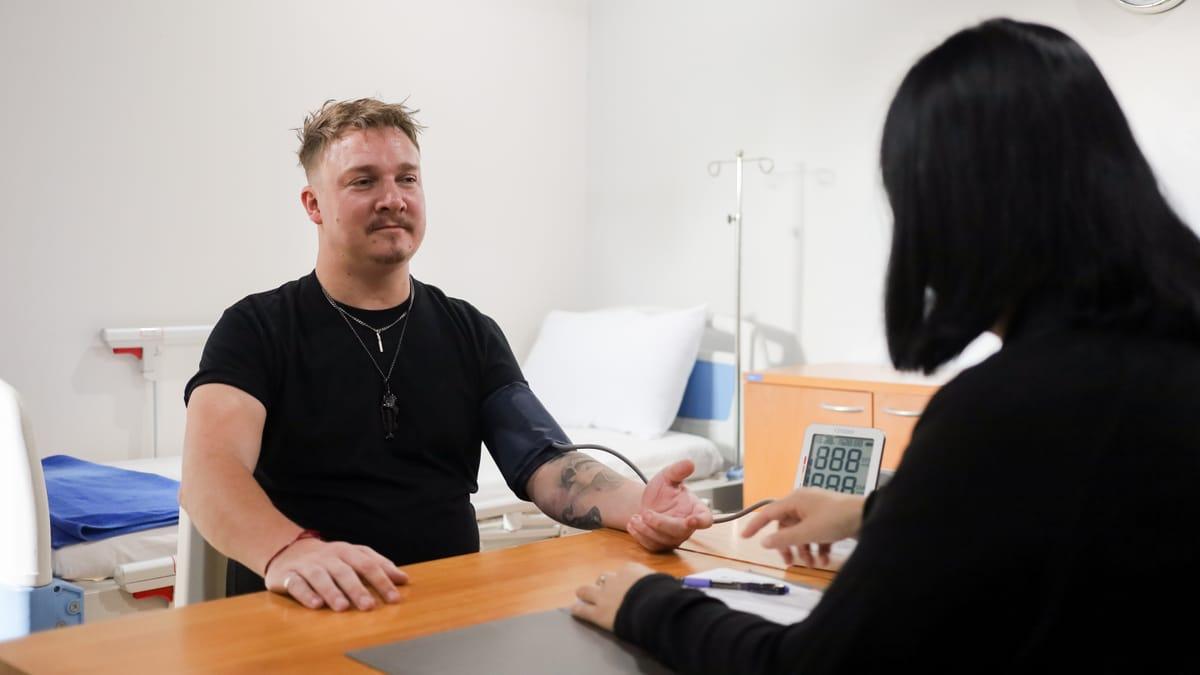
The Mental Health Half of the Roster.
Alcohol is usually the visible half. The other half is a mental health picture, and Jintara treats addiction and mental health conditions together rather than one after the other. In the same study of 216 Australian FIFO workers, 33.4 percent reported high levels of psychological distress, and working long shifts was one of the strongest things associated with it.
The drivers are structural rather than personal. You are away from the people who would notice you were struggling. Sleep is shorter and worse on site, which the same study measured at 6.3 hours against 7.5 hours at home. Decisions at home get made without you and then reported to you. Return home and the household has a routine that ran fine for two weeks and now has to move to accommodate you. Camp life leaves very little to do with an evening except drink or scroll.
Drinking sits on top of that as the available treatment, and it works for about two hours. Treating one half without the other is the reason people come back from a program and relapse inside a swing. For a rostered worker, treating both usually means the depression, the anxiety or the sleep problem is addressed in the same 30 days as the drinking.
If trauma is part of the picture, and in this workforce it often is after a fatality, a serious injury or a rescue on site, that is a longer piece of work. Trauma processing at Jintara requires a minimum stay of 60 days, because EMDR is not started until you are medically stable. That is a real constraint and it is better known before you book than after.
A Failed Test Is Usually the Trigger, Not the Problem.
Most FIFO workers who look at treatment do it in one of two weeks: the week after a random test came back positive, or the week after a partner said something final. The test is not the problem. It is the first time the problem became visible to someone with authority.
That matters for timing. A worker who acts before a test forces the issue keeps control of the sequence, including what he tells his employer and when. He books his leave, completes treatment and returns with his record intact. A worker who acts afterwards is negotiating from a much weaker position, sometimes from a site ban, and a ban can close several employers at once because contractor networks in Australian mining overlap heavily.
Fitness for duty is the other reason to move early. A worker who has been through supervised detox and 30 days of residential treatment, with a discharge plan and a clinician he can name, is in a far better position at a return to work conversation than a worker with a positive test and no plan. The document that helps you is a treatment record, and you cannot produce one retrospectively.
Jintara does not report to workplaces and does not contact an employer without your written consent. What you say, and when, is your decision alone.
How FIFO Workers Assemble Thirty Clear Days.
Most FIFO workers reach 30 clear days by one of three practical routes, and often by a combination of them.
- Swing plus a short block of leave: A four week window covers 28 days. Two to four days of annual leave, added at either end, closes the gap and covers travel. Fly out on the Saturday your swing ends, admit on the Sunday, complete 30 days, fly home on day 31, and you are back for the start of the next swing having used four days of leave.
- Swing plus unpaid or long service leave: Where the roster gives a shorter block, workers extend it with unpaid leave or, after seven to ten years with one employer, long service leave. Both are ordinary requests, both are commonly approved with medical documentation, and neither requires you to state a diagnosis.
- Extend past 30 days: Jintara treats 30 days as a foundation rather than a finish line, and extension runs week by week. Jintara does not take payment for more than four weeks at a time, so the decision to stay longer is made on clinical grounds rather than because the money is already spent. If trauma work is part of your treatment, the minimum stay is 60 days.
The program fee is USD 12,500 for 30 days, funded personally, through family, or through early release of superannuation on compassionate grounds. Admission dates are set with you rather than fixed to intake weeks, so the start date can be lined up with the first day of your break.
Getting From Your Home Base to Chiang Mai.
Direct flights to Bangkok leave daily from Perth, Brisbane, Melbourne and Sydney, with a domestic connection on to Chiang Mai. Total travel time from the east coast is around 10 to 12 hours. Chiang Mai is nine hours from Sydney by flight time and sits close enough to Perth in time zone terms that calls home land at reasonable hours for a Western Australian family.
A private transfer from Chiang Mai International Airport is included in the program fee, so nobody is finding their own way from the airport on day one. The routes out of Perth and the east coast, the entry stamp and what to pack for a 30-day stay are set out step by step, and the wider practical ground for Australians travelling to Thailand for treatment sits on the parent page.
One scheduling note is specific to FIFO. Book the flights after the admission date is confirmed, not before. Roster changes and shutdown work move dates at short notice, and an admission date set with the clinical team is easier to move than a booked international fare.
What Your Employer Has to Be Told.
Very little, and in most cases nothing about the reason.
Jintara provides a letter confirming residential treatment at an overseas medical facility with admission and discharge dates. It does not name a diagnosis, a substance or the type of treatment, and Australian privacy law does not give an employer a right to more than that. The leave categories, the legal protections and the reintegration plan for returning to work after treatment are set out in full elsewhere, so there is no point restating them here.
Three points are specific to FIFO. Your medical record stays in Thailand and is not accessible to the Australian health system, which matters more in an industry with pre employment and periodic medicals. A planned absence that lines up with a roster block attracts far less attention than a run of sick days scattered across three swings. And because rosters are published weeks ahead, a FIFO worker generally has more notice to arrange leave quietly than an office worker does.
Aftercare Built for a Rotation, Not a Working Week.
Most aftercare is designed around someone who is home every night and free on Tuesdays. A FIFO worker is unreachable for a fortnight, then has a week with no structure at all, which is the highest risk pattern either half of the cycle produces.
Jintara aftercare runs on that assumption. There is a welfare contact within 24 hours of you landing home, and the aftercare plan itself is written with your therapist before you fly. There is a one hour structured call with your own therapist at 28 days, reviewing that plan and checking whether local referrals were followed through. The SMART format group sessions run free on Zoom with the same clinical team, so they reach a camp room as easily as a lounge room, and a camp room is private in a way a suburban living room often is not. Outcome check ins follow at three and twelve months.
The part worth planning before you leave Thailand is the first swing home. The first week off after treatment is the week the whole cycle has trained you to spend drinking, and it arrives roughly two weeks after discharge. Decide what that week contains while you are still in Thailand with a therapist in the room, not on the flight back. For a FIFO worker it is the single highest value hour of the discharge week.


Talk with Our Admissions Team
Your enquiry is confidential and goes only to our admissions team.
Common Questions About Rehab on a FIFO Roster
Can I do rehab in Thailand inside a four week swing?
Not the full program. A four week swing gives you 28 clear days and the residential program at Jintara runs for 30, plus a day of travel at each end. Most FIFO workers close the gap with two to four days of annual leave. Jintara does not run a shortened version to fit a roster.
Do I have to tell my employer I am going to rehab?
No. Jintara provides a letter confirming residential treatment at an overseas medical facility with dates only and no diagnosis. Jintara does not contact workplaces without your written consent. The detail on leave types and legal protection sits on the returning to work page.
Will treatment in Thailand show up on my Australian medical record?
No. Your treatment record stays in Thailand and is not accessible to the Australian healthcare system, including pre employment and periodic site medicals.
I only drink on my week off. Is that a problem?
It can be. Australian research on FIFO workers finds risky drinking is far more common on off shift days than on shift days, 57.9 percent against 34.3 percent in one study of 216 workers. A dry fortnight on site is enforced by the camp rather than chosen, so it is not evidence of control. What matters is the total across the cycle, the pattern, and what happens when you try to stop.
What if I fail a random test before I get to treatment?
Treatment is still available and the sequence still works, but you have less control over it. Acting before a test forces the issue keeps the decision, the timing and the disclosure in your hands, and it gives you a treatment record to bring to a fitness for duty conversation.
Can I detox at home in the week before I fly?
That is the option to avoid. Unsupervised alcohol withdrawal can escalate to delirium tremens, which MedlinePlus records as most often starting 48 to 96 hours after the last drink, and it carries seizure risk in heavy daily drinkers. Detox at Jintara is medically supervised with 24 hour nursing from day one.
What does the 30 day program cost and can superannuation pay for it?
The program fee is USD 12,500 for 30 days. Some Australians fund treatment through early release of superannuation on compassionate grounds, which has its own page setting out the criteria and the process.
How does aftercare work when I am back on a roster?
It runs remotely. A welfare contact within 24 hours of arriving home, a one hour therapist call at 28 days, free SMART format Zoom groups with the same clinical team, and outcome check ins at three and twelve months. The groups reach a camp room as easily as a lounge room.
Jintara is a small adult residential rehab in Chiang Mai. This page describes general leave and disclosure practice in Australia and is not legal advice. Speak with a Fair Work adviser or an employment lawyer about your own situation.
Jintara Rehab is licensed by the Thai Ministry of Public Health as a rehabilitation centre. The clinical information on this page describes Jintara's general approach to supporting clients during the early recovery period. Medical decisions, including medication protocols, are determined by addiction-specialist psychiatrists through our partner hospital pathway. Individual treatment varies based on clinical assessment. This content is for informational purposes and does not constitute medical advice.