

What Our Medical Standards Actually Mean During Detox
Medical care during detox is not a tagline. It is the set of protocols that decides what happens at three in the morning when someone is not coping. The people behind those protocols are introduced across the about section, and this page sets out what actually happens during detox at Jintara. Nothing here is aspirational.
- Psychiatric assessment included from arrival, never billed as an extra
- Nurses awake overnight, checking every one to two hours in early detox
- Day 2 hospital workup at Bangkok Hospital Chiang Mai or RAM Hospital, covered by Jintara
- Hospital transfer the moment a risk signal appears, including at two in the morning

Fully Licensed and Hospital Accredited
Medical Supervision Here Is a Written Standard, Not a Slogan
Medical supervision in detox is the monitoring, medication oversight and escalation that keeps someone safe.
The question underneath this page is nearly always the same one, and it is not really about credentials. It is whether the person you love will actually be safe when the hardest part of it arrives. Jintara answers that by writing the standards down, so that our written commitments on client rights govern how every shift runs rather than how any one person happens to feel that night. Alcohol, benzodiazepine and opioid withdrawal can each turn medically dangerous, and the gap between catching a complication early and finding it late is a practised system rather than good intentions.
Detox is treated here as a medical event, not a resting period. From the moment someone arrives, nursing assessment is active, withdrawal risk is scored, and a psychiatrist-led care plan is already underway. The clinical reasoning behind that approach is set out in the NIAAA Core Resource on Alcohol, which frames withdrawal management as active medical care rather than observation. These standards apply to every client in the program, whatever the substance and whatever the history.
Arrival Assessment Builds the Care Plan in the First Hours
The first hours at Jintara go into building a clinical baseline, because nothing that follows is safe without one. Done on arrival:
- An alcohol breath test.
- A urine drug screen.
- A structured withdrawal screen.
The combination of substances and the timing of last use shape both the medication plan and the level of monitoring assigned. Most people arriving have not told anyone the full picture, and that is ordinary rather than a failure. Undisclosed substances change withdrawal risk, so the assessment is built to find what was not said without turning it into an interrogation. Any arriving prescriptions, including benzodiazepines and sleep medications, are reviewed by the clinical team under the psychiatric plan rather than left with the client to take freely. High-risk presentations, meaning abnormal vital signs, high withdrawal scores, or a picture that does not match the disclosed history, move straight to tighter observation. The Clinical Institute Withdrawal Assessment for Alcohol, Revised (CIWA-Ar) is the scoring tool used for alcohol withdrawal. It is not a Jintara invention, and the scale was validated in the British Journal of Addiction in 1989 and has been standard clinical practice since. COWS, the Clinical Opiate Withdrawal Scale, does the same job for opioid withdrawal. The score sets the check frequency, and the table below shows how that works in practice.
The CIWA-Ar score is not recorded for its own sake. It sets how often a nurse comes to the bedside, and it is recalculated at every check rather than fixed on arrival, so monitoring tightens or eases as the withdrawal actually moves.
How the CIWA-Ar Score Sets Nursing Check Frequency
| CIWA-Ar score | Nursing check frequency | What that level means |
|---|---|---|
| Above 14 | Every 1 to 2 hours | Severe withdrawal, tightest observation and medication review |
| 8 to 14 | Every 4 to 6 hours | Moderate withdrawal, actively managed and reassessed |
| Below 8 | Every 8 to 12 hours | Stabilising, tapering toward once-daily checks |
Above 14
Nursing check frequency: Every 1 to 2 hours
What that level means: Severe withdrawal, tightest observation and medication review
8 to 14
Nursing check frequency: Every 4 to 6 hours
What that level means: Moderate withdrawal, actively managed and reassessed
Below 8
Nursing check frequency: Every 8 to 12 hours
What that level means: Stabilising, tapering toward once-daily checks
A Day 2 Hospital Workup Finds What Nobody Told Us
On day 2, every client well enough to travel attends a full diagnostic assessment at Bangkok Hospital Chiang Mai or RAM Hospital, Jintara's two confirmed partner hospitals in Chiang Mai. It covers:
- A full blood spectrum.
- Liver function tests.
- Kidney function tests.
- An electrocardiogram.
- A chest X-ray.
Jintara covers the cost of that workup as part of the program. Families often ask why the testing happens so early, when the person has barely arrived. The results change the plan, and getting the plan right on day 2 is worth considerably more than correcting it on day 5. Liver and kidney function determine how medications are dosed and tapered, which is why the day 2 diagnostic workup sits before the hardest part of withdrawal rather than after it. The federal detoxification protocol in SAMHSA TIP 45 treats that baseline as a precondition of safe withdrawal management rather than an optional extra. Cardiac findings require specialist follow-up before certain activities begin, and blood anomalies can reflect nutritional deficits or the residual effects of heavy substance use. The team has identified cardiac issues, blood irregularities and chest complications through this pathway, in clients who had no idea they had them. That is the honest reason the workup exists. A person cannot be kept safe in a detox setting by a team working without a clinical baseline.
Awake Nursing Overnight Is What Makes Detox Safe After Dark
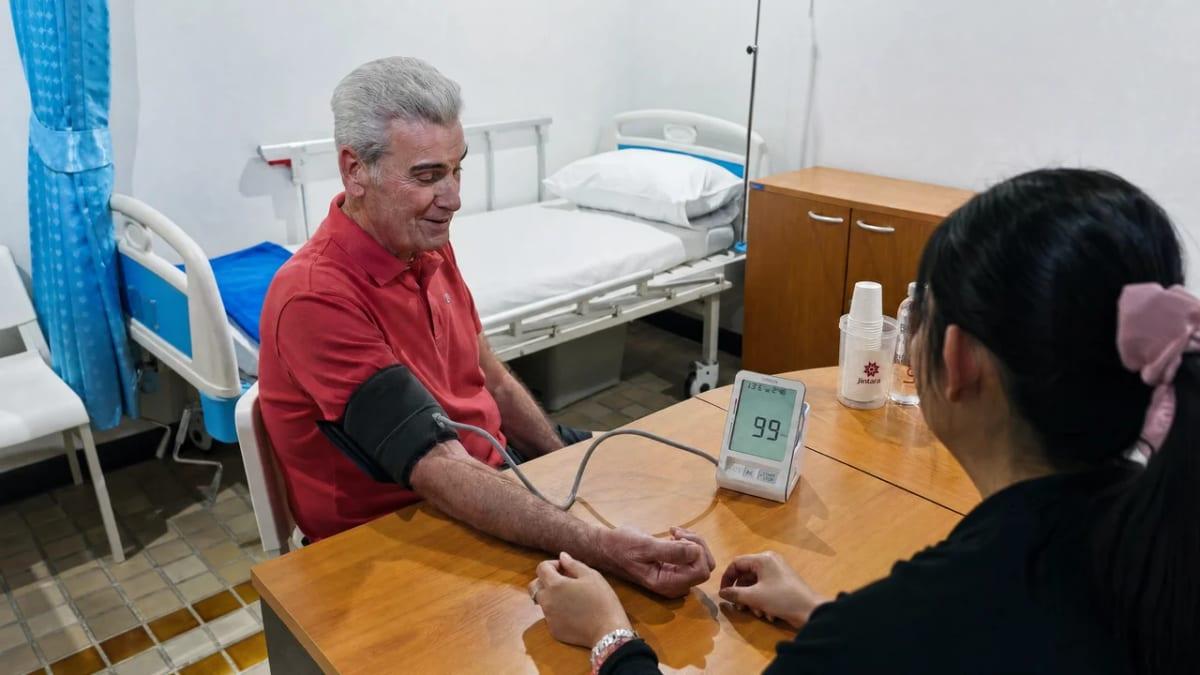
Jintara's nursing team works awake overnight on active rotation, not on call from a room down the hall. A nurse who is asleep cannot carry out the proactive checks, symptom observation and medication support that early detox requires. The service runs to hospital-level supervision standards because withdrawal risk does not keep office hours. The fear that keeps families awake is specific, and it is almost always about the night. What happens at three in the morning is the part nobody can see from a website, so here is the actual answer. A client in early detox receives a bedside visit every one to two hours through the night, and nursing is led by Lertkhwan Sukpia, who has worked in drug and alcohol rehabilitation nursing since 2017. Checked and documented at every visit:
- Heart rate.
- Blood pressure.
- Temperature.
- Oxygen saturation.
The nurse also reads mental state, agitation and sleep quality alongside the numbers, because acceptable vital signs do not always mean a client is safe. Shift handover notes carry each observation to the next nurse, so the clinical picture is continuous rather than restarted every eight hours. Detoxification on its own is not addiction treatment, a point NIDA states directly in its guidance on treatment and recovery, and the nursing record is one of the things that carries a person from one into the other. None of it depends on the client being well enough to ask for help.
“A nurse who is asleep and waiting for a client to call is not enough. We run like a hospital. The client should not have to come and find us. We come to them.
Medication Oversight Is Psychiatrist-Led From Day One
The medication plan is written by a psychiatrist after an initial assessment, and that assessment is included in the program cost rather than billed separately. Plans for alcohol, opioid, benzodiazepine and poly-substance detox look nothing like each other. What is prescribed reflects the person in front of the psychiatrist, not a standard protocol applied regardless of history or risk.
People often arrive expecting to be handed medication and left to manage it themselves, usually because that is what happened somewhere else. Medication here is reviewed as symptoms respond rather than on a fixed weekly schedule. If sleep is not returning, or withdrawal symptoms persist on the current plan, a psychiatric review happens, and how medication is managed day to day is set out in full in the detox section. Some clients see the psychiatrist five, six or seven times across the program because the plan keeps needing adjustment, and where a regular appointment falls on a weekend the team uses clinic pathways so care does not pause.
No client self-administers medication at any point. Nurses dispense, observe and document each dose, which removes the risk of a client doubling up or quietly adjusting their own plan. Clients who arrive on existing prescriptions have those folded into the same plan rather than run alongside it.
Observation Means the Whole Picture, Not Just the Numbers
Nursing observation at Jintara goes past the vital signs chart. The team is trained to tell the difference between a client who is uncomfortable and stable and one who is uncomfortable and escalating, and the same habit of recording what is actually happening carries into outcome tracking after discharge once a client goes home. That distinction rarely shows up in heart rate or blood pressure.
It shows in how a person answers a question, whether their anxiety is climbing, and whether agitation arrives in waves. Nurses use conversation as a clinical tool alongside the structured scoring, and Denise O'Leary leads the clinical side of that work, with therapy coordinated daily against what the nursing team is seeing physically. If a client's symptom picture does not match what they disclosed on arrival, the team reassesses rather than assuming.
- Overnight documentation. The night nurse records sleep quality, early waking, agitation, comfort, and any red-flag complaint, not simply the vital signs reading.
- Symptom and history mismatch. A picture that does not fit the disclosed substance history is treated as a clinical signal and triggers reassessment.
- Shift handover. Every observation passes forward at handover, so the clinical picture stays continuous across each 24-hour period.
- Therapy coordination. Therapists and nurses coordinate daily, so emotional support is timed to match what is happening physically rather than running on a separate schedule.

Hospital Escalation Is Part of the Plan, Not a Last Resort
Escalation at Jintara means acting on risk signals before they become emergencies. Treated as reasons to act, not reasons to keep watching:
- Severe headaches.
- Unusual internal pain.
- Symptoms that do not fit the expected withdrawal pattern.
A transfer happens at two in the morning if that is when the risk presents. The question families actually want answered is what happens on the worst night, not the average one. Bangkok Hospital Chiang Mai and RAM Hospital are both confirmed transfer partners with addiction-specialist psychiatrists, which is a different thing from having a hospital's phone number. Deciding at 2am is not a judgement call made under pressure, because the signals that trigger a hospital transfer are agreed in advance. Alcohol withdrawal can escalate into delirium tremens, which MedlinePlus lists among the medical emergencies of withdrawal, and that is the scenario the whole escalation plan is built around. Darren Lockie's position is that a rehab without escalation pathways and hospital relationships is ethically unacceptable, and he says so on the record. None of this is a differentiator. It is the baseline requirement of safe medical detox, and it is what the day-to-day running of the place is organised around.
“Detox is stabilisation. Our job in those first days is to keep the person safe, keep them oriented, and give them one clear reason to stay for one more day.
Therapy Begins Alongside Detox, Not After It
Therapy starts alongside detox from the first or second day, once medical stabilisation is underway. This is not deep trauma processing during withdrawal. It is early contact, orientation and stabilising support, so a client knows what to expect and has a trusted person to speak to before anxiety and shame take over.
The days people most often leave treatment are the first few. A client who feels alone during detox is more likely to go before the recovery work has a chance to begin, so connection is treated as a protective factor rather than a nicety. As the physical symptoms ease, therapy steps up gradually toward the evidence-based work of the full 30-day program, including cognitive behavioural therapy and, where indicated, EMDR. The gap people fall through is the handover between a detox unit and a rehab somewhere else, which running medical detox and therapy in one place removes entirely. That continuity is the point of the arrangement, not the convenience of it.


Talk with Our Admissions Team
Your enquiry is confidential and goes only to our admissions team.
Common Questions About Our Medical Standards
It means a psychiatrist designs the medication plan, registered nurses are awake around the clock monitoring symptoms and vital signs, and hospital escalation is available immediately if something goes wrong. Those standards are checked by people outside the facility, and the licences and accreditation Jintara holds are published with their certificate numbers. It is active, documented clinical care, not a bed and a box of pills.
The day 2 workup covers blood tests, liver and kidney function, an electrocardiogram and a chest X-ray. It gives the team a clinical baseline before the most demanding part of detox begins, and the results shape medication decisions, identify underlying health issues, and confirm the client is safe to continue in the program. Jintara covers the cost of the workup itself.
In early detox a nurse checks every one to two hours. As withdrawal stabilises, checks move to every four to six hours, then less often as the body settles. Rising agitation, worsening symptoms, or any complaint that does not fit the expected withdrawal pattern will trigger extra checks regardless of where the score sits.
A psychiatrist writes the medication plan after an initial assessment. That assessment and the nursing care are included in the program, while prescribed medications carry a separate cost, as does hospital care if a client arrives needing stabilisation first. Everything covered by the program fee is itemised rather than summarised, so the cost does not arrive as a surprise. The admissions team will go through the figure before anyone commits.
Nurses are awake and present rather than on call. If a client shows signs that warrant medical assessment, the team coordinates hospital transfer without waiting, including at two in the morning. The partner hospitals are Bangkok Hospital Chiang Mai and RAM Hospital, both with addiction-specialist psychiatrists on staff. Nobody waits until morning to make that call.
Jintara manages detox for a wide range of presentations, including clients with co-occurring health conditions, because the program includes active psychiatric involvement and daily nursing observation. Cases that need a specialised medical program, such as primary eating disorder treatment, are not a fit. The admissions team will tell you plainly whether we can treat you safely, and will say so directly if we cannot.
Yes. The admissions team can walk you through the arrival protocol, what is included in the detox plan, and what the day 2 hospital visit covers. There is no pressure to commit during that conversation. If Jintara is not the right fit medically, the team will say so and point you toward alternatives.
Jintara is a small adult residential rehab in Chiang Mai with on-site medical detox. If there is a clinical question here that matters to your situation, the admissions team can answer it before you book.