

Clear Pricing for Drug and Alcohol Rehab in Thailand
Talking about money often comes after months or years of trying to hold things together. By the time people reach this page they are usually tired, scared of making another wrong move, and trying to work out if real help is even possible. On this page you will find:
- What a 30-day stay at Jintara costs
- What is included in the fee and what is not
- How Jintara compares with other rehabs in Thailand
- How deposits, refunds, and payment methods work
If any part of this feels confusing or overwhelming, you can take it one step at a time with a simple call instead of trying to decode it alone.

Fully Licensed and Hospital Accredited

How Much Does Rehab in Thailand Cost?
Jintara's 30-day residential program is priced at $12,500 USD, covering a private villa suite, twenty-four-hour awake nursing, psychiatrist-supervised medical detox, individual therapy, and a full clinical assessment at Bangkok Hospital Chiang Mai. Fees are structured in 30-day blocks so clients know exactly what they are committing to before arrival, and because Jintara is confidential self-pay treatment, no insurance claim or third-party record is ever created. Published pricing that does not move between enquiries is one of the checks in our guide to assessing a facility before you commit. Most stays run between 30 and 60 days depending on clinical response.
We understand that cost is more than a number on a page. It is months of pay, savings, or superannuation, and it has to turn into care that genuinely changes the direction of your life. At Jintara the cost of rehab in Thailand is kept simple and predictable, so you can see exactly what you are committing to:
- Jintara's standard program is 12,500 USD for 30 days in a private villa suite with a separate bedroom, lounge, kitchenette and large shower
- Most people stay between 30 and 60 days, depending on risk, history, and how they respond
- Fees are always in 30-day blocks so you are never paying far in advance of what you can actually use
If you need help working out what a realistic length of stay might be, the admissions process walks through cost, risk, and timing together.
Convert to your local currency
“The care and support provided by all of the Jintara staff was exceptional. From the healthy foods, nursing support, therapy, exercise and excursions I was always well cared for. All I needed to do was show up and do the work.”
Is Jintara an Affordable Option Compared to Other Thai Rehabs?
Private residential rehab in Thailand ranges from $5,000 to $20,000 USD per month, depending on group size, staffing ratios, and hospital access. At $12,500 USD for the one-month residential program, Jintara sits in the middle-market range by design, directing the budget toward clinical staff and hospital partnerships rather than large marketing operations. British readers weighing a full breakdown for UK clients will find the private market at home priced above that middle band. For clients from Australia, the UK, and the US, this makes Jintara one of the most affordable fully medically supervised options in Asia.
- Budget rehabs in Thailand charge around $5,000 USD a month by running bigger groups and lighter staffing with very basic facilities
- Luxury rehab brands run between $17,000 to $20,000 USD a month, with a lot of spend going to large marketing cost and their investment partners
- Our focus is on adult-only groups, high nurse and therapist ratios, and strong hospital links rather than repaying investment groups
- Medical care includes arrival screening, a detox plan set by an addiction psychiatrist when needed, nursing on-site day and night, and a detailed hospital checkup at Bangkok Hospital Chiang Mai included in your fees.
At $12,500 USD for 30 days, Jintara is one of the most affordable options for medically supervised private rehab available to clients from Australia, the US, and anyone comparing rehab in Thailand for UK residents against the private market at home. That price point reflects a decision to spend the budget on clinical staff and hospital partnerships rather than large marketing operations.
Rehab Cost Comparison: Thailand vs Australia, UK and the US
| Feature | Budget Thai Rehab~$5,000 USD / month | Jintara$12,500 USD / 30 days | Luxury Thai Rehab$17,000 to $20,000 USD / month | Western Private RehabAU / UK / US and other countries |
|---|---|---|---|---|
| 30-day cost | ~$5,000 USD | $12,500 USD | $17,000 to $20,000 USD | AU ~$28,000 / UK ~£15,000 / US ~$35,000+ |
| Room type | Shared or basic single room | Private villa suite with separate bedroom, lounge, kitchenette and large shower | Private ensuite room (hotel-style) | Private room (varies by facility) |
| Maximum clients | 15 to 20 | 10 (adult-only) | 25 to 35 | 20 to 50+ |
| Medical detox | Basic nursing supervision | Psychiatrist-led detox with 24-hour awake nursing | Medical oversight on-site | On-site medical team |
| Nursing at night | Staff sleep on site | Nurses awake and doing rounds through the night | On-call or on-site | Typically on-call |
| Hospital access | Emergency referral only | Full health check at international hospital on day 2, included in fee | Hospital partnership or referral | On-site or immediate hospital access |
| Individual therapy | Limited, mostly group-based | Daily 1:1 with master's-level clinicians | Regular 1:1 sessions | Regular 1:1 sessions |
| Group therapy | Large groups, high frequency | Small adult groups built around evidence-based therapy | Regular groups, larger than Jintara | Regular groups, size varies |
| Physical activities | Basic gym or none | Pickleball, full-size pool, Muay Thai, yoga and supervised city outings | Small pool, basic gym (varies by property) | Gym and walking paths (varies by facility) |
| Pricing | Rarely listed publicly | Fully transparent. All costs on this page. | Usually gated behind a call or PDF download | Not always published |
Budget Thai Rehab
~$5,000 USD / month
Jintara
$12,500 USD / 30 days
Luxury Thai Rehab
$17,000 to $20,000 USD / month
Western Private Rehab
AU / UK / US and other countries
Put simply, a 30-day stay at Jintara costs roughly a third to two thirds less than comparable private residential rehab in Australia, the UK or the US. Rehab in Thailand as a whole typically runs 40 to 70 percent below Western prices for the same level of medical care, which is why so many international clients treat here.
Based on publicly available pricing as of April 2026. Western costs shown in local currency.

What Does the $12,500 USD Cover at Jintara?
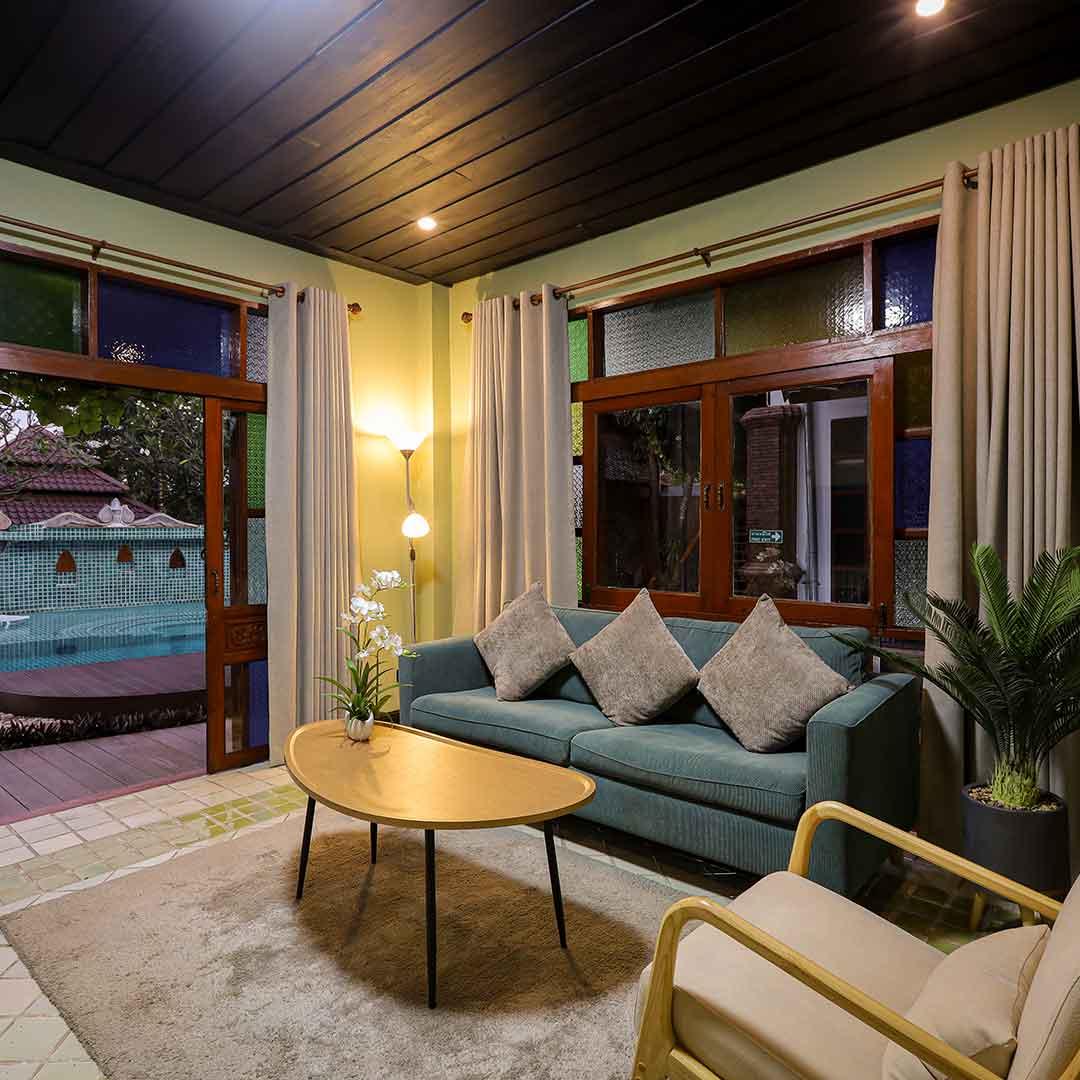
The $12,500 USD program fee at Jintara covers all essential living costs and clinical services for a 30-day stay. This includes a private ensuite suite, housekeeping, all meals, airport transfers, arrival screening, psychiatrist-supervised detox planning, twenty-four-hour awake nursing, a full hospital assessment at Bangkok Hospital Chiang Mai, individual therapy, small clinical groups, fitness and movement sessions, supervised outings, and initial aftercare contact.
The fear for many people is that they will send a large payment, arrive tired and frightened, and then be surprised by extra bills mid-stay. The complete breakdown of what the $12,500 covers, including how it compares with other Thailand facilities, explains exactly which services fall inside the fee and which do not.
- Everyday living is covered, including a private suite, daily housekeeping, laundry, all meals and snacks, airport pick up, and local medical transfers
- Medical care includes arrival screening, a detox plan set by an addiction psychiatrist when needed, nursing on-site day and night, and a detailed hospital checkup at Bangkok Hospital Chiang Mai included in your fees.
- Therapy includes individual sessions with master's level clinicians, small adult groups built around CBT and related approaches, and access to trauma-focused work such as EMDR when it is safe
- Movement, mindfulness, Muay Thai or fitness, and supervised outings sit inside the core fee, along with at least one individual online follow up session and access to group aftercare
What is not included
The 12,500 USD fee covers your full stay at Jintara. The handful of costs below are paid separately, listed up front so there are no surprises after you arrive.
- International flights. to Chiang Mai or onward, booked separately by you or your travel agent
- Visa and visa extension costs. including Thai immigration fees if your stay needs to be extended
- Prescription medication from home. anything you bring with you, separate from what a visiting psychiatrist prescribes
- Off-site medical or dental treatment. anything beyond the included Day 2 hospital workup, where extra care is needed
- Personal spending money. for cigarettes, coffee, or gifts. Most clients use 50 to 100 USD per week
- Optional add-ons. such as one-to-one Muay Thai sessions or extra excursions outside the standard schedule





What Clinical and Medical Safety Does Jintara's Program Fee Cover.
Medical detox from alcohol and certain drugs carries genuine physical risk. SAMHSA's TIP 45 chapter on physical detoxification identifies seizures and delirium tremens as severe alcohol-withdrawal outcomes that can lead to fatal consequences. At Jintara, every client with alcohol or benzodiazepine dependence receives an admission assessment by an addiction psychiatrist, twenty-four-hour awake nursing, and a clear hospital pathway at Bangkok Hospital Chiang Mai if risk escalates.
If you have already tried to stop alone or in poorly supported settings, you know detox is the part you cannot afford to gamble on. Jintara's price is built around that reality.
- On arrival you are assessed by an experienced addiction psychiatrist who sets a detox and medication plan around your substances, doses, and health history
- Detox usually runs on site, with nurses awake through the night, close monitoring of vitals, and a clear pathway to hospital or ICU if risk changes
- A full day two check at our partner hospital in Chiang Mai includes detailed blood work, liver and kidney tests, a chest X ray, and heart studies so the team is not guessing about your physical state.
- Jintara holds a Ministry of Public Health licence and is independently accredited against the same national quality standard applied to Thailand's hospitals, jointly certified by the Healthcare Accreditation Institute, the Princess Mother National Institute on Drug Abuse Treatment, and the Department of Medical Services. Certificate 25/2569, valid 20 May 2026 to 19 May 2029.
The question is not only what the room looks like, but how closely your body and mind are watched in the days when everything feels most unstable. Jintara's protocols have been independently assessed against Thailand's hospital-grade accreditation standard, jointly certified by the same three national authorities that inspect Thai hospitals. Held to that clinical bar, and small enough to know you by name.

How Do People Pay For Rehab in Thailand?
Jintara accepts payment by international bank transfer, credit or debit card via Stripe, or cash in Thai baht by prior arrangement. Many clients from Australia use a combination of personal savings and, where eligible, early-release superannuation funds, while Canadian clients funding treatment more often draw on private insurance reimbursement and employer assistance programs, and American clients using health savings accounts pay from funds that are already their own. Jintara does not currently accept cryptocurrency or direct insurance billing, but provides detailed itemised receipts for clients who wish to claim reimbursement from their own insurer.
Behind every invoice there is a story: savings that took decades, a business that still needs cash flow, a partner or parent who is scared of being left carrying debt. Much of that weight sits with relatives paying for someone else's rehab, and the payment routes we use most often reflect it.
- Many people use international bank transfer through services like Wise to keep fees low and exchange rates fair
- Some prefer credit or debit card payment via Stripe, so they can use existing limits and card protections
- Some pay in cash in Thai baht by prior arrangement, which the admissions team organises with you in advance so there is no need to travel carrying large amounts of cash
- Jintara does not currently accept cryptocurrency or direct insurance billing, and instead provides detailed receipts so you can claim back from your own insurer if your policy allows it
- Clients in Australia and New Zealand often draw on personal savings or, where eligible, early-release superannuation for medical hardship. New Zealand has no equivalent scheme, so the funding options for New Zealand clients come down to savings or family support. Private health funds rarely cover offshore residential rehab
- Some UK and US clients occasionally claim under out-of-network behavioural health benefits, supported by detailed itemised receipts and, in the US, a clinical summary letter from the treating psychiatrist
Most clients find that $50 to $100 USD per week in personal spending money is plenty once they are on site.
What If The Numbers Still Feel Heavy.
Jintara's clinical team regularly speaks with people who want the program but are working through how to cover the cost. Others are working through the practicalities of taking leave for rehab without disrupting their employment. A short, honest call can clarify whether a realistic plan exists before anyone commits. In some cases a shorter initial stay with structured aftercare works as a practical bridge. In others, the honest answer is to keep building toward the cost before starting.
It is common to read a price like 12,500 USD and feel a mix of panic, guilt, and relief that there is at least an affordable and concrete option. You may already have spent large amounts on holding things together or on past attempts that did not stick.
It can also help to weigh that figure against the cost of doing nothing for another year. The bill for waiting tends to arrive in different currencies. A failed self-detox followed by an emergency room visit. A repeat outpatient program that does not address the medical layer, which is the mismatch between severity and level of care that sends people back a second time. Months of strain on work, finances, and the people closest to you. None of those costs land in one neat invoice, but they keep arriving, and they are usually larger than 12,500 USD by the time you add them up.
- Many people who call are juggling mortgages, school fees, elderly parents, or staff and clients who rely on them
- Some carry shame about asking family, partners, or employers for help again after previous relapses
- Others are trying to weigh the cost of treatment against the cost of doing nothing for another year
- Almost all feel a strong urge to sort money out alone in their head before speaking to anyone, which often keeps them stuck
A short, honest conversation can cut through a lot of that noise and bring the decision back to safety, fit, and timing rather than fear.

Talk with Our Admissions Team
Your enquiry is confidential and goes only to our admissions team.
How Admissions Works at Jintara
Simple, Honest Care From the Moment You Reach Out
A Direct Conversation
Your first call is with Darren, our owner. No salesperson, no call centre. Just a simple, honest conversation about your situation and whether Jintara is the right fit.
Clinical Review
Darren and our Master-level therapists will review your substance use and medical history to confirm we are a good fit and that we can support you safely.
Arrival and Care Begins
June, our client liaison, will meet you at Chiang Mai airport. Your vitals are checked on arrival and, if detox is needed, the medical protocol starts immediately with our 24-hour nursing team. The shape of your first week is set out day by day so there are no surprises.
Independently Verified
Jintara is accredited against Thailand’s national quality standard for drug treatment and rehabilitation facilities, jointly certified by the Healthcare Accreditation Institute, the body that accredits Thailand’s hospitals, with the Princess Mother National Institute on Drug Abuse Treatment and the Department of Medical Services, Ministry of Public Health. Certificate no. 25/2569, valid 20 May 2026 to 19 May 2029.
Pricing FAQ
Common Questions About the Cost of Rehab in Thailand
Below you'll find the main questions our Admissions team are asked about treatment costs at Jintara, what your fee actually covers, and how payments work before, during, and after your stay in Thailand.
The fee reflects the fact that you are not just buying a quiet room and some groups, you are paying for on site medical detox, a full Bangkok Hospital workup, and twenty four hour awake nursing in a small adult setting. Jintara runs with about ten clients and roughly thirty two staff, including master's level therapists and nurses who have worked in major hospitals, so each person is watched and adjusted closely rather than folded into a large crowd.
The 12,500 USD covers your room, food, diagnostics, detox oversight, therapy, movement program, weekend outings, and structured aftercare, so there are no surprises once you arrive. Whether your concern is drug use, alcohol, or both, the same clinical infrastructure applies and nothing is removed to cut costs.
Most people on this page are still arguing with themselves that others have it worse, while watching their own drinking or drug use quietly wreck work, relationships, or health. A stay at Jintara becomes worth the cost when you see that the alternative is another year of damage, emergency decisions, and half measures that do not hold.
If substances are dictating your days, your sleep is broken, or people close to you are worried, your problem is already expensive in time, money, and trust. Investing in a focused block of medically supported treatment is about changing that direction rather than waiting until things collapse completely.
The program fee is designed so you can stop scanning for hidden charges and focus on recovery. It includes your private ensuite room, housekeeping, laundry, all meals, airport pick up in Chiang Mai, and local medical transfers. Clinically it covers arrival screening, psychiatrist led detox planning where needed, twenty four hour awake nursing, a full day two hospital checkup with bloods, liver and kidney function, chest X ray and EKG, individual therapy, small adult groups, fitness and Muay Thai sessions, mindfulness, supervised outings, and an initial run of aftercare contact.
You pay separately for flights, visas, prescription medication, any extra off site medical or dental treatment, and personal spending money such as cigarettes, coffee, or gifts. The clinical work includes access to trauma focused modalities when the team assesses you are ready, so specialist support is built into the fee rather than billed as an add on.
Price differences usually come down to scale, staffing, and where the money is spent. Lower priced centres often run bigger groups with fewer nurses and therapists per client, limited diagnostics, and less access to hospital care for complex detox, which keeps their monthly rate down.
High priced brands can charge two or three times Jintara's fee because they operate large properties and heavy international marketing teams that all need to be funded. Jintara sits in the middle by choice, keeping numbers at about ten adults and using the budget for nursing, therapy time, and hospital partnerships rather than sales offices or luxury add ons that do not change clinical outcomes. Many clients arrive with both substance use and underlying dual diagnosis conditions, and the staff ratio means both are addressed properly.
Nobody wants to feel trapped by an invoice while their head is still clearing. At Jintara you pay in clear 30-day blocks, and that block is normally non refundable once you are in it, because the team has held that room and staffing for you instead of offering it to someone else. If you choose to leave early or are discharged for serious rule breaches, that period is usually paid in full.
In rare cases where a new medical issue makes it unsafe or inappropriate to continue, Darren can look at the situation with you and the hospital team and may offer a partial goodwill refund or credit, but the starting assumption is that each 30-day block stands on its own.
A non-refundable reservation deposit of USD 2,000, or as otherwise quoted, is paid once your start date is confirmed, and that secures your private room. The first 30-day block of program fees is then due on arrival or, by agreement, within a short window after admission. Extensions beyond the first 30 days are billed block by block, never far in advance of what you will use.
For most clients the deposit and balance run in parallel with notifying employers, organising leave, and talking with family, all of which take time. The admissions team works to a date you can actually meet rather than rushing you into a transfer that strains the rest of your life. International bank transfers through Wise or SWIFT usually take five to seven working days to clear from Australia, the UK, or the US, so most clients start the balance transfer about a week before arrival. Card payments via Stripe and cash in Thai baht are also accepted by prior arrangement. The 30-day block is non refundable once you are inside it, because the room and staffing have been held for you instead of being offered to someone else, so the timing matters more than the size of the first transfer.
Behind nearly every admission there is a mix of fear and relief around money, because you are balancing treatment against mortgages, school fees, staff, or aging parents. Many people use savings or a combination of their own funds and family help once there is a clear start date and plan.
Australian clients sometimes access superannuation early and then pay Jintara from those released funds. Others use a mix of bank transfer and card payment to spread the load and keep paperwork clean for accountants or insurers. The aim is always to create a plan that feels weighty but possible, not to push you into a level of debt that simply becomes another crisis later.
It is common to feel that Jintara is exactly the kind of program you need and still not see how the figures add up without serious strain. In those cases the most useful step is an honest conversation rather than trying to solve it alone in your head. Darren will tell you if your current budget is unlikely to cover the length of stay you need, and sometimes the right answer is to delay and keep preparing rather than arrive underfunded and stressed.
In other situations a shorter initial stay with strong aftercare can be a realistic bridge. When Jintara Rehab is not viable, the team can still point you toward safer lower cost options so you are not left choosing from glossy websites with no clinical context.
Yes. Jintara is jointly accredited by three Thai national health authorities: the Healthcare Accreditation Institute, the body that certifies Thailand's hospitals; the Princess Mother National Institute on Drug Abuse Treatment; and the Department of Medical Services, Ministry of Public Health. Certificate 25/2569 covers both facility categories and runs from 20 May 2026 to 19 May 2029. One of only six private rehabs in Thailand to hold it.
The accreditation matters for pricing because it tells you the clinical standard was assessed by a body with no financial interest in Jintara's success. The same national authority that audits Thai public hospitals inspected the detox protocols, medication handling, nursing qualifications, and clinical governance records. When you are weighing a significant spend, independent national verification is a more useful check than any marketing claim.
The Healthcare Accreditation Institute accreditation covers clinical protocols for detox, medication safety, nursing rounds, and documentation, not just the building. It is not a one-time inspection. Ongoing compliance is required, which means the standards that were audited are the ones that run day to day. For someone with alcohol or benzodiazepine dependence, where the medical risk during withdrawal is highest, that ongoing clinical framework is exactly what the program fee is built around.
Jintara is a residential rehabilitation centre, not a hospital. What the accreditation confirms is that the clinical layer of care was found to meet the same national benchmark. The clinical governance page explains how care decisions are reviewed and documented for each client.