

Motivation To Change Cannabis Use Cannot Be Instructed. It Has To Be Found.
Many people arrive at cannabis addiction treatment in Chiang Mai genuinely uncertain about whether they want to stop. Motivational interviewing is the clinical technique Jintara uses to work with that uncertainty rather than argue against it. It is not a separate session type. It is woven into individual therapy from the first week.
- Integrated into every individual therapy session from day one
- Specifically suited to clients who are ambivalent about stopping
- Non-confrontational approach that builds internal motivation, not compliance
- Delivered by therapists with post-graduate qualifications in counselling or psychology

Licensed by the Ministry of Public Health.
Accredited under Thailand’s national standard for drug treatment and rehabilitation facilities.
Motivational Interviewing Draws Out A Person's Own Reasons For Change
Motivational interviewing is a clinical technique that draws out a person's own reasons for change. Developed through decades of research in substance use treatment, it works from one core principle: when people articulate their own reasons for wanting things to be different, those reasons carry more weight than anything a therapist can assert. Rather than instructing someone toward change, the therapist's job is to create the conditions in which the person convinces themselves.
This matters more for cannabis than for most substances. The person who reaches cannabis addiction treatment often recognises that cannabis is causing problems while remaining genuinely unsure they want to stop. That state is not resistance or denial. It is ambivalence, and clinically it is called contemplation: holding both sides of the argument at once without committing to either.
Motivational interviewing does not try to win the argument for the change side. It explores both sides with curiosity, reflects back what the person values, and draws out what is called change talk: the statements a person makes themselves about why change matters to them.
Cannabis Users Arrive With Higher Ambivalence Than Almost Any Other Group
Cannabis users present with higher ambivalence about stopping than almost any other substance use group, and the reasons are structural rather than personal. Unlike alcohol or opioids, where physical consequences are visible and often frightening, the changes cannabis produces develop slowly and are easy to attribute to other causes. Motivation difficulties, memory changes, and reduced engagement with things that once felt rewarding can each be explained away, though NIDA's research on cannabis documents these as recognised features of cannabis use disorder. "I've been stressed." "I've just been tired."
The perception that cannabis is not a real addiction compounds this. Many people who reach out for help with cannabis use have already been told it is harmless, even though cannabis psychological dependence is a recognised clinical condition. That message, repeated, produces a person who is genuinely uncertain whether their use warrants attention, and who is likely to be sensitive to any clinical stance that feels like judgment.
Motivational interviewing is the clinical approach best suited to this presentation. It does not take sides. Where anxiety or depression sits underneath the cannabis use, co-occurring mental health treatment addresses those conditions inside the same integrated program rather than as a separate track. It meets the person where they are and works with what they already know.

At Jintara, Motivational Interviewing Runs Through Every Individual Session
At Jintara, motivational interviewing is integrated into every individual therapy session rather than scheduled as a separate module or session type. A scheduled MI session treats motivation as a topic to be covered and moved on from. Integrated MI, woven through the wider treatment program, treats motivation as something that shifts across the thirty days and needs continuous attention. This distinction matters clinically, because motivation is not a switch.
Denise O'Leary, Jintara's Clinical Director, describes it plainly. "It is a technique used to help people find their own motivation." The goal is not a single moment of resolution where the person declares they are ready. Motivation builds through repeated conversations in which the person articulates what matters to them, hears it reflected back, and gradually consolidates their own case for change.
In practice, the therapist listens for change talk: any language that signals movement toward change. "I don't want to be like this forever." "I want to be able to sleep properly again." These statements are not celebrated in a way that feels manipulative. They are reflected back, explored, and connected to what the person has already said they value. As Darren Lockie puts it: "Everybody who comes to rehab has ambivalence. That's okay. We can work with that."

“It is a technique used to help people find their own motivation. You cannot give motivation to someone. You can only create the conditions for them to reach it.
The Evidence For Motivational Interviewing In Cannabis Treatment Is Consistent
The clinical evidence for motivational interviewing in cannabis treatment is consistent across multiple trials, and the effect is clearest in treatment engagement. Cannabis users who receive MI at the start of treatment show better attendance, lower dropout rates, and more sustained participation than those who do not. This matters more than it sounds. A person cannot benefit from treatment they discontinue.
The mechanism is not complicated. Cannabis users who arrive carrying ambivalence are vulnerable to leaving when the first difficult week arrives, when sleep is poor, mood is low, and cravings are uncomfortable. Without an internal rationale for staying, the immediate discomfort wins. MI builds that rationale before the difficult week arrives and gives the person a way to revisit it when resolve wavers.
The clinical point is that MI removes obstacles rather than supplying motivation. A client engaged enough to be honest is the precondition for treating the full picture of what a person is carrying, which is where the deeper work happens. The SAMHSA Treatment Improvement Protocol on enhancing motivation for change frames MI as effective precisely because it helps people change themselves rather than being changed. That reframing is what makes the shift durable.
A Motivational Interviewing Conversation Works With Four Core Skills
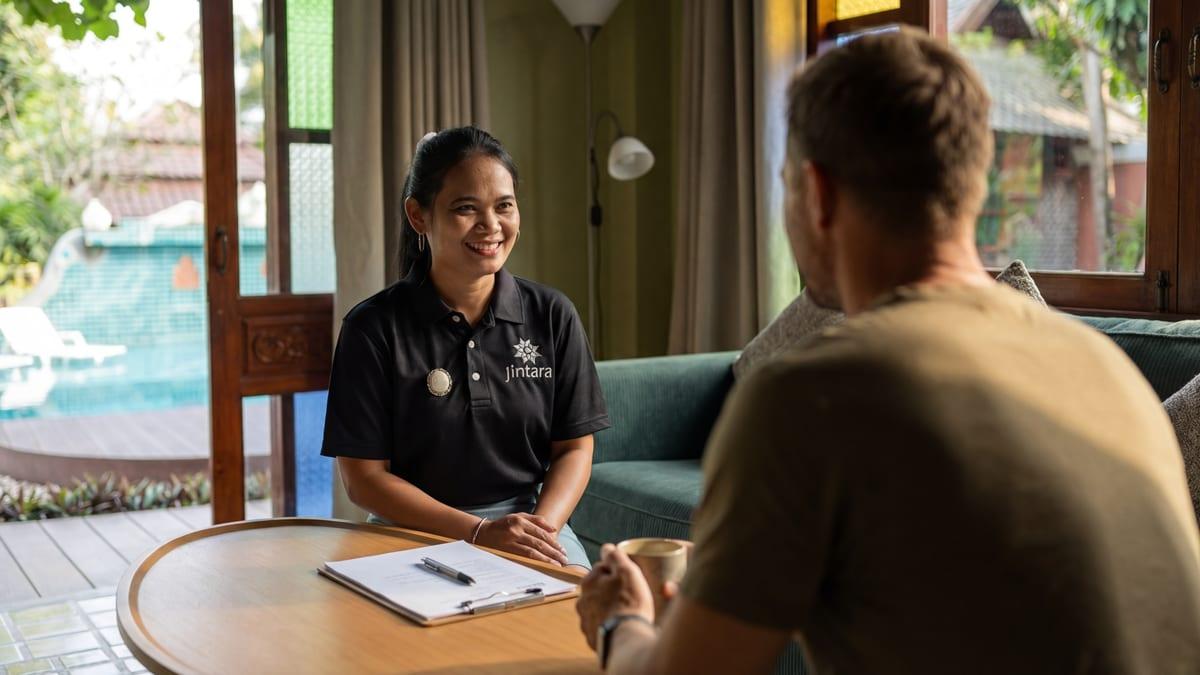
A motivational interviewing conversation works with four core skills that reduce defensiveness and build commitment without confrontation. These are open questions, affirmations, reflective listening, and summaries, known together as OARS. Reflective listening is the most technically demanding of the four: the therapist reflects back what the person has said in a way that draws out meaning without distorting it. Used together, these skills produce a conversation in which the client does most of the talking.
What this produces in practice surprises many people. They expect to be told what to do, or to be challenged on their rationalisations. Instead they find space to hear their own thinking without pressure.
There is no confrontation and no advice-giving in the early stages, and research suggests this is a central part of why the approach works. For clients whose cannabis use sits alongside significant physical history, medically supervised detox runs alongside therapy from the first day, so motivation and medical stability are built in parallel. NIMH guidance on co-occurring substance use and mental health lists motivational interviewing among the evidence-based approaches for this population, because people who feel challenged become defensive and argue against change rather than for it. The absence of pressure is the mechanism, not a softness in it.
The Four OARS Skills In A Motivational Interviewing Session
| Skill | What the therapist does | Why it lowers defensiveness |
|---|---|---|
| Open questions | Invites the person to talk rather than confirm or deny | The person explores instead of defending a position |
| Affirmations | Recognises what the person is already doing well | Effort is seen, not only the problem |
| Reflective listening | Reflects meaning back without distorting it | The person hears their own thinking clearly |
| Summaries | Draws the conversation together at natural points | The person hears their own position stated plainly |
Open questions
What the therapist does: Invites the person to talk rather than confirm or deny
Why it lowers defensiveness: The person explores instead of defending a position
Affirmations
What the therapist does: Recognises what the person is already doing well
Why it lowers defensiveness: Effort is seen, not only the problem
Reflective listening
What the therapist does: Reflects meaning back without distorting it
Why it lowers defensiveness: The person hears their own thinking clearly
Summaries
What the therapist does: Draws the conversation together at natural points
Why it lowers defensiveness: The person hears their own position stated plainly
Jintara Uses Motivational Interviewing Most Intensively In The First Two Weeks
Jintara uses motivational interviewing most intensively in the first two weeks of the 30-day program, when ambivalence is highest and the risk of leaving treatment is greatest. Cannabis withdrawal does not produce the dramatic physical symptoms of alcohol or opioid withdrawal, but it produces a reliable cluster of experiences that undermine motivation: poor sleep, low mood, irritability, reduced appetite, and a flattening of reward that makes early abstinence feel unrewarding rather than relieving. These are the weeks when a person most needs an internal reason to stay.
From week two onward, as acute withdrawal resolves and sleep begins to normalise, individual therapy shifts toward deeper work on the patterns and beliefs that sustained cannabis use. For clients whose use developed in response to anxiety or stress, cognitive behavioural therapy runs alongside MI, addressing both the motivation to change and the tools for sustaining it. EMDR is available where trauma is identified as a contributing factor.
The clinical team designs individual therapy to build through the thirty days rather than front-loading insight and letting the later weeks coast. The process begins the same way it continues: ask, listen, reflect, and move at the person's pace.

The First Conversation With Jintara Is Conducted In The Same Spirit
The first conversation with Jintara is itself conducted in the spirit of motivational interviewing. The initial assessment call, conducted by Darren Lockie or a member of the clinical team, is not a sales conversation. It is a clinical conversation to understand where the person is, what they have tried, and whether Jintara is a likely fit. If it is not, Jintara says so.
Many people considering treatment carry a specific version of the anxiety that motivational interviewing is built to address. They are not sure they want to stop, they are unsure whether the problem is serious enough, and they worry that asking for help will confirm a judgment they have already faced. The admissions conversation at Jintara is designed to meet that state directly, with no pressure to commit and no script that steers toward a bed. There is room to be uncertain out loud.
For people who do proceed, the residential program begins with the same approach: meet the person where they are, work with ambivalence rather than against it, and build motivation from the inside. Fees and what is included in the thirty-day program are set out clearly at the start, with no hidden costs.

Talk with Our Admissions Team
Your enquiry is confidential and goes only to our admissions team.
Common Questions About Motivational Interviewing for Cannabis
What is motivational interviewing in addiction treatment?
Motivational interviewing is a clinical conversation technique developed for substance use treatment. It draws out a person's own reasons for wanting to change rather than instructing them toward change. The therapist uses open questions, reflective listening, and affirmations to help the person hear their own ambivalence clearly and build their own case for recovery. It is non-confrontational and particularly effective early in treatment.
Why is motivational interviewing used specifically for cannabis?
Cannabis use disorder often involves high ambivalence. Many people using cannabis regularly know it is causing problems but are not certain they want to stop. The consequences are subtler than those of alcohol or opioids, which makes the problem easier to minimise. Motivational interviewing suits this because it works with uncertainty rather than arguing against it, and because it avoids the confrontational stance that typically increases defensiveness.
Is motivational interviewing a separate therapy session at Jintara?
No. At Jintara, motivational interviewing is a communication technique integrated into all individual therapy sessions rather than a scheduled session type. It is most intensive in the first two weeks of the 30-day program when ambivalence is highest, but it continues throughout treatment as the framework for how individual therapy conversations are conducted.
How long does it take for motivational interviewing to work?
Motivation to change builds gradually through repeated conversations rather than arriving in a single session. Most people notice a shift in how they think about their cannabis use within the first week of treatment, but the depth of that shift depends on how long they have been using, what role cannabis has played, and what other factors are present. MI is most effective when it runs alongside the full clinical structure of the 30-day program.
Can motivational interviewing help if I am not sure I want to stop?
Yes. Uncertainty about whether to stop is exactly the state motivational interviewing is designed for. It does not require a person to arrive committed to abstinence. It begins by exploring what the person values and what cannabis use has cost them across those areas. That exploration, conducted without judgment, is often what produces the shift from "I am not sure" to "I want this to be different."
What other therapies does Jintara use alongside motivational interviewing?
Individual therapy at Jintara draws on cognitive behavioural therapy for changing the thought patterns that sustain use, EMDR for clients where trauma is a contributing factor, and SMART Recovery principles for building self-management tools. Motivational interviewing sits underneath all of these as the conversational approach that keeps therapy aligned with what the client actually values rather than what the therapist believes they should value.
How do I find out whether Jintara is the right fit for cannabis treatment?
The initial call is a clinical conversation with no obligation to proceed. Darren Lockie or a member of the clinical team will ask what is currently happening, what has been tried, and what you are hoping for. If Jintara is not the right fit, the team will say so. Most people find the call itself clarifying, regardless of what they decide afterward.
Jintara is a small adult residential rehab in Chiang Mai with a 3.2:1 staff-to-client ratio. Motivational interviewing runs through individual therapy from the first week, not as a one-off session.
Jintara Rehab is licensed by the Thai Ministry of Public Health as a rehabilitation centre. The clinical information on this page describes Jintara's general approach to supporting clients during the early recovery period. Medical decisions, including medication protocols, are determined by addiction-specialist psychiatrists through our partner hospital pathway. Individual treatment varies based on clinical assessment. This content is for informational purposes and does not constitute medical advice.