
A Family Guide To What National Accreditation Means For A Thai Rehab
If you are reading this, you are probably not the one who needs treatment. You are trying to get help for someone you love, and you want to know this place is capable and real before you make the call. Our national accreditation is one solid answer. This guide is for you: what that means for the person you love, what it cannot promise, and what the journey to us actually looks like.
- What an independent, government-appointed team actually checked
- What it promises, and the one thing no accreditation can
- What it means in practice for the person you love
- How to check any rehab, and how to start, with no pressure
Licensed by the Ministry of Public Health.
Accredited under Thailand’s national standard for drug treatment and rehabilitation facilities.
You Are Trying To Answer One Question
You are not a doctor. You are tired, you are worried, and underneath all the research you are really trying to answer one question. Is this place actually safe and legitimate, and can I trust it with someone I love.
This page is written for you, the person doing the hard work of getting someone into treatment. It is not a lecture on accreditation. It is here to help you feel confident that the place you are looking at is capable and properly checked, and to tell you honestly what the journey to us looks like.
- A parent trying to help an adult child who may not want help yet.
- A husband or wife who has carried this quietly for a long time.
- A brother, a sister or a close friend, often organising it from another country.
You do not have to become an expert in any of this. If you want the detail on the credential itself, why it matters when you choose a rehab covers it in full. This page is about you, and them.
What The Accreditation Means, In Plain English
A team of independent assessors, appointed under Thai law, came to Jintara. They checked our medical systems, our doctors' and nurses' qualifications, our safety equipment, how we store medication, how we keep records, and how we protect privacy. They measured all of it against a national standard, and they confirmed we meet it. The assessment was theirs, not ours.
That is the whole point of an accreditation. It is the difference between a place telling you it has high standards and an outside body confirming it. Anyone can say the first. Only the second is checked.
And it was not one signature. Jintara's accreditation is certified jointly by three national bodies: the Healthcare Accreditation Institute, the same institute that accredits Thailand's hospitals, the Princess Mother National Institute on Drug Abuse Treatment, and the Department of Medical Services at the Ministry of Public Health. For a family carrying the weight of this decision, that matters. Choosing a place that three Thai government bodies have examined and signed off is a decision you can stand behind, not one you have to second-guess.

Khun Khwan accepts Jintara's accreditation certificate from Privy Councillor Professor Emeritus Dr Kasem Wattanachai, one of the King of Thailand's senior advisors, at the national ceremony in Bangkok.
What It Does Not Mean
We want to be straight with you, because you are making a serious decision and you deserve straight answers.
The accreditation does not promise that your family member will recover. No accreditation can promise that, and any place that tells you a certificate guarantees recovery is not being honest with you. Recovery depends on the person, their history, and the work they do once they are here.
What it does promise is real and important. It says the place has the qualified staff, the safe equipment and the structured systems to give your family member the best clinical chance. Once the clinical credentials check out, the practical steps of arranging admission are the next thing to work through. It speaks to how Jintara is run and how safe it is, not to the outcome for any one person. We will not pretend it is more than that.
What This Means Specifically For Jintara
The standard is a floor, not a finish line, and the way Jintara is built goes well past it. Here is what the accreditation requires, and what is actually in place for the person you love.
- Addiction-trained doctors. Our medical team is trained in addiction medicine, not general staff who happen to work at a rehab.
- Awake nursing through the night. On-site medical detox with twenty-four hour nursing. Awake nurses, not a buzzer and a wait, during the first days when the medical risk is highest.
- Safe, locked detox medication. Detox medicines, including narcotics, are kept in secure, separate, locked storage, with protocols for complications and emergencies.
- A full medical check on day two. Every client gets a full checkup at our expense: bloods, liver, kidney, chest X-ray and EKG. We want to know what we are treating before we treat it.
- Privacy that was independently assessed. Confidentiality is a scored part of the standard, so your family's privacy is part of what an outside team checked. Our client rights and confidentiality are set out in full.
- A small, private place. A maximum of ten clients at any time, thirty-two staff, and a large private room for every person.
Ten clients maximum, thirty-two staff, awake nursing around the clock, a full day-two medical check, and a private room for every client. It is a small, private place run to a national standard, with a level of personal attention a large institution cannot give.
It Was Conferred At A National Ceremony
This is not a logo Jintara bought or a certificate printed in-house. The accreditation took effect on 20 May 2026 and was presented at the 26th National Drug Dependence Academic Conference in Bangkok, alongside the other treatment and rehabilitation facilities recognised across the country that year.
The certificate was handed over by Professor Emeritus Dr Kasem Wattanachai, a Privy Councillor and one of the King of Thailand's senior advisors. It is the kind of scrutiny, and the kind of company, that should let you exhale a little.
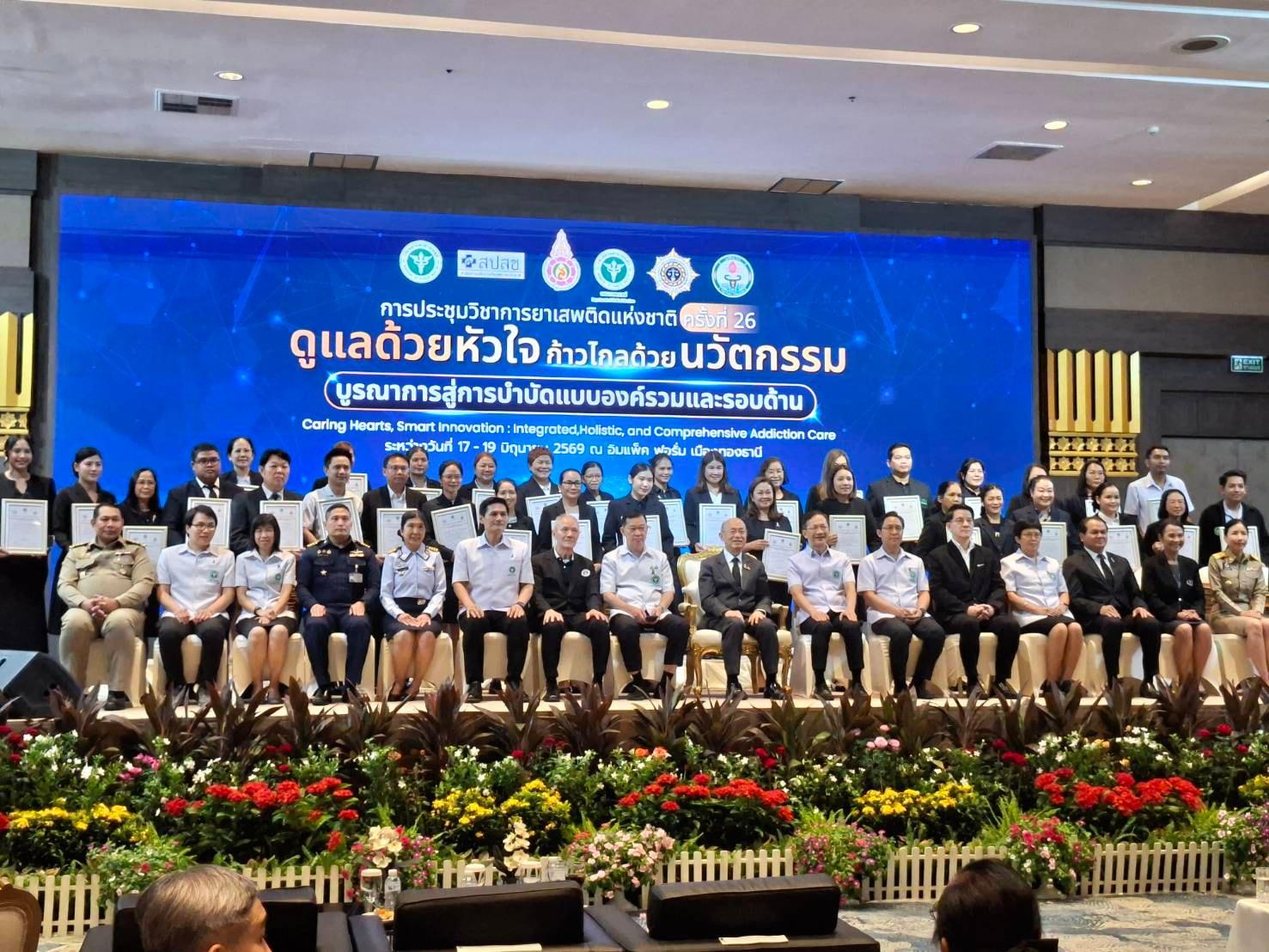
Representatives of the nationally accredited drug treatment and rehabilitation facilities at the 26th National Drug Dependence Academic Conference, Bangkok, where Jintara's accreditation was presented.
Getting Them Here, And The First Few Days
Here is the part most pages skip, and the part that probably worries you most. Before anyone talks about treatment, your person has to actually get here. That can mean walking out their own front door, getting to the airport, flying internationally, sometimes on their own, and trusting that someone will be on the other side. It is a lot to ask of someone who is not well, and it is fair to wonder whether they will make the trip at all.
That is why none of it happens cold. By the time your person travels, Darren has usually spoken with them, and with you, more than once. Often they have already spoken with a therapist. So they are not flying toward strangers and a logo. There is a person, and a plan, and a conversation already started. Someone meets them at the airport in Chiang Mai and brings them in.
Then the first days are deliberately calm. They arrive to a small place, a maximum of ten people, not an institution, with a large private room of their own. On day two there is the full medical check. Through medically supervised detox there are awake nurses, not a buzzer and a wait. Therapy starts early, alongside the medical side, not weeks later. The pace is steady and the staffing is high. It is a serious clinical setting that does not feel like a hospital.
How To Know A Rehab Is Capable, For Any Place You Look At
Other good places exist, and many of them do real work. The point of this guide is not to talk anyone down. It is to give you a few simple checks you can run on any rehab you are weighing, so what you are told on the phone is backed by what is actually there.
- It can be verified. A real accreditation or licence has a number you can check. Ask for it.
- The people are named and qualified. You can find out who the doctors and therapists are and what they are trained in.
- It is all in writing. The methods, what is included, and the pricing are written down, not kept on the phone.
- They are straight with you. A capable place will tell you what it treats, what it does not, and will say so when somewhere else is the better fit.
If You Want To Talk, Or Want The Detail
Our accreditation is certificate no. 25/2569, jointly certified by the Healthcare Accreditation Institute, the Princess Mother National Institute on Drug Abuse Treatment, and the Department of Medical Services. It is valid to 19 May 2029, and to keep it we have to be reassessed and keep meeting the standard, so it reflects how we run now, not a framed certificate from years ago. Ask us for a copy at any point.
There is a great deal more on this website, and we are happy to go through any of it with you. When you are ready, the next step is a confidential call. It is owner-led, there is no pressure, and you can ask anything, including the questions you are afraid to ask, before you commit to anything. Our admissions team can walk you through what happens next.
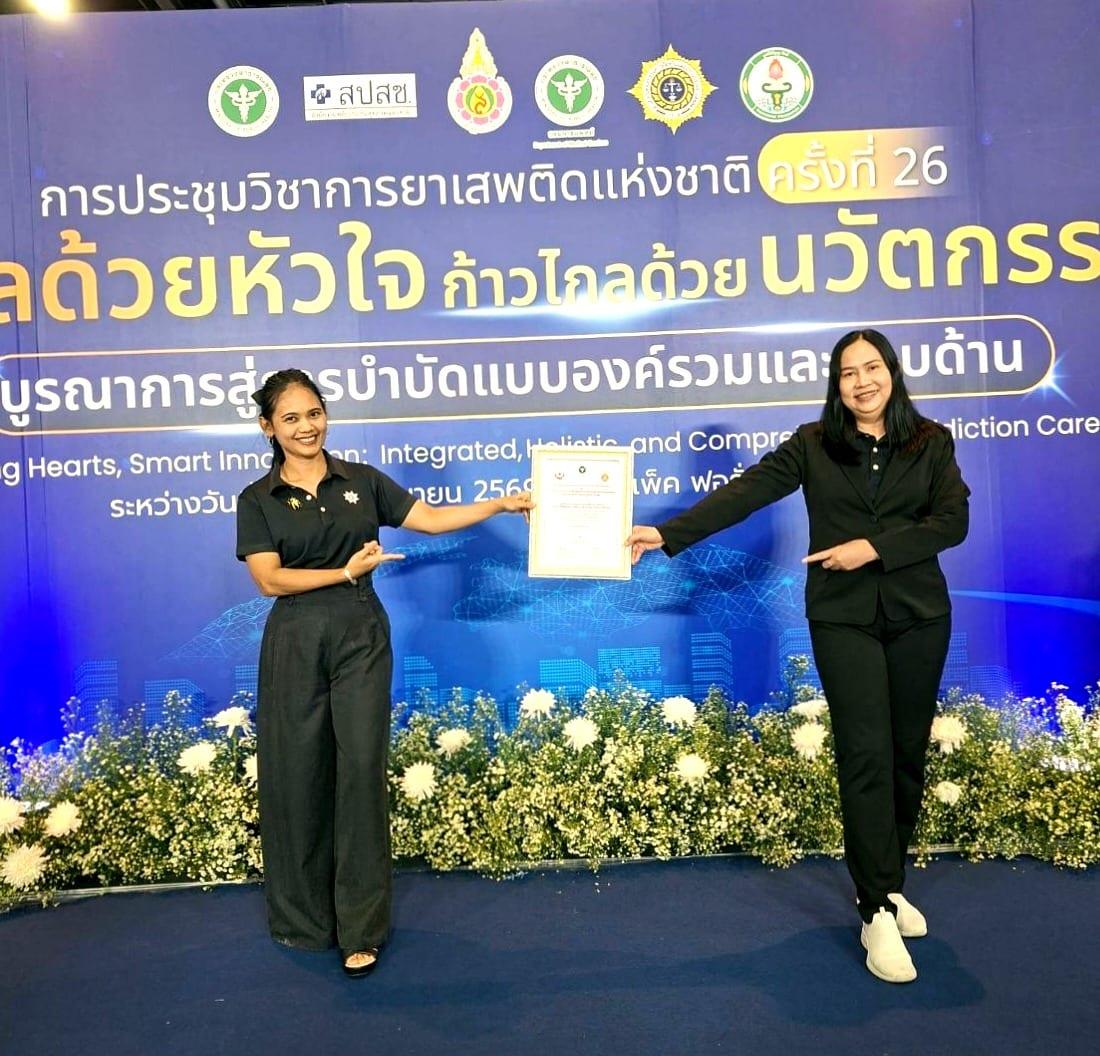
Members of the Jintara team with the national accreditation certificate, no. 25/2569, at the 26th National Drug Dependence Academic Conference in Bangkok.

Talk with Our Admissions Team
Your enquiry is confidential and goes only to our admissions team.
Questions Families Ask About Our Accreditation
How do I know a rehab is capable and real?
Look for an independent accreditation or licence you can verify, qualified addiction-trained staff you can name, twenty-four hour nursing during detox, secure medication handling, and pricing in writing. Ask directly. A capable place answers plainly and tells you what it does not do.
Who checked Jintara, and what did they look at?
An independent team appointed under Thai law, and the accreditation is certified jointly by three national bodies: the Healthcare Accreditation Institute, the Princess Mother National Institute on Drug Abuse Treatment, and the Department of Medical Services. They examined the medical systems, staff qualifications, detox safety, medication handling, privacy, records and aftercare, and measured them against a national standard.
What does the accreditation actually mean for my family member?
It means the staff, the equipment and the systems that keep someone safe during treatment have been independently checked against a national standard and confirmed. It speaks to how the place operates and how safe it is, not the outcome for any one person.
Does accreditation mean my family member will get better?
No. It means the place has the staff, equipment and systems to give the best clinical chance. Recovery still depends on the person and the work they do in treatment.
What happens before my family member travels?
There is contact first. Darren usually speaks with the person, and with the family, more than once, and they often speak with a therapist before they fly. Someone meets them at the airport in Chiang Mai. They are not arriving to strangers.
Can I speak to someone before deciding anything?
Yes. You can speak with our admissions team in confidence, owner-led and with no pressure, before you commit to anything.
Jintara is a small adult residential rehab in Chiang Mai, licensed by the Thai Ministry of Public Health and accredited against the national standard for drug treatment and rehabilitation facilities.
Jintara Rehab is licensed by the Thai Ministry of Public Health as a rehabilitation centre. The clinical information on this page describes Jintara's general approach to supporting clients during the early recovery period. Medical decisions, including medication protocols, are determined by addiction-specialist psychiatrists through our partner hospital pathway. Individual treatment varies based on clinical assessment. This content is for informational purposes and does not constitute medical advice.