
Cold Turkey Detox Is Dangerous. What Medical Detox Provides
Medical detox is more than a safer way to quit cold turkey. It is active clinical supervision that changes the outcome of withdrawal. How it works at Jintara.
Written by Darren Lockie | Medically reviewed by Denise O'Leary | Published: June 9, 2026 | Last Updated: June 27, 2026
Most people who have tried to stop drinking or using have done it alone at least once. They know what withdrawal feels like from the inside. What they often do not know is what is happening to their body during those hours, which symptoms indicate something is going wrong, and at what point pushing through stops being willpower and starts being dangerous.
Medical detox exists to answer those questions in real time, with clinical expertise, while the person is inside the risk window.
This article explains what medical detox actually involves, where cold turkey falls short, and how supervised detox works at Jintara.
Medical detox is active clinical supervision, not passive monitoring of withdrawal.
The phrase medically supervised detox gets used loosely. In some facilities it means a nurse checks in once a day and medication is available if things go badly. At Jintara's medical detox program, the phrase carries a specific operational meaning. The sections below spell it out.
Every client who arrives for detox goes through three checks on the day they arrive: a breath alcohol test, a urine drug screen, and a clinical withdrawal scoring using validated assessment tools, combined with a full set of vitals. That baseline informs the medication protocol and the monitoring frequency for the hours that follow.
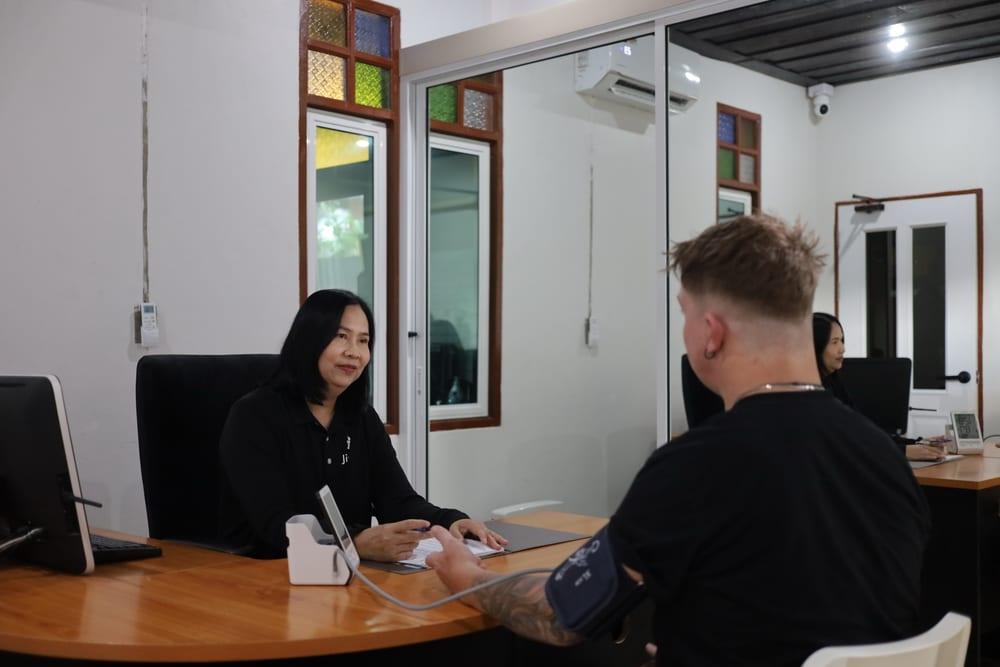
During early detox, Jintara's nursing team visits clients every one to two hours through the night. The goal is not simply to be present if something goes wrong. It is to catch the signs that something is going wrong before it becomes an emergency.
Medication is prescribed and overseen by a psychiatrist. The protocol is individual to each client, calibrated to the substance, the withdrawal severity on arrival, and the clinical response over the first 24 to 48 hours.
That level of clinical specificity is not achievable at home. It is not achievable in a facility that treats detox as a holding period before treatment begins. It is clinical work.
Cold turkey from alcohol and benzodiazepines can be life-threatening without clinical monitoring.
For most substances, cold turkey is deeply uncomfortable. For alcohol and benzodiazepines, it can be fatal.

Both substances work on the same receptor system in the brain. When someone who is physically dependent on alcohol stops abruptly, the nervous system, which has been compensating for constant suppression, swings into overdrive. The result is a hyperexcitable state that, in severe cases, produces seizures and a condition called delirium tremens.
Alcohol withdrawal seizures typically occur between six and 48 hours after the last drink. Delirium tremens, characterised by severe confusion, hallucinations, and autonomic instability, occurs in the most severe cases and typically appears between 48 and 96 hours after the last drink. Both are medical emergencies. Both are also predictable and manageable when the right clinical infrastructure is in place from the start.
The same risk applies to benzodiazepine withdrawal, which follows a similar neurological mechanism and can produce seizures that are clinically indistinguishable from alcohol withdrawal seizures.
A person attempting to detox from alcohol or benzodiazepines at home has no way to know where they sit on the severity spectrum until the symptoms arrive. By that point, without clinical support, the window to intervene safely has already narrowed. Medical detox is not a preference for people with severe dependence. It is a clinical necessity.
Opioid and stimulant withdrawal carry serious risks even when they are not immediately life-threatening.
Opioid withdrawal is rarely fatal in otherwise healthy adults. That does not make it medically benign.
Acute opioid withdrawal includes severe dehydration from vomiting and diarrhea, dangerous electrolyte shifts, and cardiovascular stress. For people with opioid addiction who also have underlying heart conditions or significant physical deconditioning, the physiological strain is meaningful. In people who have used opioids for years and whose general health has deteriorated, it is more meaningful still.
There is also a specific safety risk that cold turkey approaches cannot address: the rapid loss of tolerance that follows even a few days of abstinence. Someone who stops using opioids and then returns to their previous dose is at high risk of fatal overdose, because their tolerance has dropped while their psychological drive to use has not.
Stimulant withdrawal does not carry the same acute medical risks as alcohol or opioid withdrawal, but it does produce severe psychological symptoms including depression, suicidal ideation, and pronounced sleep disruption. Clinical supervision during stimulant withdrawal is as much about psychological safety as physical safety.
Jintara uses validated clinical scoring tools for each withdrawal type. For opioid withdrawal, the Clinical Opiate Withdrawal Scale (COWS) gives the clinical team a structured way to track symptom progression and calibrate the medication response. Supervised detox at Jintara covers the full range of substance types, and the protocol is substance-specific from day one.
Jintara's monitoring protocol runs around the clock from the moment you arrive.
Lertkhwan Sukpia, Jintara's head of nursing, manages the clinical monitoring protocol. She leads a nursing team that operates continuously through the nights when clients are most medically vulnerable.
The CIWA-Ar (Clinical Institute Withdrawal Assessment for Alcohol, Revised) is the validated instrument Jintara uses to score alcohol withdrawal severity. Scores are taken on arrival and tracked at regular intervals throughout the first 72 hours. The score at each assessment determines what happens next: whether medication is adjusted, whether the monitoring frequency increases, whether the clinical escalation pathway is activated. The CIWA-Ar was developed by Sullivan et al. (1989) for exactly this purpose. It remains the standard clinical tool for structured withdrawal measurement.
Key Takeaway
"If a nurse is sleeping during her shift, we just would not get the level of detail we need on our clients to know how to respond." Darren Lockie, Founder, Jintara Rehab
Jintara's escalation protocol involves two hospital partners in Chiang Mai: Bangkok Hospital Chiang Mai and RAM Hospital. Neither has been needed in most cases. The preparation exists because, in the cases that do require it, the time between clinical decision and hospital transfer is the variable that matters most.
The 24-hour nursing model is not a marketing point. It is the operational requirement for running a detox program that can actually respond to what is happening, rather than what is expected to happen.
The clinical protocols that govern this, medication prescribing, withdrawal scoring, nursing oversight, and hospital escalation pathways, were independently assessed in 2026. That assessment produced Jintara's hospital-grade accreditation, certificate no. 25/2569, jointly issued by the Healthcare Accreditation Institute (HAI), the Princess Mother National Institute on Drug Abuse Treatment (PMNIDAT), and the Department of Medical Services. Jintara is one of only six private rehabs in Thailand to hold this accreditation.
The Day 2 hospital workup identifies the health problems that withdrawal conceals.
People who arrive for detox are often in worse health than they know. Years of heavy substance use affect the liver, kidneys, heart, and immune system, and benzodiazepine addiction frequently co-occurs with alcohol dependence, compounding those risks. The presenting state during early withdrawal is not a reliable indicator of what is going on underneath.

On Day 2 of every client's stay, Jintara arranges a full medical workup at one of its hospital partners, at Jintara's expense. The workup includes blood panels covering liver and kidney function, a chest X-ray, and an electrocardiogram.
The results do two things. They surface conditions that need monitoring or treatment alongside the detox. And they give the clinical team a clear baseline for the rest of the program.
Common findings include elevated liver enzymes from prolonged alcohol use, which affects which medications can be safely administered and at what dose. The MedlinePlus Medical Encyclopedia article on alcohol use disorder outlines the range of health complications that co-occur with prolonged dependence. Cardiac irregularities, which are more common in long-term heavy drinkers than most people expect, can also be identified and monitored before they become a problem during the physiological stress of withdrawal.
This workup is not offered as an optional add-on. It is built into the standard Jintara program because the clinical team cannot manage what it cannot measure.
Therapy begins during detox, not after it.
The traditional model separates detox from treatment. At Jintara's 30-day program, detox is not a holding period. Therapy begins as soon as the client is physically stable enough to engage. That typically means the second or third day of the stay, well within the acute withdrawal window.

The reason is clinical. The early days of abstinence, while physically difficult, are also a period of high psychological openness. Defences are down. The person is confronting the physical reality of their dependence in a direct way they may not have for years. Therapeutic contact during that period can establish a relationship and a direction that shapes the rest of the program.
Jintara's three therapists hold post-graduate qualifications, each with a master's degree in counselling, psychology, or a related clinical field. One is a certified EMDR practitioner. Individual therapy, group sessions, and psychoeducation run in parallel with the medical detox process, not after it.
Detox without treatment is the fastest route back to where you started.
Getting through detox is not the same as getting well. The physical dependence ends. The psychological dependence, the coping patterns, the triggers, the relationship with the substance: none of that is resolved by detox alone.
The research on this is consistent. A SAMHSA review of detoxification treatment shows that people who complete detox without entering a structured treatment program return to use at substantially higher rates than those who continue directly into treatment. The detox itself does not address the reasons the person used in the first place.
Jintara does not run detox-only programs. Every admission is an admission to the full program. The reason is not a business model choice. It is a clinical position: detox without treatment is incomplete treatment, and offering it as a standalone service would be inconsistent with Jintara's commitment to outcomes rather than throughput. The relapse prevention plan is developed during the program, not handed over as a sheet of paper at discharge. It is built with the client, based on their specific triggers and history, as part of the therapeutic work that runs through the full 30 days.
What to ask any facility before committing to their detox model.
Not all detox programs are the same. Before committing to any facility, these are the questions that reveal what the program actually involves.
Who prescribes medication during detox, and are they on site or on call?
The answer tells you how quickly a clinical decision can be made if something changes. A psychiatrist who is on call from another facility is a different proposition to one who is integrated into the program.
What is the nurse-to-client ratio during nights?
Night hours are when severe alcohol withdrawal events are most likely to occur. A high ratio means shorter response times.
Do you use validated withdrawal scoring tools?
CIWA-Ar for alcohol, COWS for opioids. Facilities that are not using these instruments are not measuring withdrawal in a clinically structured way.
What is your hospital escalation protocol, and which hospitals are you partnered with?
Escalation should be a defined pathway, not an improvised response.
What happens after detox?
If the answer involves a gap, a discharge, or a handover to a different program, that gap carries risk.
Is therapy integrated during detox, or does it begin after?
Early therapeutic engagement changes the trajectory of treatment.
Is the cost of the Day 2 medical workup included in your fee?
Hidden clinical costs are worth understanding before admission. The Jintara admissions team answers all of these questions for every enquiry. Transparency about how the program works is part of how Jintara operates.
Frequently asked questions.
- What is the difference between medical detox and quitting cold turkey? Cold turkey means stopping substance use without clinical support. Medical detox means stopping with continuous clinical monitoring, validated withdrawal assessment tools, medication management prescribed by a psychiatrist, and a defined escalation protocol if symptoms become severe. For alcohol and benzodiazepines in particular, cold turkey carries life-threatening risks that supervised detox is designed to prevent.
- Which substances make cold turkey most dangerous? Alcohol and benzodiazepines carry the highest risk. Both act on the same receptor system, and abrupt cessation in physically dependent individuals can trigger seizures and delirium tremens, which can be fatal without clinical management. Opioid withdrawal is rarely fatal but produces significant physiological strain and a sharply elevated overdose risk if the person returns to use after even a short period of abstinence.
- How does Jintara monitor clients during detox? Nursing staff conduct assessments every one to two hours during early detox, including through the night. Alcohol withdrawal severity is tracked using the CIWA-Ar scoring tool at regular intervals. Medication is prescribed by a visiting psychiatrist and adjusted based on each client's scoring and clinical response. The monitoring continues for as long as the clinical picture requires it.
- What does the Day 2 hospital workup cover? Blood panels covering liver and kidney function, a chest X-ray, and an electrocardiogram. The workup is conducted at one of Jintara's hospital partners in Chiang Mai and is included in the program fee. Results inform medication decisions and establish a health baseline for the duration of the program.
- What medications does Jintara use during detox? Medication is prescribed on an individual basis by the program's psychiatrist. The specific protocol depends on the substance, the withdrawal severity on arrival, and the clinical response over the first 24 to 48 hours. Jintara does not apply a standard protocol uniformly. The psychiatry assessment and nursing supervision costs are included in the program fee. Prescription medication costs are separate.
- How long does acute detox typically take? The acute withdrawal window varies by substance. For alcohol, the highest-risk period runs from six to 96 hours after the last drink. For opioids, the acute phase typically peaks at 72 to 96 hours. Clinical monitoring at Jintara continues beyond these windows because individual variation is significant, and the program is built around the client's actual presentation rather than average timelines.
- Can someone leave rehab straight after detox? Completing detox means the physical dependence has been managed. It does not mean the underlying dependence has been treated. People who complete detox and leave without entering structured treatment return to use at substantially higher rates than those who continue into a full program. Jintara does not offer detox-only admissions for this reason. Every admission includes the full 30-day program.
- Is the psychiatrist cost included in Jintara's program fee? The psychiatric assessment and the ongoing psychiatry oversight during detox are included in the program fee. Prescription medications are charged separately at cost. If hospital transfer is required, those costs are borne by the client. Contact the Jintara admissions team for a detailed cost overview.
Further reading.
For more on cold turkey risks, what supervised detox involves, and how to evaluate any facility's clinical model before committing, the full Jintara clinical approach is covered across the medical detox and program sections of the site.
Jintara Rehab is a private residential addiction treatment centre in Chiang Mai, Thailand. You can learn more about Jintara and the 30-day program on the main site. The program integrates medical detox and therapy from day one.

Talk with Our Admissions Team
Your enquiry is confidential and goes only to our admissions team.