

10 Essential Questions to Ask Any Rehab
Most families choose rehab under time pressure. These 10 questions test any facility on clinical grounds: staff ratios, detox supervision, and aftercare.
Written by Darren Lockie | Medically reviewed by Denise O'Leary | Published: May 20, 2026 | Last Updated: October 21, 2026
Why the right questions determine the care you get.
Rehab websites use phrases like "evidence-based treatment" and "personalised care" without explaining what either means at their specific facility.
These questions target the clinical decisions that affect safety and recovery: who supervises detox overnight, what the actual staff ratio is during treatment hours, and whether aftercare is built into the program before discharge. Use this checklist before enrolling your loved one in any rehabilitation facility. Readers applying these questions to UK providers will find the checklist holds whether the shortlist is domestic or overseas, and comparing Thailand and US rehab on these questions puts the same answers beside an American program. A facility that cannot answer these questions specifically is telling you something.
You can speak directly with Darren Lockie about Jintara's clinical approach. The details for that conversation are on our contact page, including phone and WhatsApp. He takes the first call himself.
The 10 essential questions to ask any rehab.
1. What is your staff-to-client ratio?
Look for 3:1 or better across all treatment hours, not headline staff figures. At Jintara, 32 staff members support a maximum of 10 patients.
Red flag: ratios of 1:5 or worse in any facility claiming intensive personalised care.
2. Who supervises medical detox overnight?
Look for a psychiatrist-led protocol with awake nursing staff on site. At Jintara, nurses monitor patients hourly during medical detox in the first week. Psychiatrist reassessment happens at multiple points through that window.
Red flag: no physician access between 8pm and 8am at any facility offering detox services.
3. Do new patients receive a full initial assessment?
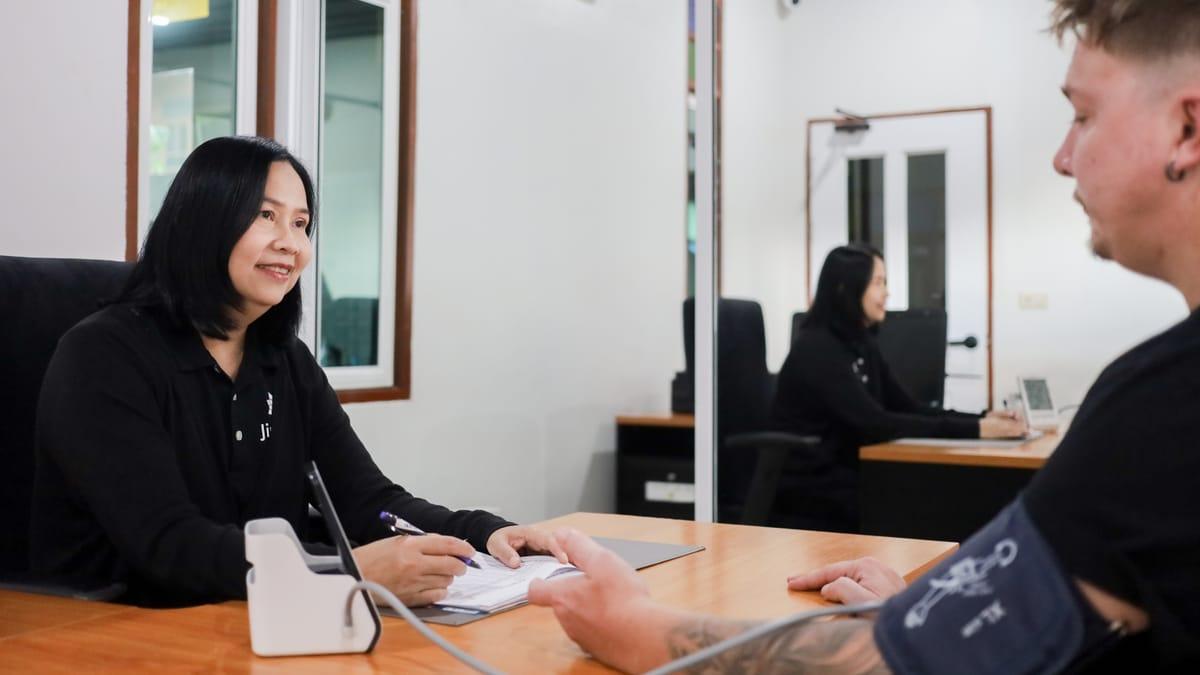
Look for a structured medical workup within 48 hours: blood work, liver and kidney panels, EKG, and psychiatric assessment. At Jintara, this full checkup occurs on Day 2 at the facility's expense.
Red flag: only vitals recorded on admission, no comprehensive laboratory work.
4. What program lengths do you offer?
Look for 30 days minimum, with clinical assessment driving duration, not cost tier. On this point, NIDA's treatment overview notes that people may require long-term or multiple episodes of treatment to achieve long-term recovery. Evidence-based addiction rehabilitation requires sustained engagement to affect lasting behavioural change.
Red flag: pressure toward 14 to 21-day programs as the primary option. These lengths are structured for price points, not clinical outcomes.
5. What evidence-based therapy and family programs does the facility offer?
Look for CBT, motivational interviewing, and individual therapy, not only group sessions. As covered in what most rehabs get wrong, the common failure is defaulting to 12-step group programs without any evidence-based psychological modalities alongside them. Facilities with EMDRIA-certified therapists provide an advantage for patients with trauma histories. Ask whether family therapy is a structured component. At Jintara: CBT, EMDR (delivered one to one by one of Jintara's three EMDR therapists, led by Denise O'Leary, MA Counselling Psychology, EMDRIA Certified Therapist), and abbreviated DBT covering all 4 modules.
Red flag: therapy described as group sessions and 12-step meetings only.
6. What does your aftercare program include?
Look for a structured aftercare plan built into the treatment plan before discharge. Ask for specifics: ongoing therapist contact, peer support access, and aftercare planning coordination. All of it should apply in the client's home location.
Red flag: "We provide a referral list at discharge." This optimises for exit, not recovery continuity.
7. Are you licensed by your country's health authority?
Ask for the licensing authority's name and a verifiable registration number. In Thailand, rehabilitation facilities are licensed by the Ministry of Public Health. Jintara holds that licence and carries national accreditation from three national bodies: the Healthcare Accreditation Institute (HAI), the Princess Mother National Institute on Drug Abuse Treatment (PMNIDAT), and the Department of Medical Services (DMS). Certificate no. 25/2569, valid from 20 May 2026. Ask for both credentials from any facility you are evaluating. A quality facility provides both without hesitation.
Red flag: inability to provide a registration number or accreditation certificate on request.
8. Can you treat co-occurring mental health conditions?
Treating addiction alongside a mental health condition requires a psychiatrist on staff, medication management protocols, and a trauma therapist whose training you can check. That is what dual diagnosis treatment means in practice. Ask what specific mental health conditions the facility treats alongside addiction, whether trauma work is one-to-one or in a group, and whether the lead trauma therapist's credential is listed on a public directory such as the EMDR International Association's.
Red flag: "We treat addiction only" or "we refer for mental health care post-discharge." Research supports concurrent treatment, not sequential.
9. What is your safety record and emergency hospital access?
Ask how far the nearest hospital is and what the overnight emergency protocol looks like. Bangkok Hospital Chiang Mai is approximately 8 minutes from Jintara and Chiang Mai RAM is approximately 20, with 24/7 awake supervision.
Red flag: evasive answers about hospital distance or after-hours escalation protocols.
10. Will I speak with a clinician or a salesperson during the initial consultation?
A sales-focused intake optimises for enrolment, not clinical fit. At Jintara, Darren Lockie conducts initial consultations directly with prospective patients and families.
Red flag: consultations that focus on pricing and availability and never reach clinical substance.
How the answers reveal quality.
Before you finish the call, run the answers through this framework. Quality facilities give specific answers without hesitation. Vague or evasive answers to any of the four core questions are a signal worth taking seriously.
- Staff ratio Green flag: 3:1 or better, confirmed for all treatment hours. Red flag: headline figure only, or 1:5 or worse.
- Detox supervision Green flag: psychiatrist-led protocol with awake nursing overnight. Red flag: nurse-only supervision or on-call physician only.
- Aftercare Green flag: structured plan built into the treatment plan before discharge. Red flag: referral list provided at exit.
- Licensing Green flag: licensing authority name and registration number provided immediately. Red flag: "Different regulations apply here" or inability to produce a number.
How Jintara answers these questions.
Darren Lockie, Jintara's founder, built the facility around clinical transparency as a differentiator. Most rehabilitation centres answer these questions in general terms. Jintara answers with specifics, because the specifics are what families are actually evaluating.
Denise O'Leary, Jintara's Clinical Director (MA Counselling Psychology, EMDRIA-Certified EMDR Therapist), on what the questions reveal:
Key Takeaway
"The questions families ask us before admission are the same questions we ask ourselves when we assess clinical readiness. Ratios, supervision, medical protocols. When those answers are specific, families can make a clear decision. When they are vague, that is the answer." Denise O'Leary, Clinical Director, Jintara Rehab.
Review Jintara's clinical approach or speak with Darren directly by visiting the contact page.
Frequently asked questions.
- What are the most important questions to ask a rehab facility? The 3 most families skip: who supervises medical detox overnight, what the real staff-to-client ratio is during treatment hours, and what the aftercare plan looks like before discharge. Specific answers take under 30 minutes to get from any quality treatment centre.
- What are the biggest red flags when evaluating a rehabilitation facility? Evasive answers about licensing, nursing-only detox without physician access, group-only therapy with no individual component, and consultations that stay on pricing. Quality facilities answer clinical questions with clinical specifics.
- Should my loved one visit the facility before enrolling? Yes, if geography allows. For international rehabilitation programs, virtual tours and direct calls with clinical staff are appropriate. Speak with a clinician, not a marketing coordinator. Jintara welcomes pre-enrollment family consultations.
- How do I verify a rehab facility's licensing status? Ask for the licensing authority's name and the facility's registration number. Verify against the government register directly. In Thailand, rehabilitation facilities are licensed by the Ministry of Public Health. Jintara holds that licence and additionally carries national accreditation from three national health bodies: the HAI, PMNIDAT, and the Department of Medical Services, certificate 25/2569, valid from May 2026. Ask any facility for the certificate number and the issuing bodies of any accreditation it claims.
- What questions should I ask about substance-specific treatment? For opioid addiction, ask about medication-assisted treatment protocols. For alcohol use disorder, ask whether CIWA-scale monitoring is used during detox and how benzodiazepine protocols are managed. For cocaine addiction, ask how the facility manages dopamine crash and crash-cycle cravings in the first two weeks. Generic answers suggest generic treatment.
- Should I get a second opinion on a facility recommendation? Yes, particularly if it came through a paid referral service. Use this checklist to compare any rehabilitation facility on clinical grounds rather than marketing claims.
- Can I request to speak with a clinical director before enrolling? At quality facilities, yes. Darren Lockie at Jintara conducts consultations with prospective patients and families directly.
- What should I do if I am already at a rehabilitation facility that does not feel right? Contact the clinical director directly with your specific concerns. If they are not addressed, discharge yourself with support from a trusted medical professional. Contact your GP or a local addiction specialist. Safety takes priority.
Further reading.
The questions on this page focus on clinical structure and what to look for on-site. For more context on how to evaluate treatment models, the comparison between boutique vs. large rehab and 12-step vs. evidence-based treatment covers the same due diligence lens applied to the broader program structure. This page is the questions; what to watch for in the answers is the companion guide, and the two are built to be used together. Both approaches are worth understanding before you make a decision.
Jintara Rehab is a private residential addiction treatment centre in Chiang Mai, Thailand. You can learn more about Jintara and the 30-day program on the main site. The structure is built for lasting recovery.

Talk with Our Admissions Team
Your enquiry is confidential and goes only to our admissions team.