
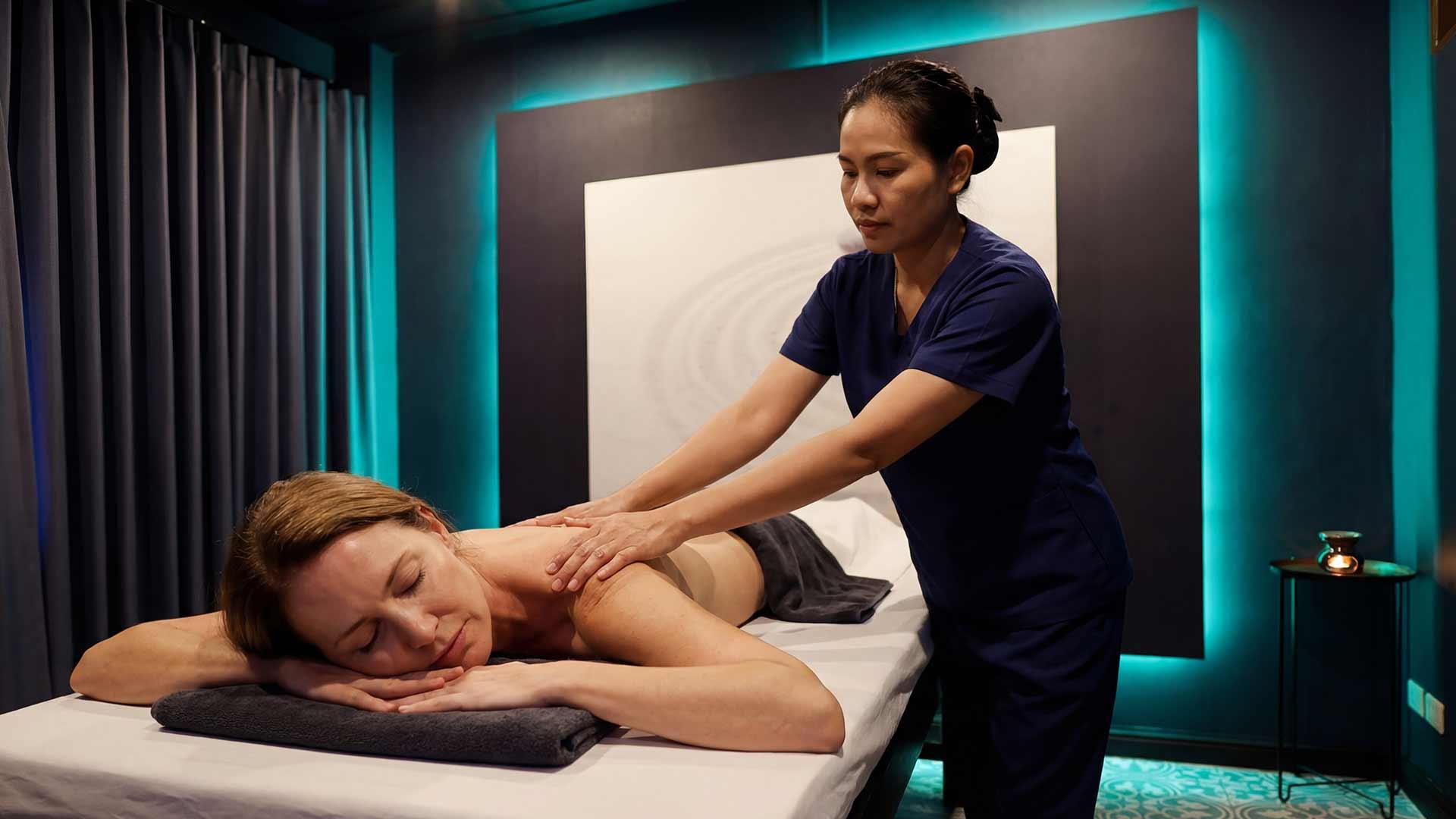
Massage in Addiction Recovery. What the Body Actually Needs
Most rehabs say they offer massage without explaining why. Here is what the research actually supports, and how massage fits at Jintara Rehab.
Written by Darren Lockie | Medically reviewed by Denise O'Leary | Published: May 4, 2026 | Last Updated: June 27, 2026
Almost every rehab in Thailand mentions massage on its website. Very few explain what it is for, what it does, or why it actually matters in addiction recovery.
Most people picture it as a perk. A nice extra you get because you happen to be in Thailand. The truth is more interesting than that, and more useful.
Used in the right way, massage is one of the few non-medical tools we have that actually does something measurable in the body during early recovery. It is not magic. It is not the treatment. But it sits in a real, well-evidenced place inside a serious clinical program, and it is worth understanding properly before you try it.
Why bodies need touch in early recovery.
Substance use disconnects people from their bodies. Drinking and using become how you cope with everything physical. Stress, pain, tiredness, hunger, fear. After a while, you stop feeling those things directly and just reach for the substance.
By the time someone arrives at rehab, that disconnection has often gone deep. People cannot tell whether they are anxious or hungry. They cannot read tiredness. They flinch from touch. They do not know what their body wants because they have spent years overriding it.
Recovery has to undo some of this. Therapy does part of it. Sleep does part of it. Food and movement do part of it. And touch does part of it.
The pattern in the literature is consistent: body-based work helps people rebuild a sense of being safe inside their own skin. That literature includes a review by the American Massage Therapy Association of massage's role in substance use treatment. That sounds soft, but it is not abstract. It is the thing that has to happen before you can notice a craving early enough to do something about it. It is the same skill that lets you tell the difference between hunger and grief.
We talk about this with clients in plain terms. The work is not about pampering. It is about helping you come back into your body slowly and safely, so you can actually use what therapy is teaching you.
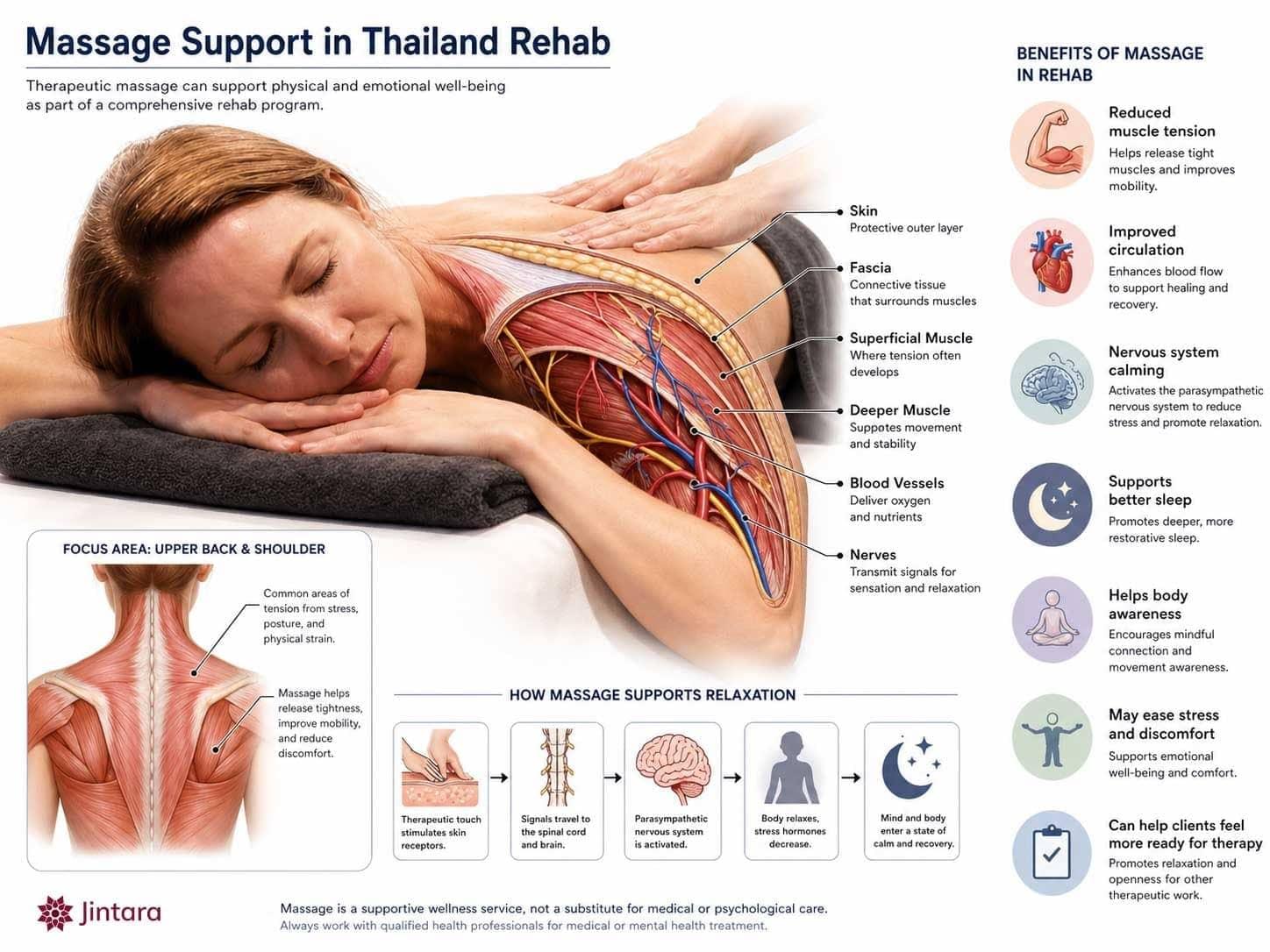
What the research says about massage in recovery.
It is worth being honest here. Some claims about massage in recovery hold up well in the research. Others are mostly anecdotal. We try not to oversell.
The strongest evidence sits around stress, sleep, and mood:
- Massage therapy is used for anxiety, depression, and stress, and for short-term pain relief. Those four things matter a lot in early recovery, when nervous systems are raw and emotions run high.
- Research synthesised by the American Massage Therapy Association describes consistent findings around lower cortisol, modest lifts in serotonin and dopamine, and increased beta-endorphins after massage. Cortisol is the stress hormone that stays high in active addiction. Dopamine and serotonin are the chemicals substances hijack. A small, gentle nudge in the right direction does not fix recovery, but it helps.
- A review of sleep disturbance and addiction treats sleep disruption as a risk factor for relapse across psychoactive substances. Anything that helps the nervous system settle in the evening is doing useful work, including bodywork.
What the research is less clear about is the deeper claims people sometimes make. Massage does not "release toxins" in any meaningful clinical sense. It does not detox you. Detox is a medical process, and your body, with the right support, does that itself. Massage does help you tolerate the discomfort of detox, which is a different and more honest thing to claim.
So the way we frame it is simple. Massage is one of several supports that help your body settle while the medical team keeps you safe and your therapist does the harder work.
Thai massage in a rehab setting.
There are two sides to massage in Thailand we need to separate clearly.
One is the tourist version. The cheap massage on Khao San Road. The shopfronts in Patong with extras for sale. That is not what we are talking about, and it is not part of any serious recovery program. We do not include offsite visits to massage parlours, and we never will.
The other is therapeutic Thai massage as it is taught and practised properly. That is a body of clinical work with a long lineage. Done well, it is closer to physical therapy than to spa pampering. The practitioner uses pressure, stretching, and movement to release tension, support circulation, and help the nervous system shift from a stress state into a calmer one.
Care is most effective when medications and psychotherapies run together, and when co-occurring conditions are treated at the same time. That picture comes from NIDA's treatment overview, not from us. It is the standard we hold every supportive activity to, including massage.
At Jintara, Thai massage is delivered on site by a qualified Thai practitioner who is part of our team. You stay fully clothed throughout, which most people find easier than other massage styles. Sessions usually run in the afternoon, between lunch and dinner, in our dedicated treatment room.
There is no add-on charge for Thai massage, Reiki, art therapy, or meditation. All holistic care at Jintara is built into the program fee. If a slot opens up because another client opts out that day, you can often take it. That flexibility is characteristic of individual holistic sessions at a boutique rehab rather than a high-volume facility. The practitioner-to-client ratio is not diluted by volume.
We also do not allow practitioners to recommend supplements, sell products, or comment on medication. Their job is bodywork. Anything to do with your medical care or your therapy stays with the medical team and your counsellor.
How massage fits with everything else you do here.
This is where the wider picture matters. Massage is one tool in a fairly full kit.
The week is built around clinical work in the morning. Group therapy. One-to-one counselling. CBT skills. EMDR for clients staying 60 days or longer. That is the spine of the program, and it does not move.
What sits around it is the body-based supports that help everything else land. Some you may know already. Some you may not.
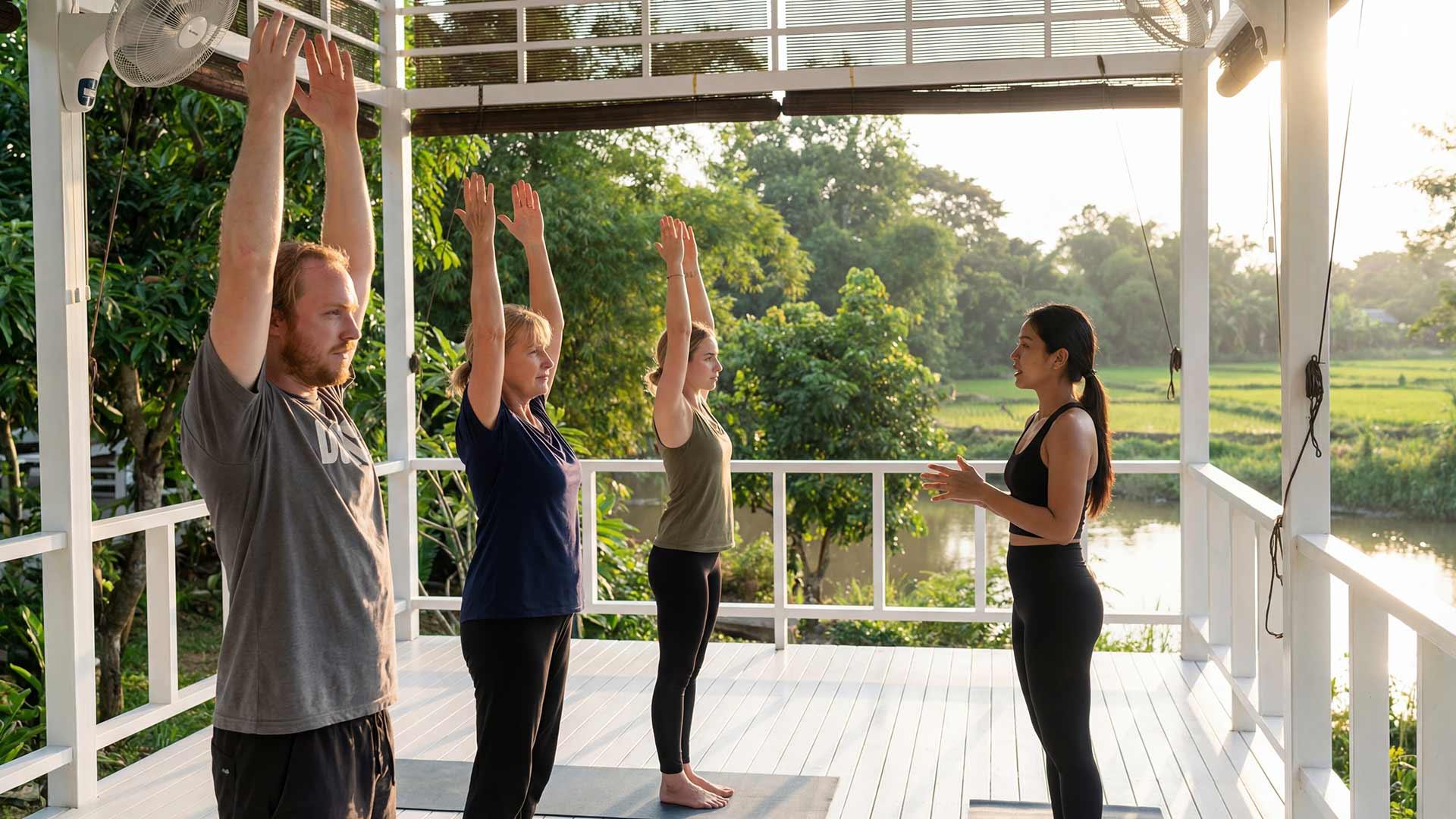
- Yoga or walking runs Monday to Friday from 7:30, before breakfast. It is gentle, adapted for newcomers, and you do not need any experience.
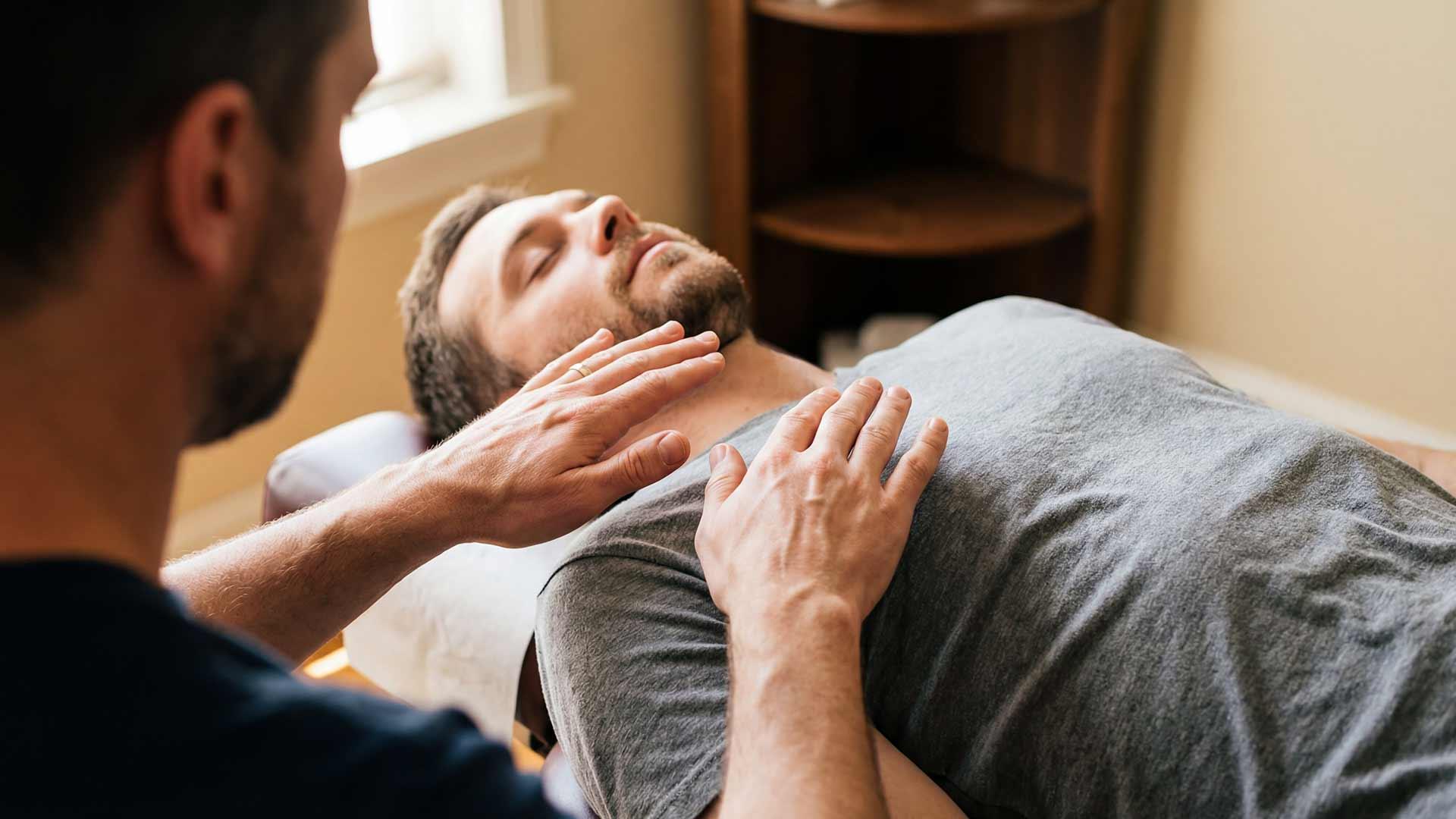
- Reiki is delivered one to one by Leszek Kudiuk, our holistic therapist, once a week. He also runs a meditation session each week. Reiki is the most-asked-about and least-understood activity. We never push it. Many clients are sceptical at first, and that is fine. Some try it and find it surprisingly calming. Others try it once and decide it is not for them. Both outcomes are valid.
- Fitness is led by Tong, our Fitness and Recovery Coach. The outdoor gym runs three times a week. Pickleball, boxing, Muay Thai, a tennis court, and a golf driving range are all on site. Tong assesses everyone in the first week and adapts the work to where you are.
- Art therapy runs Friday mornings with a visiting therapist. No artistic skill required.
Massage sits inside this rhythm, not as the centrepiece, but as one of the body-side supports that help the rest of the work go deeper. You will try most of these activities at some point during your stay, and keep the ones that help.
What a session actually looks like.
If you have not had Thai massage before, the practical side is worth knowing.
You arrive in loose clothing. Most people wear their normal training clothes. The practitioner explains the session before starting and asks about any injuries, medical conditions, or areas you want left alone. Pressure is adjusted to your tolerance, not the other way round.
The session itself is a slow sequence of pressure points, gentle stretches, and rocking. You stay on a low padded mat. There is no oil and no removing of clothing. The whole thing usually runs about an hour.
A few things are worth saying outright:
- You can stop at any time. No explanation needed. The practitioner will not push you.
- You can adjust the pressure in real time. "Lighter please" or "softer here" is normal and welcome.
- Touch is consent-based throughout. If you have any history that makes touch difficult, including past trauma, the practitioner can adapt the session, focus on stretching only, or work with no contact at all.
After a session, most people feel a noticeable drop in physical tension and a calmer, slightly tired sense in the nervous system. Some people fall asleep mid-session. Some find emotions surface afterwards, especially in the first session. That is normal, and the team is around if you want to talk it through with your counsellor.
The same standards apply to Reiki sessions with Leszek. You can read more about how Reiki sits inside the wider recovery program on the program page. Same room, same consent rules, different practice.
What gets in the way.
Not everyone can or wants to do massage, and that is fine. The main reasons clients opt out are worth knowing about because we run into them often.
Safety, choice, and trustworthiness are the foundations for any therapeutic intervention. We hold every body-based session to that standard.
- Religious or cultural reasons. Some clients decline Reiki because it does not align with their faith. We have had Muslim and Christian clients politely opt out, and we never push it. Thai massage is more widely accepted, but the same opt-out applies if you prefer.
- Touch trauma. Some people find any form of physical touch difficult, especially if there is past sexual or physical trauma involved. The practitioner can adapt completely, including running a session with no physical contact, or you can use that time differently. There is no need to explain.
- Gender preference. If a male client prefers a male practitioner, or a female client prefers a female practitioner, we will do our best to accommodate. The Thai practitioner gender at any given time depends on the schedule, so this needs a quick conversation in advance.
- Medical reasons. Some conditions make traditional Thai massage unsuitable, including certain cardiac issues, blood clotting disorders, and very recent surgery. The medical team checks these on intake.
The important thing is that opting out is treated as a normal, adult choice. You do not have to justify it.
What massage does not replace.
This is the line that matters most.
Massage does not treat addiction. Reiki does not treat addiction. Yoga and pickleball do not treat addiction.
What treats addiction is medical care during withdrawal, evidence-based therapy, time in a safe environment, and a recovery plan you can take home.
Therapy is delivered by Denise, our clinical director, who holds a Master of Arts in Counselling Psychology and is EMDRIA-certified. Alongside that, medical detox is run by qualified clinical staff with 24/7 nursing on site. The 30-day program is built around CBT, with DBT-derived skills woven in, and EMDR is available for longer stays where trauma is part of the picture.
Key Takeaway
Everything else, including massage, is a support around the clinical core. It helps you tolerate detox. It helps you sleep. It helps you reconnect with your body. It does not replace any part of the medical or therapeutic work.
We are honest about this on the phone, and we are honest about it here. If a rehab promises that bodywork alone will fix things, walk away.
Want to talk about how this fits.
If you are weighing up rehab and wondering whether the holistic side is real or just marketing, you can call us and ask. The conversation is with Darren, the founder, not an intake coordinator with a script.
We will tell you what we do, what we do not do, and whether we are the right fit. If we are not, we will tell you that too and point you somewhere better.
To see the full schedule of holistic activities, the holistic treatment page covers all of it. You can also read more about Jintara and how the program is structured as a whole. Both give context for how these sessions sit inside the wider program.
Talk with Our Admissions Team
Your enquiry is confidential and goes only to our admissions team.