

Heroin requires medical supervision from first contact to discharge.
Heroin addiction is one of the most physically demanding opioid conditions to treat. At Jintara, substance addiction treatment includes a dedicated approach to heroin dependency where medical detox, psychiatric care, and therapy run from the first day, not in sequence.
- Methadone taper through withdrawal, not long-term maintenance or Suboxone dependency.
- 24/7 awake nursing with Clinical Opiate Withdrawal Scale scoring throughout detox.
- Psychiatrist-led assessment on arrival with Day 2 hospital blood panel and EKG.
- Therapy begins during the acute withdrawal window, not after it resolves.

Fully Licensed and Hospital Accredited

Heroin addiction is an opioid use disorder marked by compulsive use and withdrawal.
Heroin addiction is an opioid use disorder marked by compulsive use and withdrawal. When a person uses heroin regularly, the brain's endogenous opioid system adapts to the presence of the drug, reducing its own production of natural pain-relieving and mood-regulating chemicals. This produces both tolerance, where more of the drug is needed to achieve the same effect, and physical dependence, where the absence of the drug triggers a predictable withdrawal syndrome, as documented in NIDA's research on heroin.
Many people using heroin are not chasing a high by the time they present for treatment. They are using to avoid withdrawal. The fear of withdrawal, not the pleasure of the drug, often becomes the primary driver of continued use. This distinction matters clinically because it shapes the treatment approach. Getting through withdrawal safely is the first clinical priority, but it is not treatment in itself. Opioid addiction of this severity requires a longer, more structured response.
Most people who come to Jintara for heroin treatment have already attempted to stop several times. By the time they arrive, the signs of heroin addiction have usually been visible to the people around them for months. What distinguishes a treatment admission from a failed attempt is the medical and psychological structure that surrounds it, not the strength of the person's motivation.

Most street heroin today contains fentanyl, and that changes the overdose and withdrawal picture entirely.
Fentanyl contamination of the heroin supply means that most people using street heroin are also being exposed to a synthetic opioid 50 to 100 times more potent than morphine. The contamination is not always visible or measurable. A person who has been using street heroin for years cannot know with certainty what they have actually been taking. The same supply now increasingly carries nitazenes, a class of synthetic opioids that can be more potent still. This affects both overdose risk and withdrawal severity.
Fentanyl binds more tightly to opioid receptors and takes longer to fully clear. This means withdrawal from fentanyl-contaminated heroin can be more prolonged and unpredictable than withdrawal from pharmaceutical opioids or pure heroin. Clients seeking fentanyl addiction treatment or who report street heroin use are assessed and managed on the assumption that fentanyl is present, because the consequences of underestimating that risk are serious.
Medical detox at Jintara accounts for this reality in the initial assessment. The psychiatrist reviews the client's recent use pattern, the likely composition of their supply, and any prior withdrawal experiences before setting the detox protocol. Protocols are adjusted based on clinical presentation, not on a fixed assumption about what substance was used.
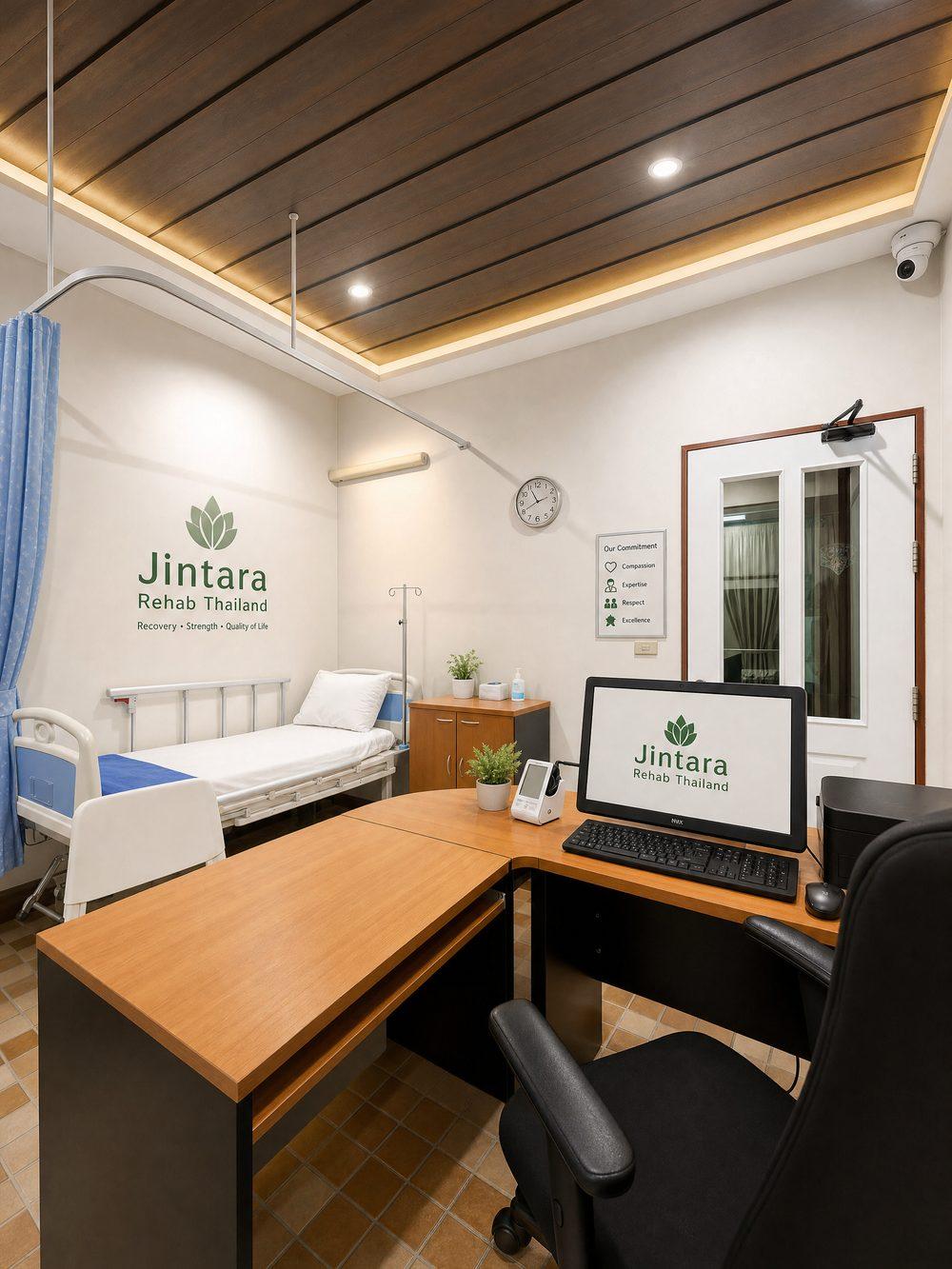
IV heroin use introduces medical complications that must be assessed before any treatment program begins.
People who inject heroin are at higher risk of skin infections, abscesses, blood-borne infections, and, in severe cases, infective endocarditis, a bacterial infection of the heart valves documented as a direct complication of intravenous drug use. These are well-established clinical consequences that must be assessed before any treatment protocol is set.
The Day 2 hospital workup at Jintara includes full blood spectrum, liver function, kidney function, EKG, and chest X-ray. For clients who have been injecting, this workup has clinical value beyond baseline tracking. It can identify infections, cardiac changes, and liver damage that the client is unaware of and that need to be managed alongside the detox. On the rare occasion that the workup identifies something requiring specialist input, Jintara's escalation pathway connects directly to Bangkok Hospital Chiang Mai and RAM Hospital.
The intake assessment at Jintara includes a physical review that looks specifically for injection site complications. Clients are encouraged to disclose the full history of their use, including route of administration, because the treatment protocol depends on it.

Withdrawal from heroin is not fatal but it is among the most physically distressing detox experiences.
Heroin withdrawal is a predictable medical process that typically peaks between 36 and 96 hours and resolves over seven to ten days with appropriate support. The heroin addiction withdrawal timeline covers each phase in detail, from the first symptoms through the peak and into the protracted recovery window. The acute phase involves nausea, vomiting, diarrhea, muscle cramping, sweating, temperature dysregulation, insomnia, and intense psychological distress. It is rarely life-threatening when medically managed, but without medication and monitoring it is severe enough to drive most people back to use within hours.
The clinical goal during withdrawal is not to eliminate discomfort entirely but to reduce it to a level where the client can stay present, sleep, and engage with the early stages of treatment. Protocols are adjusted as withdrawal progresses. A person who is comfortable on day two may be significantly more distressed by day four as the taper medication drops. That trajectory is expected and managed, not a sign that something has gone wrong.
Clients at Jintara are told what to expect during withdrawal before it happens. Denise O'Leary, Jintara's Clinical Director, described the standard opioid detox experience in interview: the first couple of days are often manageable. The harder days come later, and preparing clients for that is part of the first week of treatment.
Families choosing a facility for heroin detox carry the medical worst-case scenarios alone. The hospital-grade accreditation Jintara holds was issued jointly by the Healthcare Accreditation Institute, the Princess Mother National Institute on Drug Abuse Treatment (PMNIDAT), and the Department of Medical Services, cert. 25/2569. Those three bodies set the clinical standard Thailand applies to its hospitals, and they confirmed Jintara meets it. Held to a hospital's clinical bar, and still small enough for nursing staff to know which client is struggling at 3am.
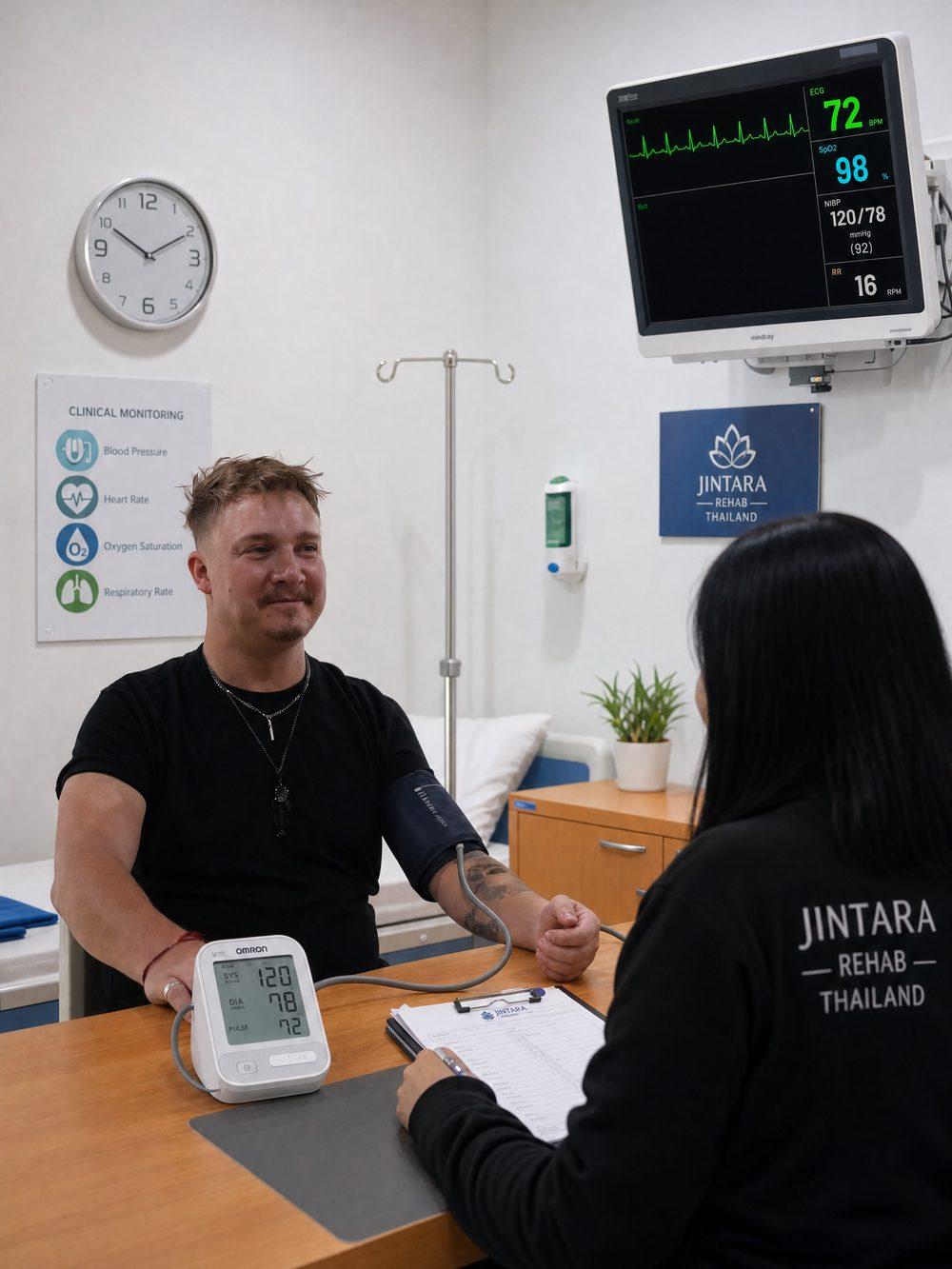
COWS scoring is how nursing staff track opioid withdrawal severity and adjust medication in real time.
COWS, the Clinical Opiate Withdrawal Scale, is the named assessment tool Jintara's nursing team uses to measure where a client sits on the opioid withdrawal curve at each monitoring point. Scores guide medication adjustments. A client scoring in the moderate to severe range receives closer observation and medication review. As scores reduce over days three through seven, monitoring frequency decreases and the taper begins.
Vital signs, including heart rate, blood pressure, temperature, and oxygen saturation, are recorded at regular intervals through the acute withdrawal window. Nursing staff are on site and awake 24 hours a day, not on-call. In the first 48 to 72 hours of opioid detox, checks happen multiple times per day. The frequency reduces as the client stabilises, but nursing oversight does not stop until the clinical picture is stable and the COWS score normalises.
This level of monitoring is not standard in every facility. At Jintara, it is non-negotiable. The distinction between a medically supervised detox and a managed withdrawal is exactly this: someone tracking the numbers, adjusting the plan, and available at 3am if the client deteriorates. The protocols that govern Jintara's broader drug addiction treatment work follow the same principle: monitoring that is continuous, not periodic.

Methadone at Jintara is a short-window taper for withdrawal, not a long-term replacement therapy.
Jintara uses methadone as a detox taper medication, consistent with SAMHSA TIP 45 on detoxification and substance use treatment, not as a maintenance prescription. Clients are stabilised on a low dose at the start of detox and then the dose is progressively reduced over the acute withdrawal window until they are medication-free. There is no ongoing methadone prescription at discharge. No Suboxone. No naltrexone maintenance. The goal is to reach zero without substituting one long-term dependency for another.
This approach differs from the model many clients encounter in the UK, Australia, or North America, where methadone maintenance programs are widely available and sometimes presented as the standard of care. Some clients arrive at Jintara specifically because they want to come off opioids entirely rather than transition to a different prescribed opioid, which is the whole argument behind medication-assisted treatment for opioid use as it is practised here. Others arrive uncertain. Darren Lockie, Jintara's founder, noted in interview that clients who initially resist methadone during the taper phase often request it within three or four days once the severity of withdrawal becomes clear. The team collaborates with the client to find the protocol that is both safe and acceptable to them.
- No maintenance prescription at discharge: The goal is full opioid cessation, with no ongoing methadone, no Suboxone, and no naltrexone maintenance. The taper stops when the client is medication-free, typically within the first two weeks of admission.
- Psychiatric medications treated separately: For clients with co-occurring mental health conditions, psychiatric medication may continue as a distinct clinical matter. Those conditions are treated separately from the addiction itself. For more on co-occurring diagnoses, see dual diagnosis treatment.
“Let's say heroin, or some sort of opiate-based painkillers. They're going to be on, typically, a methadone taper. At the start it's not too bad. Little do they know that the misery comes later. Our job is to prepare them for that.

The detox assessment on arrival is led by Jintara's psychiatrist, not a triage nurse.
Every client who arrives at Jintara for heroin treatment begins with a psychiatric assessment before any medication is prescribed. This is a detailed meeting that covers the client's substance history, physical health, current medications, prior withdrawal experiences, and any co-occurring mental health presentations. The protocol that emerges from that meeting is specific to the individual, not drawn from a standard template.
The psychiatrist may schedule additional review appointments during the detox period if the client's presentation changes or if medication adjustment is needed. Standard practice is one to three psychiatrist reviews during a four-week admission, with more scheduled if the clinical picture requires it. This is included in the program cost, unlike at many competing facilities where psychiatric review is billed separately.
Lertkhwan Sukpia, Jintara's Head Nurse & Operations Manager, leads the nursing team and coordinates directly with the psychiatrist throughout the detox period. The nursing staff are the eyes and ears of that clinical relationship. When vital signs shift or the client's presentation changes, the information moves up the clinical chain quickly because the facility is small enough to allow it.

Therapy begins while detox is still active because the two processes are not separate.
Jintara runs therapy and medical detox in parallel from the first day of admission. This is not universal practice. Many residential facilities require clients to complete detox before entering the therapeutic program. The reasoning often given is that clients in acute withdrawal cannot benefit from therapy. Jintara's clinical experience, and the view of its founder, is that the opposite is often true.
The window of acute discomfort, when a person is at their most physically and psychologically open, is frequently the most productive window for early therapeutic contact. It is not the time for deep trauma processing. It is the time for orientation: understanding the treatment plan, establishing trust with the clinical team, and beginning to build the cognitive and behavioural framework that will support the rest of the program.
The treatment program at Jintara is scheduled for clients from day one. Individual therapy sessions, group sessions, and psychoeducation all begin during the first week. Physical activities are modified during acute withdrawal but are not removed entirely. Jintara's experience is that participation, even limited, reduces the subjective severity of withdrawal by giving the nervous system something other than the discomfort to focus on.

Most heroin dependency sits on top of unprocessed trauma, and treating one without the other produces short recoveries.
Research and clinical practice at Jintara both show that the majority of people who develop heroin dependency carry a trauma history that has never been formally addressed. The trauma is not always large or obvious. It may be developmental, the result of childhood circumstances rather than a single identifiable event. What matters clinically is whether it is driving the self-medication pattern that keeps the person returning to use.
Heroin is a highly effective short-term solution to emotional pain. It suppresses anxiety, dampens the distress associated with trauma memories, and provides a predictable state change in people whose internal regulation is dysregulated. Understanding that function, not judging it, is where the clinical work begins. When the trauma history is not addressed, the person leaves treatment having removed the substance but retained the reason they were using it. NIDA's overview of co-occurring disorders reports that over 30 percent of adults with substance use disorder had childhood trauma, and that trauma is a shared risk factor for substance use. Trauma therapy at Jintara is not an optional add-on. It is central to the program.
Clients who arrive with heroin dependency are assessed for trauma history as part of the initial psychiatric evaluation. The clinical team does not assume that every person with heroin addiction has experienced significant trauma, but the assessment is thorough enough to identify it when it is present. What the team then does with that information depends on the individual's clinical presentation, readiness, and the length of their stay.
“A detox alone does not deal with the why. Most people that do a detox end up relapsing pretty quickly because they haven't dealt with the reasons they're self-medicating.

EMDR and individual therapy are the primary tools for the psychological layer of heroin addiction.
Once the acute withdrawal window closes, typically by the end of week one, the therapeutic workload increases. Individual therapy sessions at Jintara use CBT as the primary framework, with Motivational Interviewing integrated throughout. For clients whose heroin dependency is rooted in trauma, EMDR trauma therapy becomes relevant once the client is medically stable and the clinical team assesses them as ready.
EMDR at Jintara is led by Denise O'Leary, who is an EMDRIA-certified EMDR therapist. It is not assigned automatically. The decision to introduce EMDR processing depends on clinical readiness, the nature of the trauma, and the length of the client's program. Clients on a 30-day program may begin orientation to the EMDR process. Those who stay 60 days are more likely to reach the active processing stages.
In addition to EMDR and individual therapy, the program includes group therapy, DBT skills training covering distress tolerance and emotion regulation, psychoeducation on the neuroscience of addiction, and relapse prevention planning. Holistic components, including meditation instruction, Reiki, and fitness assessment, run alongside the clinical program from the first week.

The 30-day program gives clients a structured foundation, and most people who need heroin treatment benefit from staying longer.
A medically supervised detox clears heroin from the body. The 30-day program at Jintara is designed to do more than that. The acute detox phase takes approximately the first seven to ten days. What follows is three weeks of intensive therapeutic work and relapse prevention planning. For most clients with heroin dependency, that is enough to establish a foundation.
The average length of stay at Jintara is six weeks. Extensions beyond four weeks typically happen when clients recognise, around week two, that the work they came to do takes longer than expected. Extensions are available in weekly increments. No lock-in requirements apply. The clinical team is direct about what treatment duration means for outcomes.
Discharge from Jintara includes a structured aftercare planning session covering individual relapse warning signs, continuing care options in the client's home country, and the support structures needed before returning home.
Jintara's admissions team is available to answer questions about the program, the clinical approach, and whether the model fits a specific situation. If Jintara is not the right fit, the team will say so and refer to a facility that is.

Talk with Our Admissions Team
Your enquiry is confidential and goes only to our admissions team.
Common Questions About Heroin Addiction Treatment in Thailand
Heroin addiction is a form of opioid use disorder in which the brain becomes physically dependent on an illicitly obtained opioid, typically injected or smoked. It differs from prescription opioid addiction primarily in route of administration and supply purity. Street heroin carries fentanyl contamination risk and injection-related medical complications that prescription opioids typically do not. Both require medical detox. Heroin-specific cases often require more intensive medical oversight during the acute withdrawal window.
Heroin withdrawal is rarely fatal when medically managed, but it is severe enough to drive most people back to use without support. The primary dangers are dehydration from vomiting and diarrhea, and the psychological distress that causes people to use again when withdrawal peaks. For clients whose heroin supply contained fentanyl, the withdrawal period may be longer and less predictable. Medical supervision makes the process safe and medication is available when it is needed.
The primary medication is a methadone taper. Clients are stabilised on a low dose and the dose is progressively reduced over the acute withdrawal window. Comfort medications to manage nausea, cramping, and sleep disruption are prescribed by the psychiatrist based on the individual assessment. The protocol is specific to each client, not drawn from a fixed template.
Methadone at Jintara is used exclusively as a short-window taper medication, not as a long-term replacement. The distinction matters. In a maintenance model, clients continue taking methadone indefinitely to prevent withdrawal. At Jintara, the dose is progressively reduced until the client is medication-free, usually within the first two weeks of admission. The goal is full opioid cessation, not substitution. This approach is why some clients who have been on methadone maintenance programs elsewhere come to Jintara specifically.
Jintara's position is that medications should not be used to treat substance use post-detox. The clinical team's view, stated directly by the founding clinical staff, is that the root causes of addiction are psychological and behavioural, and that replacing one opioid dependency with a pharmaceutical substitute does not address those causes. Clients with co-occurring mental health diagnoses may continue on psychiatric medications. Those are treated as separate from the addiction.
The Day 2 hospital workup, which includes full blood spectrum, liver function, kidney function, EKG, and chest X-ray, identifies any existing infection, cardiac change, or organ damage that needs to be addressed. Jintara's escalation pathway connects directly to Bangkok Hospital Chiang Mai and RAM Hospital for conditions requiring specialist input. Clients with active injection site complications are assessed at intake.
Clinically, yes. Fentanyl binds more tightly to opioid receptors and has a longer effective half-life than heroin. Clients who have been using fentanyl-contaminated heroin may experience a more prolonged withdrawal arc and a delayed peak compared to clients who were using pharmaceutical opioids. The assessment on arrival at Jintara accounts for this. Detox protocols are adjusted based on the client's presentation, not on a fixed assumption about what substance was used.
Yes. All clients at Jintara have private rooms. This is not an upgrade option. Privacy during the acute withdrawal period is standard. For clients whose heroin dependency has a trauma component, private accommodation is a relevant clinical consideration, not just a comfort one. The facility accommodates a maximum of ten clients at any time, which means care is individual and nursing staff are never spread across a large ward.
Yes, for clients who are clinically ready and whose program length supports it. EMDR is led by Denise O'Leary, who is an EMDRIA-certified EMDR therapist. It is not assigned automatically. The clinical team assesses readiness after the acute detox window closes. Clients on a 30-day program may begin EMDR orientation. Those on a 60-day program are more likely to reach active processing. The decision is always collaborative and based on individual presentation.
Jintara's admissions team at the Chiang Mai facility is available to answer questions about the program, the clinical approach, and whether the model fits a specific situation. They do not pressure callers. If Jintara is not the right fit, the team will say so and refer to a facility that is. That is a stated position, not a marketing claim.
Yes. Jintara holds certificate no. 25/2569, issued jointly by the Healthcare Accreditation Institute, PMNIDAT, and the Department of Medical Services, Ministry of Public Health. These are the same three bodies that set Thailand's hospital-grade clinical standard. The accreditation covers both facility categories and is valid from 20 May 2026 to 19 May 2029. Jintara is one of only six private rehabs in Thailand to hold this accreditation.
It means Jintara's medical protocols, nursing coverage, medication handling, and clinical governance were independently assessed against the same standard applied to Thailand's hospitals and confirmed to meet it. For heroin treatment specifically, that covers the things families worry about most: the quality of the detox protocol, the credentials and round-the-clock coverage of nursing staff, and the medical escalation pathway when a client deteriorates. The accreditation is issued by three national bodies, not one, and is checkable at certificate 25/2569, issued 20 May 2026.
Independently Verified
Jintara is accredited against Thailand’s national quality standard for drug treatment and rehabilitation facilities, jointly certified by the Healthcare Accreditation Institute, the body that accredits Thailand’s hospitals, with the Princess Mother National Institute on Drug Abuse Treatment and the Department of Medical Services, Ministry of Public Health. Certificate no. 25/2569, valid 20 May 2026 to 19 May 2029.